The next revolution in AI and robotics
As China's president, Xi Jinping, prepares to travel to Washington, D.C., on September 24, his approach will reflect not only the specific issues on his agenda but also broader geopolitical transformations that are currently underway. These developing revolutions create enormous opportunities for China, but also risks that both Beijing and the international community will have to face.
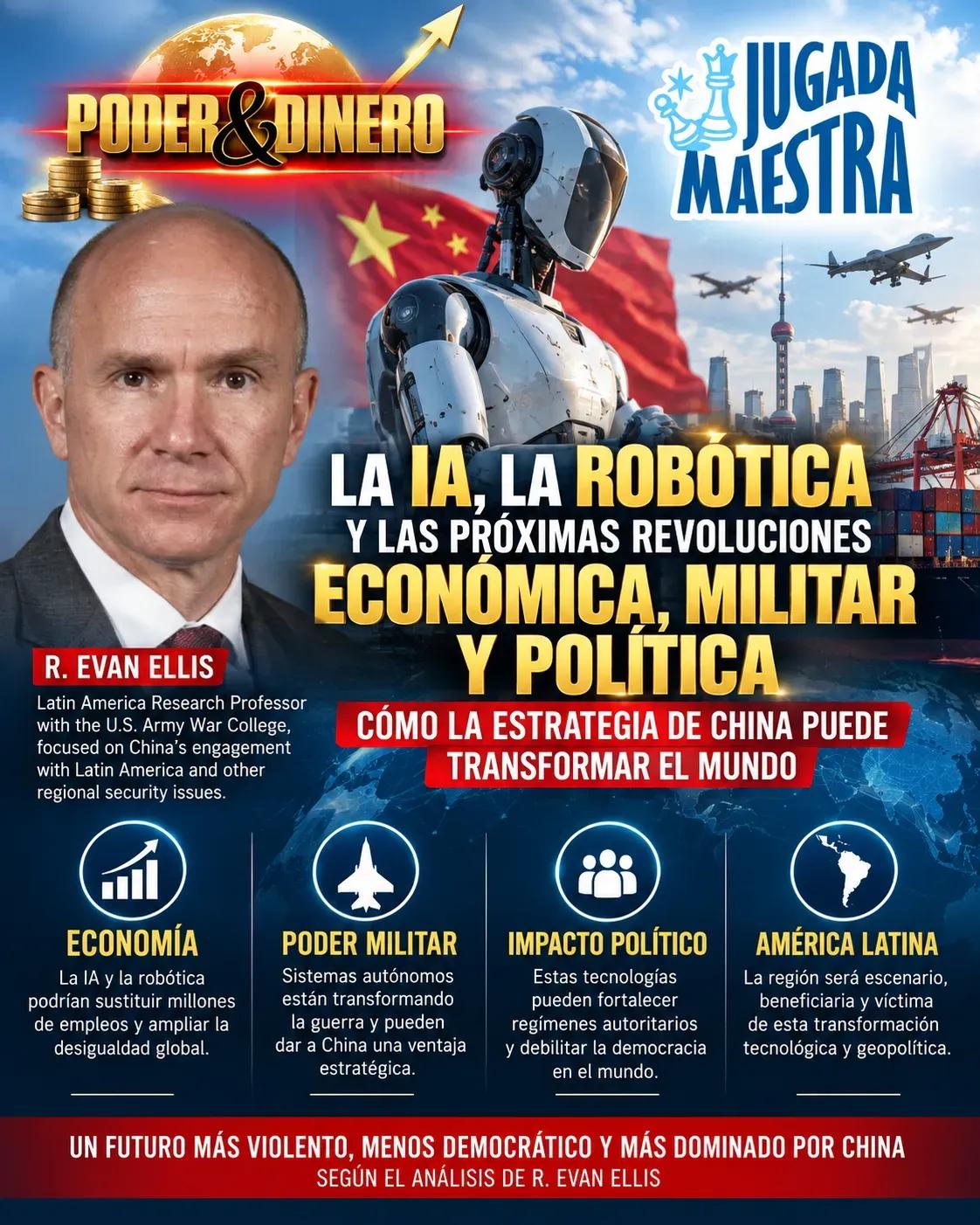
Advancements in big data, artificial intelligence (AI), autonomous systems, and robotics are rapidly transforming economic and military dynamics, with radical implications for political systems and the global balance of power. Latin America and the rest of the developing world will be stage, beneficiaries, and victims of this enormous and chaotic process of change.
While the future cannot be predicted with certainty, a possible outcome of the convergence of these trends is a world much more violent, less democratic, and more dominated by China. This future could appear more swiftly than many traditional analysts expect.
During the next decade, advancements arising from the combination of AI and robotics are likely to offer non-human alternatives for a wide variety of jobs, both white-collar and blue-collar, skilled and unskilled. The transformation could cover a much greater number of activities and occur more rapidly than during the industrial revolution of the last century.
The amortized cost of industrial robots is already, in many cases, lower than the cost of employing a person to perform certain tasks.
Mass-produced Chinese robots from companies like Unitree and UBTech can be acquired for as little as US$5,000, while many industrial units cost only US$20,000 to US$50,000. At those prices, a robot capable of replacing three shifts of factory workers may cost only a few months' worth of human salaries. As was the case with personal computers in the 1990s, these costs are likely to continue to decrease, while the sophistication of hardware, firmware, and AI-driven control mechanisms will increase.
What makes the current revolution even more transformative is that AI tools, both virtual and embedded in physical devices, have the capability to replace humans not only in factories but also in domestic and service tasks as well as in administrative and professional jobs.
This is particularly relevant in technical areas such as computer programming, legal work, medical technicians, and administrative support staff, among others.
As noted by Jensen Huang, CEO of Nvidia, it is highly likely that the nature of work will change: humans will shift from directly performing tasks to directing and supervising AI and robotic systems responsible for executing them.
However, the author believes it is highly unlikely that the supervisory positions created by the new AI and robotics economy, together with new activities aimed at supporting or complementing it, will fully compensate for the human jobs that will cease to be economically competitive.
The World Economic Forum estimates that current advancements could displace 92 million jobs by 2030. Additionally, the speed at which this new technological economy appears, coupled with the inherent difficulty for humans to adapt to new capabilities and workplaces, could rapidly expand what 19th-century philosopher Thomas Robert Malthus referred to as a "redundant population."
Just as with the industrial revolution, the revolution in AI and robotics will likely also widen socioeconomic inequality between those who own, implement, and manage the structures of the new economy and those who lose their jobs or see their wages decrease due to competition from new AI and robotics alternatives.
These effects could be especially strong among populations that already show growing discontent with the functioning of democratic political systems and their ability to respond to contemporary challenges.
Compensation and repression
The responses of various political systems to these pressures will likely combine two impulses: compensation and repression.
Some governments will create or expand social protection networks to retrain, relocate, or at least mitigate the suffering of those who lose their jobs.
Other governments—or even the same ones—will use state repression instruments against those who react to the consequences of economic displacement through common crime or, alternatively, violent protests and terrorism.
Paradoxically, the tools designed to monitor and control the movements of the population, their finances, and other aspects of their lives are also being significantly strengthened thanks to advancements in AI, access to big data, and other technologies.
As AI exerts greater pressures on democratic political systems and market economies, it will also play an increasingly important role in the distribution and, ultimately, allocation of resources for the populations.
AI is already being used today for operational and logistical management by both businesses and governments.
The author argues that AI could even reduce some of the distortions and inefficiencies historically associated with government-led economic systems, as prominently analyzed by Friedrich Hayek in 1945.
In this way, AI could help China and other authoritarian governments compete more effectively against democratic free-market systems by improving both their performance and their repressive capabilities, while technological disruption increases tensions on democracies and market-based systems.
The revolution in military affairs
Parallel to this economic and political transformation, technological advancements are also accelerating a revolution in military affairs.
AI-driven autonomous systems will progressively replace manned systems in the air, on and below ground, and on and under water.
These systems will be increasingly coordinated by AI-based combat and logistics management systems. Their ability to quickly identify patterns and analyze outcomes from numerous response scenarios could provide them with significant advantages over systems that keep humans directly in the decision-making circuit.
At the same time, new technologies will allow medium powers, small states, and even non-state criminal and terrorist groups with access to resources to challenge and extort much larger actors, as the author argues Iran has done against the United States through its drone and missile systems.
China's strategy in AI
In the context of these transformations, China's current strategy is particularly concerning and potentially transformative.
On the one hand, just as it has with other technologies, including electric vehicles, Beijing has allocated significant resources to master advancements in AI and robotics.
Repeating a model it has already used, China has invested heavily in basic and applied research, protected and subsidized strategic technological sectors, and utilized its enormous captive internal market to develop commercial products capable of competing and eventually dominating global markets.
In the field of AI, China seeks to lead the world by developing efficient open weight models, such as Kimi K3, DeepSeek V4, and Qwen 3.8, even when its companies do not have access to the highest-performing chips, such as Nvidia Vera Rubin and Blackwell.
The author argues that while Chinese models would still be modestly inferior to leading Western models, such as Claude Fable 5.1, Mythos 5.1, ChatGPT 6 Astra, and Grok, in the long run, their open-source nature and capability to function with lower-performing chips could enable them to dominate global markets like Latin America, Africa, and developing Asia, even if they are excluded from the United States and Europe.
Following a similar path used to conquer other sectors of the global economy, China is deliberately leveraging control over its internal market to introduce cutting-edge capabilities through AI-driven robots before market forces fully generate that demand.
China is deliberately integrating AI-powered robotics into its factories and other domestic applications, which, according to the author, gives it an advantage over Western competitors like Tesla's Optimus humanoid robots, which may be slightly more sophisticated but are still largely in the prototype stage.
As was previously the case with electric vehicles, telecommunications, solar panels, and other strategic sectors, China appears to be on track to use the low-cost products and increasing capabilities it develops in its internal market, which it is beginning to export, to displace American competitors in third markets like Latin America.
Even if the markets of the United States and Europe remain protected against the entry of Chinese AI models, AI robots, and other systems, the author asserts that China is on track to become, within a decade, the world's leading supplier of these models, robots, and systems.
By extension, it could become the leading producer of these systems on an industrial scale.
As occurred in telecommunications with companies like Huawei, this situation could leave the United States expressing concern over the risks associated with the use of Chinese AI and robotic systems and warning or threatening its partners, but without sufficient competitive commercial alternatives to offer them.
A dominant Chinese position in AI and robotics would exponentially multiply the influence that Beijing already possesses over the global economy and political dynamics.
China is increasingly using its power as a major buyer of raw materials and infrastructure operator to pressure governments that act against its companies or strategic interests.
The author mentions recent examples such as inspections of Panama-flagged vessels after a decision by the Panama Supreme Court related to the Hutchison company, and Beijing's threat not to renew the currency swap with Argentina after its president declared he would not do business with "the Chinese communists."
Together with the increase in Beijing's economic and political influence, if robots, autonomous vehicles, and AI-based military management systems become fundamental elements for the success of future military operations, Chinese dominance of those industries, combined with the industrial capacity to produce millions of robots, would greatly accelerate its military position and ability to maintain and rebuild its forces.
The strategic importance of a large industrial base was demonstrated by the role of Ukrainian production of millions of drones during its resistance to the Russian invasion.
This was also evidenced by the U.S. need to replace the enormous quantity of precision munitions used in the Gulf War and by the capacity of Chinese shipyards to produce, according to the document cited by the author, 200 times more warships than the United States.
A future in which China far surpasses the United States as the arsenal of military robots and autonomous systems would grant Beijing a considerable advantage not only to conduct and sustain a conventional war with the United States but also to deploy those systems in defense of its commercial and other interests abroad.
In summary, the author argues, Chinese dominance in both the commercial and military dimensions of the AI and robotics revolution could become the structural pillar of a transition of China from a cautious geopolitical competitor to an "empire" with Chinese characteristics.
The growing power and influence of China will likely affect how Beijing acts towards the United States and in other regions.
Historically, when China has perceived itself as weak —for example, in areas geographically close to the United States like Latin America— Beijing has behaved cautiously. In contrast, where it has perceived itself as strong, such as in the South China Sea, it has acted more aggressively.
Examples include the militarization of reefs and sandbanks and the assertion of its territorial claims along the so-called "nine-dash line".
The current global power transition, with mutually reinforcing technological, commercial, and military dimensions, also implies, according to the author, a China with greater confidence to act more aggressively in Latin America or even to act decisively with the aim of ending the autonomy of Taiwan.
Such actions and the associated conflicts would strongly affect the countries of the Western Hemisphere, even through significant disruptions to trade and finance stemming from a large-scale war, in addition to the possibility of part of that conflict unfolding in strategic territories of the Western Hemisphere.
The forces unleashed by the interdependent and mutually reinforced revolutions of artificial intelligence and robotics far exceed the specific discussions that will take place during the upcoming summit between Trump and Xi.
However, that summit comes at a symbolic and decisive moment when technological and trade advances
"Alliances and the strategic decisions of both nations could lead to rapid changes in the relative balance of power between them and reconfigure the geopolitical landscape for decades.Robert Evan Ellis is a Research Professor of Latin America at the U.S. Army War College, specializing in the relationship between China and Latin America and in other regional security issues.
"
Comments