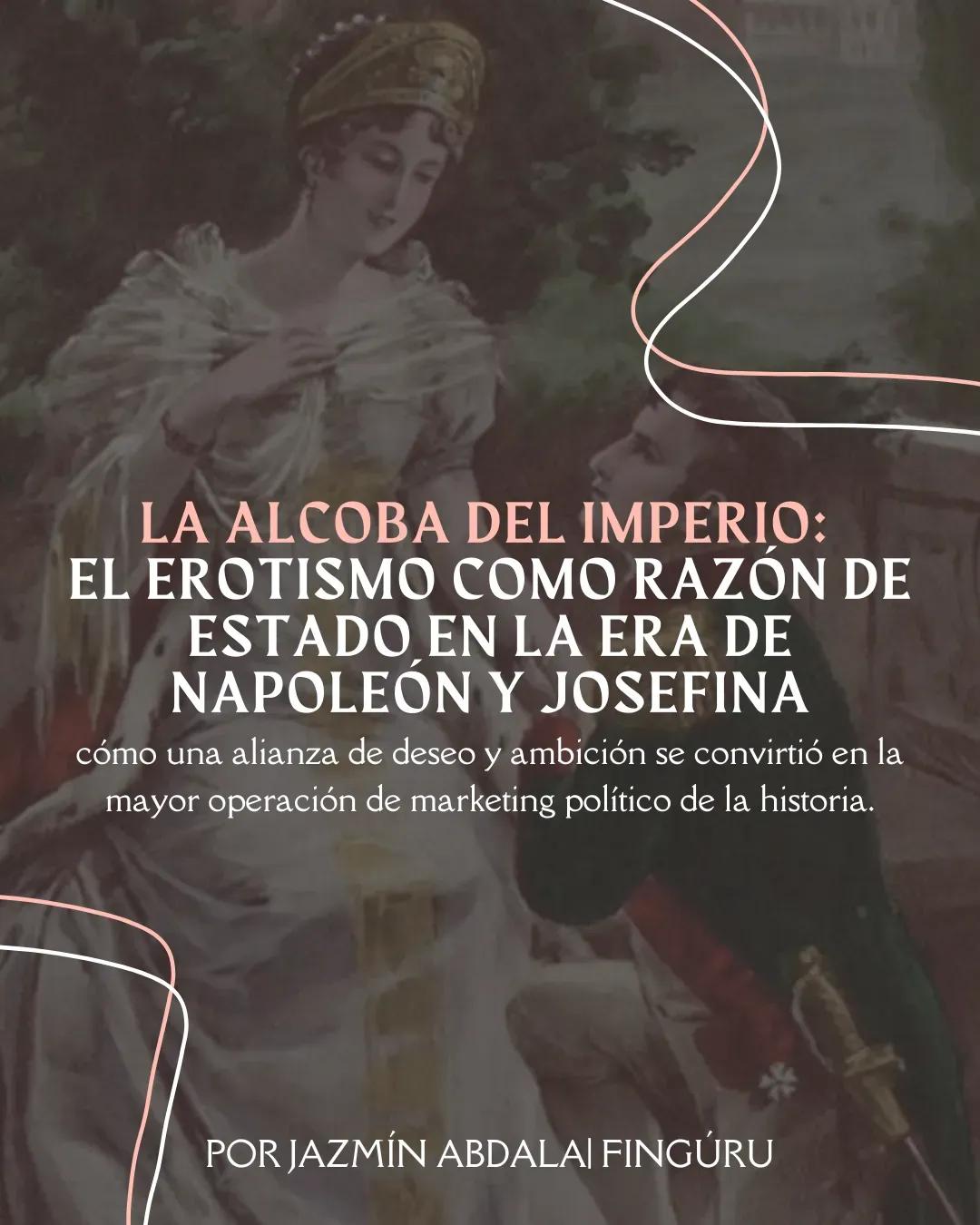
Paris in 1795 was a feverish organism, a city trying to wash its neck after the passage of the guillotine while the air still vibrated with the echo of wagons over the cobblestones. After the end of the Terror —that paranoid period when the French Revolution devoured its own children and where simply being an aristocrat was a death sentence—, the capital surrendered to an urgency to live that bordered on madness. In the salons of the Directory —the corrupt and decadent transitional government that replaced the bloody idealism of Robespierre—, politics ceased to be conducted in the barricades and took refuge in the bedchambers. It was in this scenario of "loose sleeves" sexual and desperate ambitions that two shipwrecked souls of history crossed paths, understanding before anyone else an uncomfortable truth: What if desire were not the warrior's rest, but his sharpest weapon? Is it possible that eroticism is actually the perfect facade for high politics?
She walked with the lightness of someone who has been on the verge of losing their head and now values every gram of air. Her name was Marie Josèphe Rose Tascher de la Pagerie, though the world would know her as Josephine. She was a Creole —a term used for the descendants of Europeans born in the American colonies— from the island of Martinique, a woman with lazy, feline movements who exhaled a perfume of violets capable of masking the decay of a crumbling aristocracy. Up close, her teeth were darkened by the consumption of cane sugar from her childhood, a detail she hid with a closed, mysterious, rehearsed smile that everyone mistook for aristocratic timidity. Josephine was not a classical beauty; she was a master of tactical seduction. After becoming a widow of a guillotined viscount and surviving the Carmes prison, she understood that her body and her ability to weave social networks were her only currency. She became the mistress of Paul Barras —the most powerful and vicious man of the Directory, a politician who managed France as if it were his own brothel—, and in his parties, she learned that desire is the perfect lubricant for state negotiation. But, how to convince a country that hates nobles that an aristocrat should be at the top? By playing with fascination.
In front of her appeared a man who seemed to be her absolute opposite: Napoleon Bonaparte. At that time, he was nothing more than a brigadier general of twenty-seven years, thin as a hungry wolf, with olive skin and straight hair that fell over his shoulders without any grace. He spoke a rough French, marked by his Corsican accent —the Mediterranean island that France had annexed just a year before his birth—, which made him feel like a perpetual foreigner in his own adopted homeland. Napoleon was a man of neglected hygiene and an intensity that frightened; his eyes were two glowing coals that sought not romance, but an anchor. He was a brilliant military man but socially awkward who desperately needed the legitimacy that only a woman of old nobility could provide. How could this "little Corsican" earn the respect of the Parisian elite? By possessing his most desired woman.
As soon as they met in the autumn of 1795, Napoleon was stunned by that blend of Caribbean indolence and Parisian cunning. In an almost psychopathic gesture of possession, he decided to rename her: to the rest of the world, she was Rosa, but he called her Josephine, as if changing her name could erase her past in the beds of other powerful men. They married in March 1796, in a civil ceremony where the notary warned her that she was joining a soldier with no future. In the marriage record, the couple executed their first act of political marketing —the use of communication techniques to enhance a leader's image—: she subtracted four years, and he added one to disguise the age gap. But, who was fooling whom? Just two days after the wedding, the general left for the Italian campaign, leaving his new wife in a Paris that she knew much better than he did.
While Napoleon crossed the Alps and sent daily letters that burned the paper with declarations like "a kiss on the lips and another on the heart, and then much further down," Josephine used that absence to reactivate her own ambitions. The eroticism here became a financial tool: while feigning a pregnancy and abortion to avoid traveling to the front with her husband, Josephine surrendered to a public romance with an officer named Hippolyte Charles and, what is more serious, got involved in military supply businesses —government contracts to provide clothing and food to the army—. It is a fact that many forget: Did you know that while General Bonaparte was winning battles for France, his wife was enriching herself behind his back selling cardboard-soled boots to the very soldiers who died for him? For her, marriage was not a union of souls but a limited liability partnership where sex guaranteed the flow of money.
However, the fate of both was chained to a political superstition. With the coup d'état of 1799, Napoleon became the face of France and Josephine its aesthetic ambassador. She imposed the Empire style —characterized by high-waisted dresses just below the bust, almost transparent muslin fabrics, and an elegance that imitated the goddesses of ancient Greece—. This look was not innocent: by dressing this way, Josephine presented the new Napoleonic France not as a bloodthirsty republic but as the heir to classical civilization and order. How do you convince a people that dictatorship is necessary? By making it look beautiful. The eroticism of her bare shoulders and cashmere shawls was the needed anesthesia for the French bourgeoisie to accept the transition from freedom to the rule of a single man. She played with public desire, turning her own image into the brand of the regime.
The climax of this representation occurred in 1804, under the vaults of Notre Dame. In the coronation ceremony, Napoleon took the crown and placed it on Josephine's head before the gaze of a humiliated Pope. It was the moment when eroticism was completely institutionalized: she was the Empress, the gentle face of a military regime. But tragedy had already been written in the books of biology. Josephine, worn out by the excesses of her youth and the aftermath of prison, could not give him an heir. The man who drafted the Napoleonic Code —the set of laws that, ironically, reduced women to the category of minors under the law— decided that his own wife was a defective piece in the machinery of the State. What good is it to be the empress of hearts if you cannot secure the throne for your children? In 1810, the divorce was a political surgery operation: Napoleon needed a "royal womb" and sought it in Maria Louisa of Austria, sacrificing his amulet for an alliance with the Habsburgs, the most rancid dynasty in Europe.
In the end, the story of Napoleon and Josephine leaves us with a troubling reflection on the nature of power. Often we are told it was a great romance, but the journalistic reality shows us an emotional battlefield where desire was the currency and betrayal the everyday language. Josephine survived Napoleon, keeping his castle in Malmaison —her personal refuge where she created one of the most important botanical collections in Europe— while he rotted in exile. She understood before anyone else that eroticism is the perfect facade for politics because humanity will always prefer the distraction of a bedroom scandal over the coldness of a death toll on the front. Was it she who used him or he who used her? Surely both devoured each other under the pretext of love. He died with her name on his lips, perhaps not out of romance, but because she was the only one who knew how to give the "little Corsican" the polish of eternity that battles alone could never buy him. Empires are built with cannons, but are sustained by the fascination of those who know how to turn private desire into public legend.

Comments