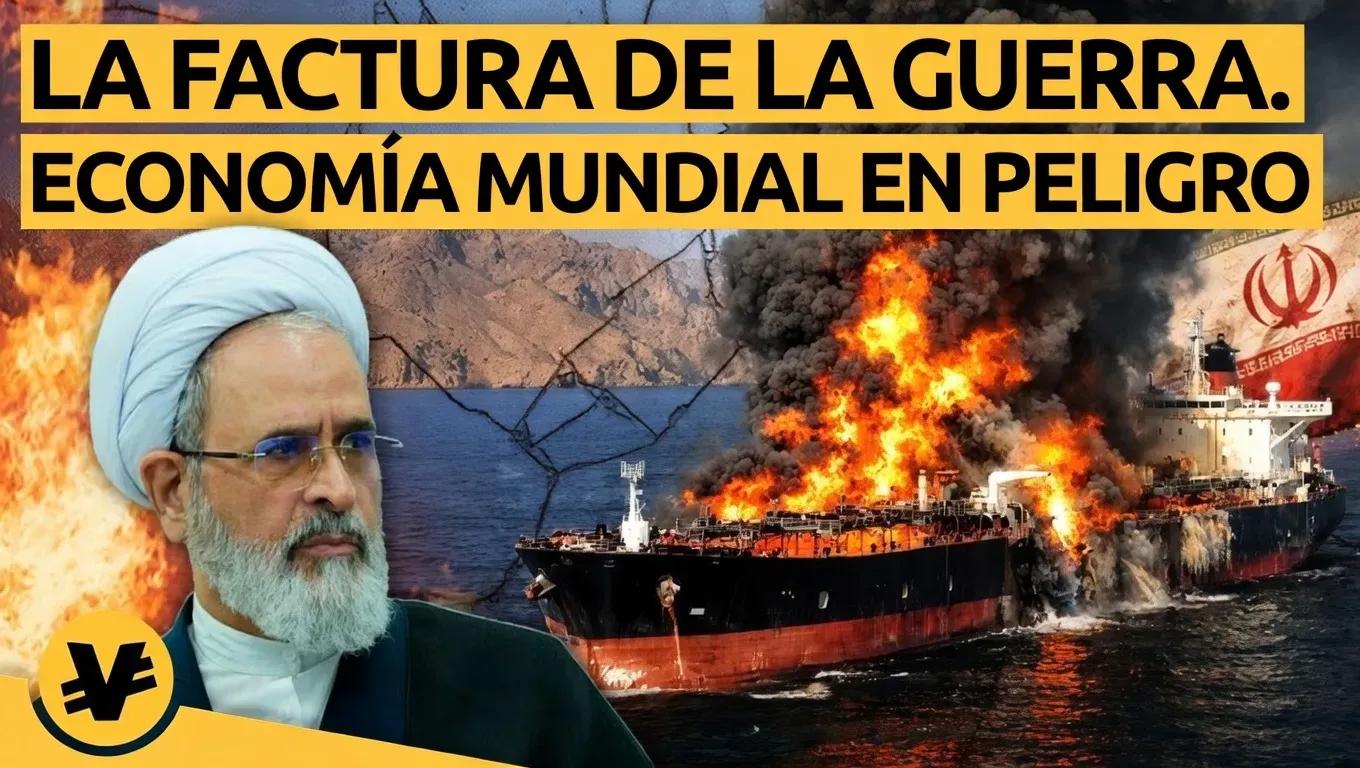
The open war between the United States, Israel, and Iran has quickly transcended the military battlefield to become a global economic crisis. In just a few days, the confrontation has triggered a chain of disruptions that permeate the energy market, maritime trade, the international financial system, and the economies of the Middle East. The magnitude of the costs is still difficult to accurately calculate, but initial estimates place the total economic impact at tens of billions of dollars daily, a figure reminiscent of the most critical moments of the great energy crises of the 20th century.
The conflict has first and foremost become an extraordinarily costly war in strictly military terms. The air and naval operations of the United States and Israel involve the deployment of some of the most expensive military platforms in the Western arsenal. Stealth bombers B-2 Spirit, F-35A Lightning II fighters, F-22 Raptor, F-15E Strike Eagle, and F/A-18 Super Hornet are participating in attack missions, air defense suppression, and air superiority. Each of these operations entails the launch of precision-guided munitions, Tomahawk cruise missiles, and the intensive use of intelligence, surveillance, and reconnaissance systems.
The operational costs of a war of this intensity are enormous. According to the prestigious specialized publication Defense Review, in previous conflicts between Israel and Iran, such as the twelve-day direct confrontation in June 2025, Israeli daily spending on fuel for aircraft, maintenance of systems, air missions, and munitions was estimated at around 700 million dollars. However, the actual cost of the war is not limited to offensive operations. Israel must simultaneously deploy a complex defensive architecture based on missile interceptors such as David's Sling, Arrow-2, and Arrow-3, Patriot, SM-3, SM-6, and the U.S. THAAD system. Each interceptor can cost between one and four million dollars, and the volume of missiles launched during Iranian attacks has raised Israeli total daily spending to nearly 2 billion dollars even in moderate intensity scenarios.
The current escalation has multiplied those numbers. The latest estimates place the combined cost of Israeli and U.S. military operations between 5 billion and 8 billion dollars daily, if operational expenses, missile interceptors, damage to military infrastructure, and logistical costs of bases deployed in the region are included. The damage caused to a U.S. military base in Qatar alone could exceed 10 billion dollars.
This direct spending is compounded by the destruction of strategic infrastructure in Iran. The bombings have particularly targeted oil facilities, fuel depots, and refineries. Before the war, Iran had a refining capacity close to 2.2 million barrels per day spread across nine major refineries. The destruction of distillation units, hydrogen plants, and catalytic cracking systems means the loss of facilities whose replacement requires between three and five years. Each destroyed industrial complex implies billions of dollars in future reconstruction and reduces global refining capacity, a key factor for the international energy market.
The economic impact immediately extends to the Gulf countries, where a decisive part of the world energy infrastructure is concentrated. The United Arab Emirates, Qatar, Saudi Arabia, Kuwait, Bahrain, and Oman have suffered drone attacks, disruptions at airports, and airspace closures. The financial and logistical hubs of Dubai, Doha, or Manama have seen many of their activities paralyzed. Direct losses in aviation, tourism, financial services, and regional trade already exceed one billion dollars daily, while indirect effects—from the drop in tourism to disruptions in supply chains—could raise the regional economic losses to between 3 billion and 5 billion dollars daily.
However, the element that has amplified the global impact of the conflict is the energy crisis triggered by the disruption of traffic in the Strait of Hormuz. This maritime corridor, just 34 kilometers wide at its narrowest point, transported around 20% of the world's oil and nearly 20% of global liquefied natural gas trade before the war. The interruption of maritime traffic has resulted in the loss of approximately 10 million barrels per day in the international market, of which eight million correspond to crude oil and two million to refined products.
This is the largest oil supply disruption recorded in the history of the modern energy market. Before the conflict, about 15 million barrels of crude oil and five million barrels of derivatives traversed Hormuz. Currently, traffic has fallen to less than 10% of those levels. The International Energy Agency believes the supply shock surpasses even the 1973 oil crisis or the disruption caused by the Russian invasion of Ukraine in 2022.
Alternative routes barely compensate for a fraction of the lost flow. Saudi Arabia can divert part of its production through the East-West pipeline to the port of Yanbu on the Red Sea, with a capacity close to 7 million barrels per day. The United Arab Emirates has another pipeline between Habshan and Fujairah capable of transporting about 1.5 million barrels per day. Even using these infrastructures to their fullest, the diverted volume remains far below the flow that normally passed through the strait.
The immediate consequence has been a sharp rise in oil prices. WTI crude surpassed 92 dollars per barrel in the early days of the escalation, while analysts find it plausible that it could jump above 100 dollars if the disruption persists. Some Iranian military commanders have explicitly declared that the strategic objective of the war is to push the price of oil to 200 dollars per barrel, a figure that would trigger an energy shock comparable to the great oil crises of the last century.
The repercussions on the global economy are already starting to be visible. Each sustained increase of ten dollars in the price of oil can subtract between one and two tenths from global economic growth in the following year, according to estimates from international banks. In developed economies, a 10% increase in crude oil prices could add between two and four tenths to annual inflation.
The impact also transmits to other energy sectors. The Gulf concentrates a substantial part of global fertilizer and petrochemical production, especially ammonia and urea. The disruption of exports from Qatar and other countries threatens to raise fertilizer costs and push food prices higher, especially in Europe and Asia.
International trade suffers another significant upheaval from the conflict. The interruption of maritime traffic in the Gulf has left hundreds of ships trapped or diverted. More than 3,200 ships are inactive within the Persian Gulf, while another 500 are waiting outside. The paralyzed capacity amounts to about 470,000 standard containers, approximately 10% of the global container fleet.
The largest shipping companies have suspended entire routes. The Danish Maersk has at least ten vessels trapped in the Gulf, unable to leave the area. Ships that manage to continue their journey must go around Africa via the Cape of Good Hope, adding between ten and fourteen days to the journey between Asia and Europe. This detour increases fuel consumption, delays the arrival of goods, and causes a domino effect throughout global logistics.
Maritime shipping rates have reacted quickly. Companies have imposed emergency surcharges of up to 1,800 dollars per 20-foot container, 3,000 dollars per 40-foot container, and nearly 4,000 dollars per refrigerated container. Other shipping lines have added additional surcharges of up to 3,000 dollars per unit. To this is added a 300% increase in maritime insurance premiums due to war risk.
These disruptions are already translating into price increases in industrial sectors. Shipments of semiconductors from Asia to Gulf assembly centers have been delayed, threatening to raise consumer electronics prices by between 20% and 30%. Agricultural products are also affected by the interruption of fertilizer and raw material trade.
Tourism constitutes another of the immediate victims of the conflict. The Gulf cities, which had become major air transit hubs and global tourist destinations, have suffered temporary closures of airports and massive flight cancellations. Airlines face longer routes to avoid Iranian airspace and much more expensive fuel. Consequently, international airfares have risen between 3% and 15% in just a few days.
The crisis also hits the regional financial system. The Iranian decision to consider banks linked to the United States and Israel as military targets has generated fear in the financial centers of the Gulf. The mere threat of attacks against international banking institutions has led to risk recalculations by insurers and financial entities. The danger of bank runs or mass withdrawals of deposits has become a real concern in cities like Dubai, Manama, or Kuwait.
China occupies a singular place in this new geoeconomic scenario. While much of international maritime traffic avoids the Strait of Hormuz, Iranian oil continues to flow to Chinese ports through a clandestine fleet of sanctioned tankers. Since the beginning of the war, at least 11.7 million barrels of Iranian crude have been exported to China through these channels. Beijing purchases between 80% and 90% of Iranian oil exports and also has sufficient strategic reserves to cover between 90 and 130 days of consumption. This situation allows China to cushion the energy impact of the crisis while the rest of the world faces rising prices.
Finally, the heaviest bill will arrive when the war ends. The reconstruction of damaged infrastructure in Israel, Iran, and the Gulf countries could reach colossal figures. Repairing refineries, fuel depots, ports, airports, and industrial centers will drain resources for years. Rebuilding a large refinery can cost between 5 billion and 10 billion dollars, while repairing airports, ports, and energy networks can add tens of billions more.
Overall, the war already looms as one of the most costly conflicts in recent history. The combination of intensive military operations, destruction of energy infrastructure, trade disruptions, and financial volatility threatens to transform a regional conflict into a global economic shock. In this case, the war is not only fought with missiles and planes: it is also fought in energy markets, in the ports of global trade, and in the bank accounts of millions of people.
Adalberto Agozino holds a Ph.D. in Political Science, is an International Analyst, and a Lecturer at the University of Buenos Aires.

Comments