Some disasters arrive slowly, like a storm forming on the horizon. Others appear overnight and leave a city unrecognizable by dawn.
In July 2010, Hurricane Alex struck Monterrey with a force that those who experienced it will never forget.
The storm did not just pass through the city. It tore it apart.
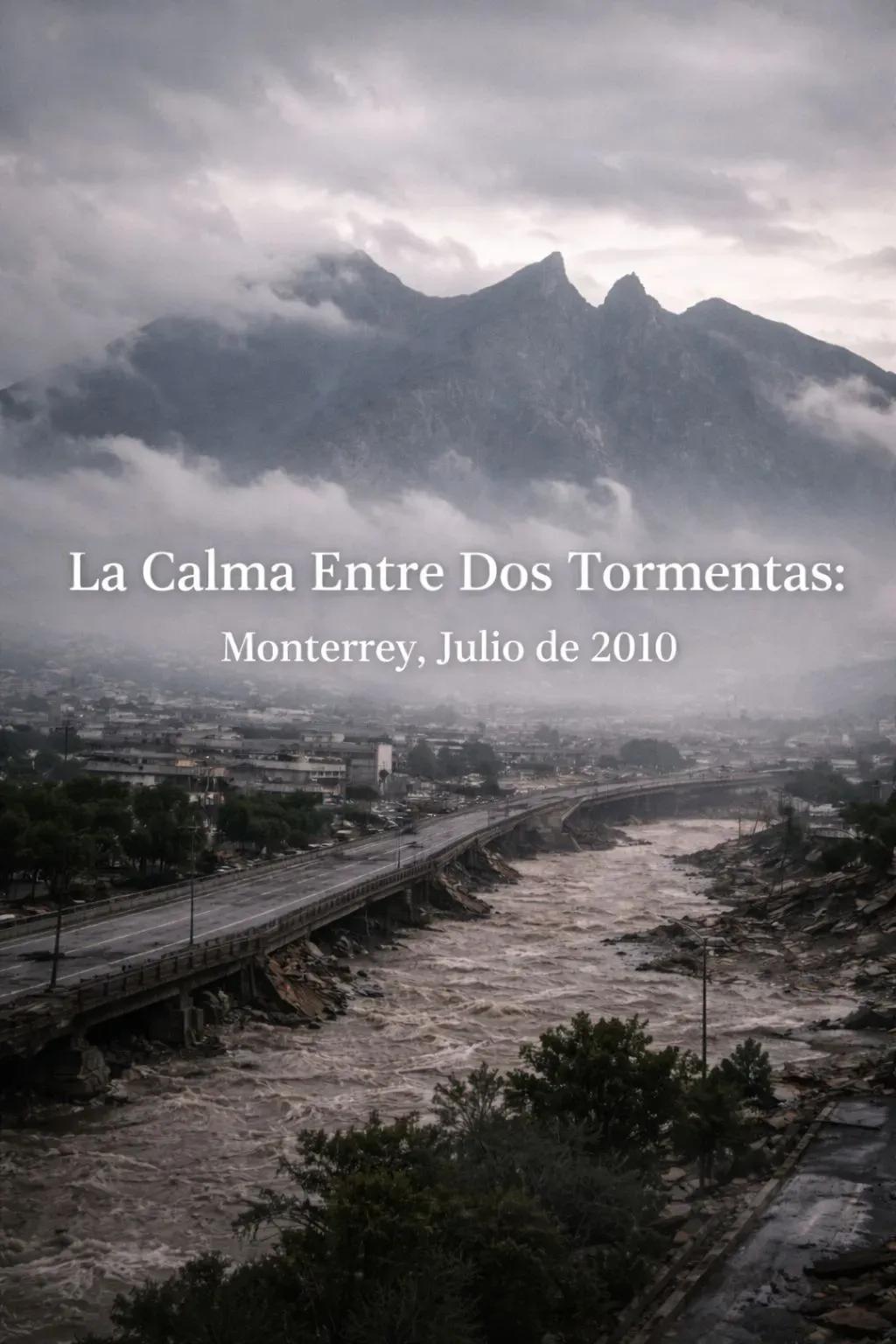
Roads disappeared. Bridges collapsed. Entire neighborhoods were buried under water and mud. The normally calm bed of the Santa Catarina River—so familiar to the residents of Monterrey—had turned into a brown torrent roaring with fury. A river that crossed the heart of the city like a blade.
Above all, the dark peaks of the Sierra Madre loomed over the city, their slopes marked by new landslides where relentless rains had ripped pieces from the mountain.
I was on vacation when the hurricane made landfall. I watched the first reports from afar and knew the damage would be severe.
But nothing prepared me for what I saw when I returned a few days later.
Driving through Monterrey felt like entering another world.
What struck me most was the silence.
The highways of Monterrey are normally filled with activity—cars speeding by, honking horns, the constant hum of a city in motion. But that day the streets were unsettlingly quiet.
No honking. No engines. No distant murmur of traffic.
Only a heavy, somber silence that engulfed the city.
It was chilling.
The city seemed apocalyptic.
Sections of highway simply ended where the water had torn them away. Cars lay twisted in places where no car should be. Entire houses had been ripped from their foundations and swept away by the current.
In the hills surrounding the city, parts of the mountain had collapsed under the constant rain. Rocks and mud descended without warning, destroying homes and businesses indiscriminately.
Nature did not distinguish between rich and poor. The storm showed no regard for wealth or reputation. It struck both humble neighborhoods and the affluent slopes of San Pedro.
Everything in its path was treated the same.
One of my closest friends lived in San Pedro Garza García, one of the most prosperous communities in Mexico. That week, the raging waters swept away his house and everything his family owned.
When the waters finally receded, he, his wife, and their children were left with nothing but the clothes on their backs.
They survived.
Everything else was lost.
And yet, even in the face of such destruction, the people of Monterrey did what they have always done.
They began to rebuild.
Neighbors were shoveling mud from their homes with spades and buckets. Families were pulling ruined furniture and broken appliances to the curb. Strangers helped other strangers push cars trapped in mud-covered streets.
For a moment, something else seemed to pause as well.
The city was already living under the shadow of drug-related violence. At that time, the conflict with Los Zetas was just beginning to tighten its grip on northern Mexico. But in the days following the hurricane, that battle seemed to fall silent.
It was as if the storm had forced everything else to step aside.
Looking back, that silence is unsettling.
Like the calm before another storm.
I have always said that 2011 was the most difficult year of my career. The violence that followed brought losses that none of us who lived through that period will ever forget.
Looking back now, it is hard not to think that week in July was something more than a natural disaster.
For a moment, the storm had shattered Monterrey.
Soon after, men would attempt to do the same.
*Author's Note
This essay is born from my years living and working in Monterrey during one of the most turbulent periods in the city’s recent history. In July 2010, Hurricane Alex devastated much of the metropolitan area, leaving destruction that few residents will forget. I returned to the city just a few days after the storm and witnessed how a familiar place can be suddenly transformed.
However, what marked me the most was not just the strength of the hurricane, but the resilience of the people of Monterrey and the strange calm that followed the storm, before the violence of the following year changed the destiny of the city once again.
—Leo Silva
Leo Silva is a former special agent in charge of the DEA (Monterrey Office) and the author of Reign of Terror and El Reinado de Terror. With decades of experience on the front lines of the fight against transnational cartels, Silva offers readers an intimate look at some of the most dangerous operations directed against high-level leaders and organizations.
Since the publication of his memoirs, Silva has become a recognized voice in the media and the speaking circuit. His story and analyses have been featured in interviews with Pulitzer Prize-winning journalist Jorge Ramos on Univision (This is How I See Things), three-time Emmy-winning journalist Paco Cobos (The Interview), and Ana Paulina (Voices with Ana Paulina), where his participation generated millions of views. He has also been a guest on prominent platforms such as the podcast Cops and Writers with Patrick J. O’Donnell, Game of Crimes with Steve Murphy, and Called to Serve with Roberto Hernández.
Through his books, conferences, and media appearances, Silva continues to shed light on the realities of organized crime, the work of law enforcement, and the human cost of the war on drugs while sharing lessons of resilience, leadership, and truth.

Comments