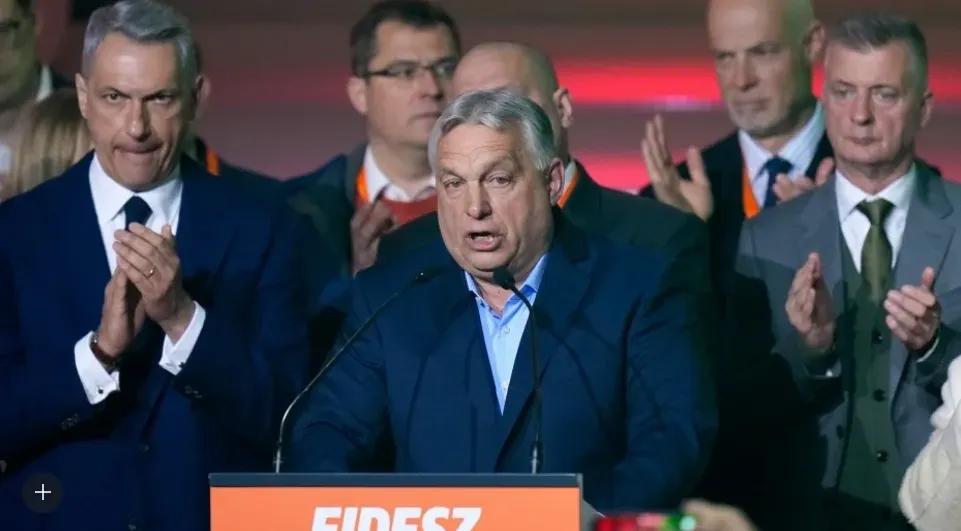
Viktor Orbán is no longer the Prime Minister of Hungary. The ultranationalist premier who governed the Central European country since 2010 with successive supermajority parliaments suffered a historic defeat on Sunday at the hands of opposition leader Péter Magyar from the Tisza party. The difference was substantial: 137 seats for the opposition, 55 for Fidesz, the party founded by Orbán himself.
The electoral day was, in itself, a message. Voter turnout reached 77.8%, the highest recorded in Hungary since the end of communism, driven by an electorate that turned out to the polls with unusual determination. Orbán acknowledged the defeat to his supporters with a phrase that summarized the moment: "For us, the result is painful, but they have made it clear that they do not grant us the responsibility of governing."
"We have liberated Hungary. We have regained our homeland."
— Péter Magyar, leader of the Tisza party and newly elected Prime Minister
Magyar, 45, is a conservative leader who came from the ranks of Fidesz before breaking with Orbán. His profile is not that of classic progressivism, but that of a Europeanist who channeled the massive discontent accumulated over years of illiberal democracy, institutionalized corruption, and alignment with Moscow. Tens of thousands of Hungarians celebrated the result on the banks of the Danube, waving flags and listening to Magyar proclaim the change of system.
The blow to Trump and Milei
Orbán's defeat is not a local event. It has direct geopolitical dimensions that reverberate in Buenos Aires and Washington. Javier Milei and Donald Trump had personally engaged in the Hungarian campaign, breaking the presidential convention of not expressing preferences in foreign elections. Milei traveled to Budapest on March 21, in a whirlwind 24-hour visit, to accompany Orbán during the campaign. Trump, for his part, sent his Vice President JD Vance to the closing of the electoral contest.
Both gestures failed. This new intervention from the White House confirmed what the polls had already suggested: Trump has become a burden for his international allies. The decline of his image in the United States, tied to rising inflation, unemployment, and the war in Iran, also drags down those who publicly embrace him.
The defeat of Orbán marks a possible shift in global public opinion against disruptive and right-wing populist leaders
For Milei, the impact is twofold. Orbán was one of his most symbolic allies within the international axis of sovereignist right: they shared criticism of multilateral organizations, confrontation with progressivism, and an ultraliberal economic agenda. With his exit from power, that space loses its most consolidated reference within Europe. Hungary will cease to be the stronghold of the populist conservative movement in the European Union.
The Argentine reaction
The news was not well received in the local libertarian universe. Figures with ties to Orbán through CPAC, like intellectual Agustín Laje, avoided commenting on the result. The Argentine Foreign Ministry issued a diplomatic statement congratulating the winner and ensuring that the government would maintain "the significant bilateral relationship" built by Milei. The text was drafted with evident discomfort: it had to congratulate the victor without repudiating the vanquished.
The opposition, on the other hand, immediately charged. Deputy Myriam Bregman described Orbán as "another little buddy of Milei who loses elections," while Kirchnerism framed the result as part of a pattern that includes Trump, Bolsonaro, and Netanyahu.
The European landscape changes
The European Union celebrated the result as its own. The President of the European Commission, Ursula von der Leyen, stated that "Hungary has chosen Europe," directly referencing the years of blockages and tensions that Orbán had caused within the bloc. Magyar, for his part, has already promised that Hungary will be a strong ally of the EU and NATO again, which represents a geopolitical shift of major significance: Orbán was the principal support for the disruptive stances of Trump and Putin within the Atlantic alliance.
The Polish Prime Minister Donald Tusk celebrated in Hungarian with a message that encapsulated European sentiment: "Russians, go home." Emmanuel Macron, Friedrich Merz, and Giorgia Meloni also celebrated, though the latter with more caution, at a moment when the war in Iran pushes her to distance herself from Trump.
Orbán does not leave in silence. He promised to continue in political life from the opposition. "We will not give up! We will never, ever give up!" he exclaimed in front of his supporters. But the era of illiberal democracy in Hungary has ended. And with it, a chapter of the global populist movement that Milei and Trump had chosen as their own banner.
Comments