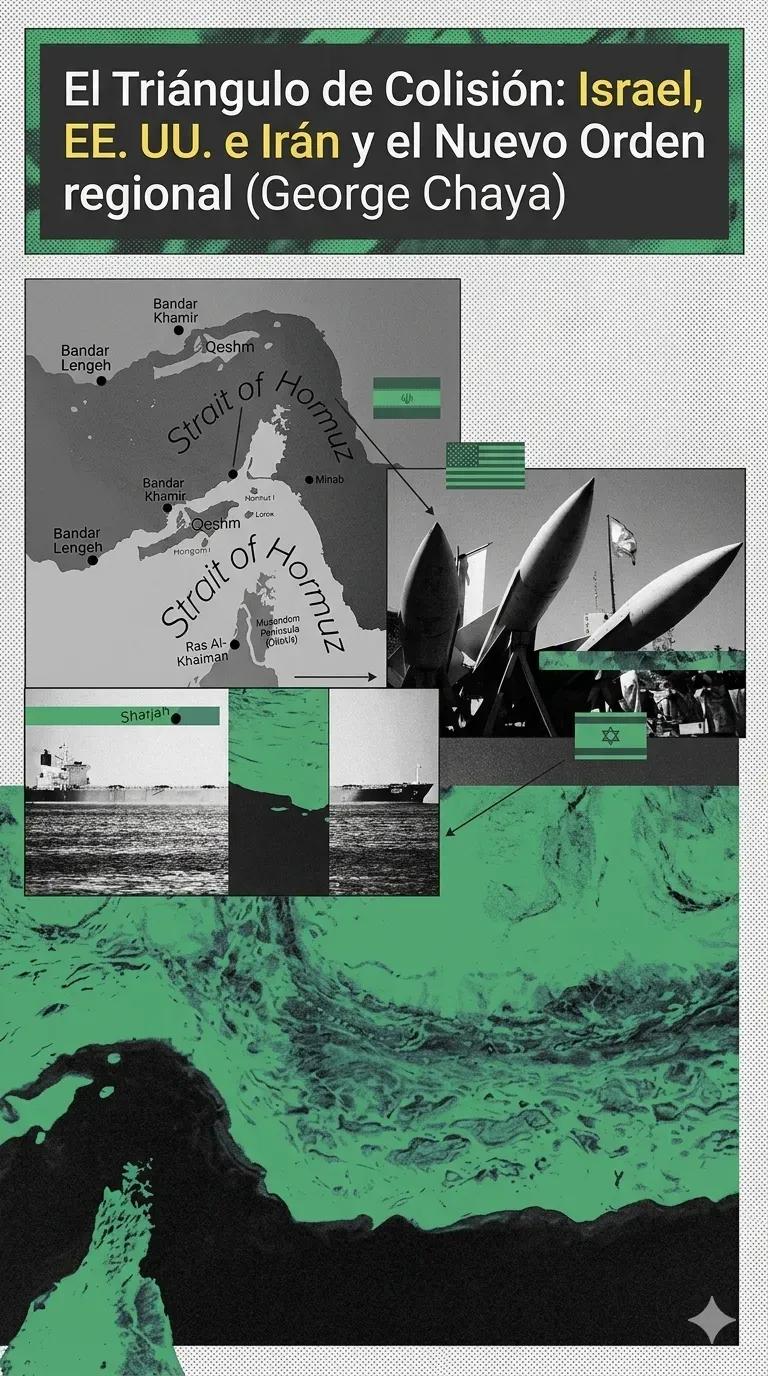
February 28, 2026, will be marked in history books as the day when the "shadow war" between Israel and Iran, sustained for decades, turned into an open and direct conflagration with the active participation of the United States.
The joint operation launched under the leadership of the Donald Trump administration, which resulted in the death of Supreme Leader Ali Khamenei and attacks on over 15,000 targets on Iranian soil, is not just a military episode; it is the catalyst for a systemic metamorphosis in the Middle East and it is here that the paradigm shift emerges, now going from "containment to eradication". Historically, the strategy of Washington and Tel Aviv was based on the "doctrine of a thousand cuts": economic sanctions, cyber sabotage, and targeted killings of nuclear scientists. However, the incursion of 2026 reveals—at least at first glance—a shift towards the direct eradication of the regime.
The current analysis suggests that Israel's calculation has been existential. Thus, for Netanyahu's government, the consolidation of Iran as a nuclear threshold and its dominance through the "Axis of Resistance" (Hezbollah in Lebanon, militias in Iraq, and the Houthis in Yemen) represented a threat that Iron Dome could no longer completely neutralize. The Iranian response—a techno-guerrilla of swarms of drones and hypersonic missiles—has demonstrated that traditional air superiority no longer guarantees invulnerability.
The Trump administration has operated under a contradictory duality. The Trump Factor regarding "America First" vs. Geopolitical Realities shows, on one hand, the use of devastating force to compel regime change; on the other, the rhetoric of a quick withdrawal (in three to four weeks, which has not happened). Such a strategic approach of maximum military pressure with minimum permanence creates a dangerous power vacuum.
Unlike the incursion into Iraq in 2003, there is no "nation-building" plan now. The U.S. objective seems to be to degrade Iran's military capability to the point of regional irrelevance, allowing internal forces (weakened after the protests of 2025 and early 2026) to finish the job. However, this pragmatism ignores the resilience of the Islamic Revolutionary Guard Corps (IRGC), which has entered a phase of territorial insurgency and attacks on the Gulf's energy infrastructure.
Thirdly, the systemic impact: "Oil, Strait, and Alliances." The crisis has put global energy security in jeopardy. The Strait of Hormuz, through which 20% of the world's oil passes, has become a combat zone and seems likely to remain so during and after the two-week truce recently agreed upon, regardless of whether it breaks before then.
The vulnerability of the Petro-monarchies, especially Saudi Arabia and the United Arab Emirates, finds them in a precarious position. The interception of hundreds of projectiles in Bahrain demonstrates that the security promised by the American umbrella is, at best, porous.
On the other hand, the operation, conducted without a mandate from the UN Security Council, marks the final decline of the international liberal order. Force has replaced diplomacy of the JCPOA (nuclear agreement), leaving Europe as a marginal actor beyond its own power and influence vacuum.
The prospective analysis of this conflict does not allow for linear conclusions. The future forks into three critical paths: a) Collapse and fragmentation (which presents a chaotic scenario) if the Iranian regime fails to stabilize after the loss of its top leadership, Iran could devolve into civil war or territorial fragmentation. This would create a geopolitical "black hole" attracting powers like Russia and China to protect their energy and strategic interests, turning Iran into a long-duration proxy war theater.
b) The IRGC manages to maintain cohesion through technocratic and nationalist military leadership via a war of attrition against its enemies. In this scenario, Iran abandons any pretense of dialogue and embarks on a long-term war against U.S. assets in the region and Israeli cities, using its strategic depth and network of allies to make the cost of victory unbearable for the West. And c) The New Regional Pact (a potential stabilization scenario). Faced with the risk of mutual annihilation or a global economic collapse, mediation led by non-Western actors (possibly Pakistan, China, and/or India) emerges. This scenario would involve recognition of spheres of influence and military de-escalation in exchange for a new security scheme that includes the Gulf monarchies, Israel, and a post-Khamenei Iran more focused on its internal survival than on external expansion.
In conclusion, the war of 2026 has ended the era of strategic ambiguity. The conflict between Israel, the U.S., and Iran is no longer a question of "if it will continue," but of "how it will end." What is at stake is not only the map of the Middle East but the credibility of American power and the survival of Israel in an environment that has learned to combat its technology with asymmetry. The current crisis is the painful birth of a new balance of power where security is no longer negotiated in Geneva but defined in the waters of the Strait of Hormuz and in the skies of Tehran and Tel Aviv.
By George Chaya (Washington DC)
Prof. George Chaya is a Senior Advisor on Middle Eastern Affairs and National Security and CEO of his own Consulting: Middle East OSINT Columbia Corp. based in Washington DC.

Comments