The coffee cools in the cup and no one seems to notice that the steam stopped rising a while ago. At this table, like so many others in this city that always seems to be on the verge of a nervous breakdown, the air feels heavy. It’s not the smoke of a cigarette, which no longer exists, but something denser: the weight of what remains unsaid. My friend stirs the sugar with a neurotic insistence; the metal of the spoon hits the bottom of the ceramic with a dry rhythm, tap, tap, tap, a metronome marking the time of a conversation that dies before it is born. We talk about the trending series, the absurd price of sneakers, the moisture seeping through the apartment walls. But when the rub of reality becomes inevitable, when politics peeks its head like an awkward relative at a party, silence falls like a guillotine. He looks at his cellphone. I look at the street through the glass stained by the smoke of the buses. We have agreed on a cowardly truce: to avoid losing our friendship, we choose to lose the world.
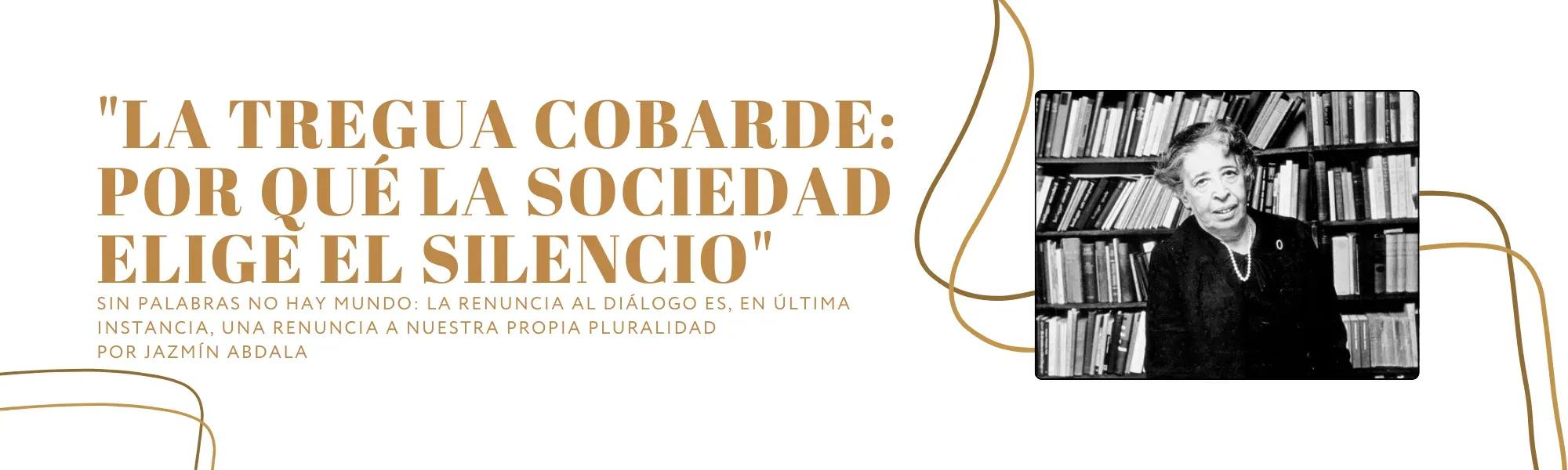
This silence is the symptom of a social gangrene that doesn't bleed, but is killing the “between” that kept us alive. Hannah Arendt used to say that politics happens precisely there, in that space that separates and unites two people, a space that is inhabited by words and gestures. For her, politics was not a parade of public officials or a bureaucratic process, but the only activity that truly makes us human because it requires the presence of others. But today, that space is mined. Disbelief has ceased to be a critical stance and has become a new skin, a hard crust that protects us but prevents us from feeling. It's no longer just that we don’t believe in politicians; it’s that we have stopped believing in the possibility that the other has a truth that isn't a trap. The street breathes a sensory cynicism: the sound of horns seems more violent, faces in the subway are more tense, and the gesture of dodging a bulk has become a national choreography. We walk with headphones on, not to listen to music, but to shield ourselves, so that the scream of reality doesn’t reach us in our bubble of perpetual suspicion.
Arendt used a powerful metaphor to explain this phenomenon: the table. Let’s imagine a group of people sitting around one; the table is what they have in common, what brings them together, and at the same time, what allows them to maintain a necessary distance to see each other’s faces without overlapping. But if suddenly the table disappears, people face each other, but they no longer have anything to connect them; they become isolated in their own subjectivity, floating in a void where the other stops being a peer and turns into an object of suspicion. Today, total disbelief in politics has made that table disappear. By no longer believing in institutions, in data, nor in the honesty of others’ words, the space between us has become an abyss. When we look at each other across the void, silence is no longer respect, but a defensive wall. If I don’t let you express your opinion, or if I self-censor to avoid listening to you under the excuse of not wanting to fight, I am not saving our relationship; I am dynamiting the only bridge that allowed us to build a shared sense of reality.
This void that remains when the table disappears is not a harmless space; it is a hunting ground. Arendt knew this well as she walked the streets of a New York that felt foreign to her, carrying the weight of having witnessed a whole civilization crumble in the silence of the 1930s. She explained that work is for survival and creation is to leave a mark, but politics is to exist in the plural. When we isolate ourselves, when we decide that our opinion doesn’t matter or that it’s better not to get involved, we are committing civil suicide. And what she dissected with the precision of a surgeon was how totalitarianism does not start with tanks but with the destruction of factual truth in daily conversations. Post-truth, in Arendtian terms, is a mist that slips under the door. It’s not about a ruler lying to us about a specific number, but something much more perverse: an attack on common sense, that sixth sense that allows us to perceive reality as something we share with others. If I say it’s raining outside and you, out of fatigue or hatred, tell me the sun is shining, we are no longer debating ideas. We are breaking the ground we walk on.
Disbelief has robbed us of the capacity for amazement at the blatant lie; we receive it with a shrug, with a “well, what did you expect,” and in that gesture of resignation, we hand over the keys to our freedom to the first one who offers us a comfortable fiction. This renunciation of facts has led us to a kind of social autism. We lock ourselves in confirmation bubbles where language degrades to become a bark. Orwell warned that if power managed to reduce language, it would succeed in reducing the range of thought. Our political discussions, when they occur, are no longer exchanges of arguments but clashing of empty slogans, of words that have lost their weight and volume. We speak in capital letters on liquid crystal screens, but we are unable to look our neighbor in the eye when they complain about an injustice. We have lost the thickness of reality. Disbelief has made us two-dimensional: we are profiles, we are potential votes, we are consumers of indignation, but we have ceased to be that political animal that is only complete in the encounter with someone who thinks differently.
This is the cruelest paradox of our era: we have never had so many tools to communicate and we have never been so alone in our convictions. The algorithm has replaced Arendt's table, but not to bring us together, but to isolate us in an infinite echo where we only hear what we already think we know. We lack the courage of exposure, that bravery of which the philosopher spoke, which doesn’t consist of going to war, but of stepping out of oneself and risking being transformed by the words of the other. We prefer the purity of isolation to the messiness of consensus. And in that purity, in that silence of clean plates and drawn blinds, what rots is the hope that something, at some point, can be different. Because if we are not capable of letting the other speak, if the mere idea of a disagreement generates in us an ethical nausea that makes us flee, what remains of our humanity?
What remains is a society of monads, of atoms that collide but do not fuse. Indifference becomes the default mode: we see the one who suffers as a flaw in the landscape, the one who demands as a noisy nuisance interrupting our endless scroll. Disbelief has made us sterile. At the end of the day, after avoiding all discussions, after maintaining family peace at the cost of truth, we get into bed with a loneliness that has the bitter taste of metal. The silence we buy to avoid fighting is, in reality, the noise of a democracy that is losing its voice; an empty table where no one has anything to say and where the only one still talking is the echo of our own fatigue, reminding us that when we stop talking about the world, the world simply stops existing.
Comments