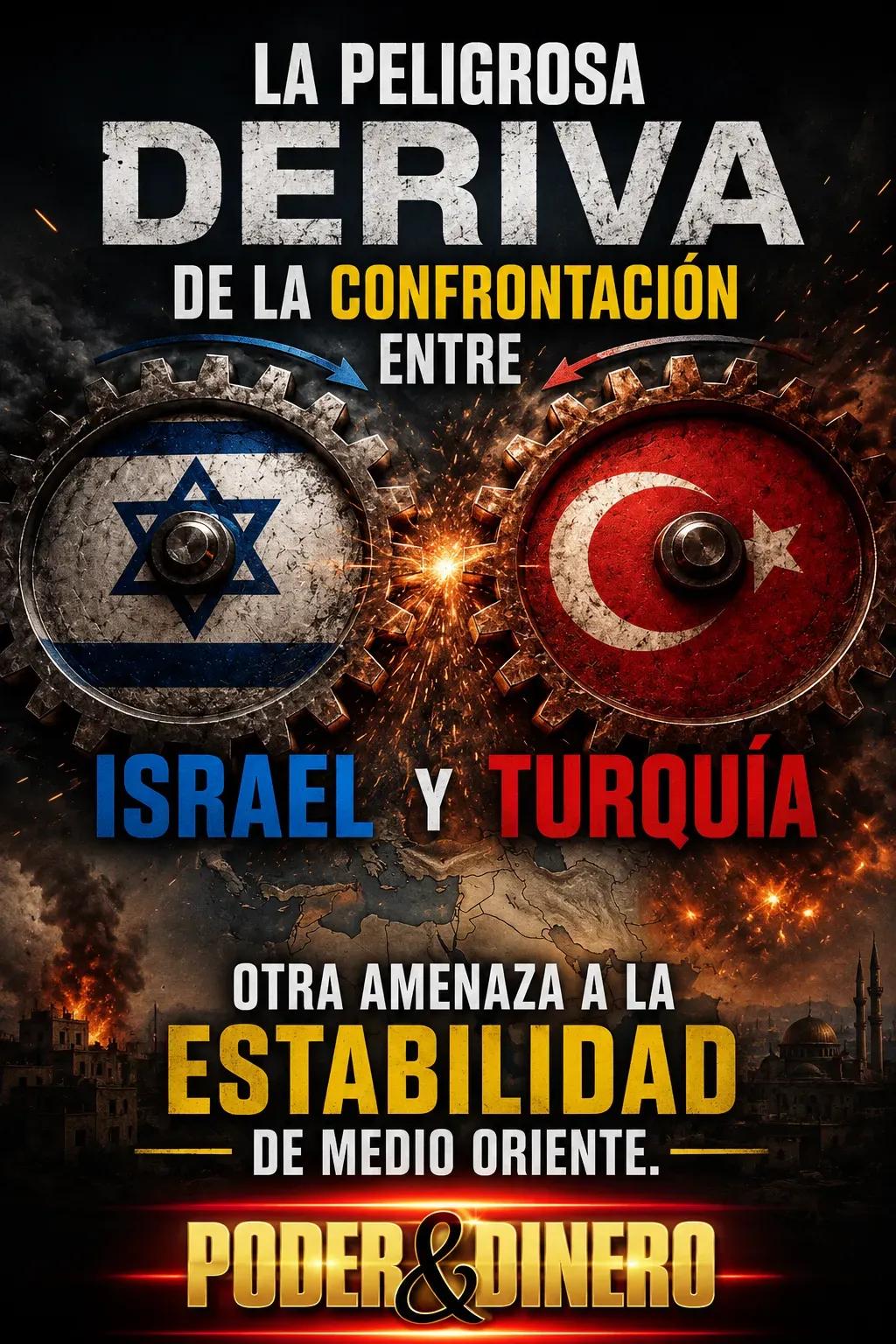
For decades, the relationship between Recep Tayyip Erdoğan and Benjamin Netanyahu has been characterized by a strategic pragmatism tinged with ideological distrust. Turkey was the first Muslim-majority country to recognize the State of Israel in 1949, and the two maintained deep military and intelligence cooperation for years. However, that bond belongs to the past. The crisis of the Mavi Marmara[i] ship in 2010 opened a wound that never fully healed. Since then, relations have progressively deteriorated, entering a phase of open confrontation after the war in Gaza and the expansion of geopolitical disputes in Syria and the eastern Mediterranean. Mutual accusations have taken on a dimension that is not only rhetorical but also concrete militarily and strategically.
In Ankara, President Erdoğan has hardened his rhetoric against Israel to unprecedented levels. In April 2026, during a speech at the International Conference of Political Parties of Asia in Istanbul, Erdoğan described Israeli actions as “a network of blood-soaked genocide” that “continues to kill children, women, and innocent civilians without rule or principle whatsoever, ignoring all human values.” He has also compared Prime Minister Netanyahu's policies to those of Hitler and warned that “just as we entered Karabakh and Libya, we could do the same with them. There is nothing preventing it; only strength and unity are required.” High-ranking Turkish officials, like Foreign Minister Hakan Fidan, have accused Israel of seeking to turn Turkey into its “new enemy” after Iran's weakening. Fidan stated in April 2026: “After Iran, Israel cannot live without an enemy. We see that both in Netanyahu's Government and in part of the opposition there is a search to declare Turkey the new adversary.”
On the Israeli side, members of Netanyahu's Government assert that Turkey aims to become the new Islamist hegemonic power in the Middle East, taking advantage of Iranian weakening and the collapse of the previous Syrian balance. Netanyahu himself has publicly accused Erdoğan of “massacring his own Kurdish citizens” and of “accommodating the terrorist regime of Iran and its proxies.” Israeli officials like former Prime Minister Naftali Bennett have warned that “a new Turkish threat is emerging” comparable to that of Iran, and Defense Minister Israel Katz has described Erdoğan as a “man of the Muslim Brotherhood” and a “paper tiger.” Israeli analysts increasingly describe Ankara as an actor capable of forging a network of allies at Israel's expense, with Syria as the central axis.
This growing hostility is largely explained by the dispute over energy corridors between the Middle East and Europe. The eastern Mediterranean has consolidated as one of the main geopolitical scenarios of the 21st century. Israel, Greece, and Cyprus have long championed the EastMed pipeline project, designed to transport natural gas from Israeli and Cypriot fields to Europe while avoiding Turkish territory. Although the project faced technical and economic difficulties —and lost explicit U.S. support in 2022— in 2025 and 2026, the three countries have attempted to revive it, linking it additionally to the India-Middle East-Europe Economic Corridor (IMEC). This scheme is not only energy-related but strategic: it consolidates a Greek-Israeli-Cypriot axis backed by the West and limits Turkish influence over regional energy routes.
Turkey sees this initiative as an existential threat to its maritime and economic sovereignty. The doctrine of “Blue Homeland” (Mavi Vatan), promoted by nationalist and military sectors close to the Government, seeks to expand Turkey's maritime influence zone in the eastern Mediterranean and questions the maritime delimitations agreed upon by Greece and Cyprus. Ankara has responded by promoting alternatives, such as energy corridors that include a possible Qatar-Turkey link through Syria, and has maintained a comprehensive trade embargo against Israel since 2024. Minister Fidan has indicated that military cooperation between Greece, Cyprus, and Israel “does not generate more trust but more problems and war.”
This energy competition is inextricably intertwined with the war and reconfiguration of Syria. Following the fall of Bashar al-Assad's regime in December 2024, Turkey emerged as the actor with the greatest influence capacity in the new Damascus equilibrium. Ankara has consolidated troops in the northern part of the country, cultivated governance structures aligned with its interests, and blocked any significant Kurdish autonomy. It also seeks to deepen its strategic depth towards the Levant. Israel observes this advance with profound concern. For Tel Aviv, a Syria under strong Turkish influence could pose a greater threat than Iran did during the Assad era. Israeli sources indicate that Israel's aviation has conducted nearly a thousand air and artillery strikes in the first seven months following Assad's fall —almost triple that of the previous seven years— with the explicit goal of thwarting the establishment of Turkish military infrastructure, including bases and air defense systems. Turkey has condemned these attacks as “dangerous escalation” and has achieved, through Azerbaijani mediation, a military de-escalation mechanism to avoid direct clashes.
The Kurdish issue further exacerbates the rivalry. Israel has expressed sympathy towards the aspirations of Kurds in Syria and Iraq —occasionally describing them as “natural allies”— a position Ankara considers an absolute red line. This divergence in views about Syria's future —Turkey seeks a friendly central government unified under its influence; Israel prioritizes fragmentation to prevent any unified threat on its northern border— has turned Syria into the epicenter of geopolitical clash.
The conflict also projects toward the Horn of Africa, one of the planet's most strategic regions. In Somalia, Turkey maintains its largest military base abroad in Mogadishu and has invested billions in infrastructure, training the Somali armed forces, and economic cooperation. In 2025-2026, Ankara announced plans for a space-port in Somalia and strengthened its naval and air presence, including deployments of F-16s. It aims to turn the Horn into a projection platform toward the Red Sea and Indian Ocean. Israel, for its part, seeks to bolster its presence to control critical maritime routes between Asia, Africa, and Europe. In December 2025, Israel formally recognized the independence of Somaliland —the first UN power to do so— prompting a strong reaction in Turkey and Qatar. President Erdoğan condemned the measure as “illegal and interventionist”, a violation of Somalia's territorial integrity and a deliberate attempt to undermine Turkish influence. The spokesman for the Turkish Foreign Ministry, Öncü Keçeli, described it as “another example of Netanyahu Government's expansionist policies aimed at creating regional instability.” The Bab el-Mandeb Strait, vital for global energy trade, has thus become a new front of indirect competition.
The rivalry is no longer merely bilateral. Increasingly defined regional blocs have consolidated. Israel has deepened its strategic alliance with Greece and Cyprus —based on energy cooperation, joint military exercises, and shared intelligence— and is exploring expansion towards India through corridors like the IMEC. Opposing this axis is a potential conglomerate made up of Turkey, Azerbaijan —a key ally after the Nagorno-Karabakh war— Pakistan —with growing military cooperation— and, eventually, Saudi Arabia, whose rapprochement will depend on the situation regarding Iran and Gaza.
The United States observes the scenario with increasing concern. Washington maintains strategic links with both countries: Israel as a fundamental ally and Turkey as a key NATO member due to its control of the straits and its military weight. U.S. Special Envoy Tom Barrack has described the tensions as “rhetorical” and has urged cooperation on security and energy, stating that “Turkey is not a country that can be played with.” However, a direct confrontation between Ankara and Tel Aviv could fracture the Western alliance system. For NATO, the dilemma is delicate: Turkey is one of its main armies and controls vital strategic positions, while Israel maintains close military cooperation with Western members. The possibility of Ankara exercising its veto in the Alliance raises concerns among political and military circles in Brussels and Washington.
Meanwhile, rhetoric and militaristic preparation continue to escalate. Turkey has showcased advancements in ballistic missiles, drones, and long-range systems capable of hitting targets in the eastern Mediterranean. Israel, for its part, has intensified operations in Syria and bolstered its defenses against possible extended regional threats. In this context emerges a particularly explosive issue: the future possibility of Turkey aspiring to a military nuclear capacity. Although Ankara is part of the Nuclear Non-Proliferation Treaty, Erdoğan has publicly questioned the “nuclear monopoly” held by Israel in the region, previously stating that “military nuclear power should be prohibited for all or allowed for all.” Turkish nationalist sectors argue that the current strategic asymmetry places Turkey in a vulnerable position and that Ankara should have equivalent deterrence. Although this scenario remains remote, the deterioration of the regional order and the proliferation of rival alliances make it increasingly less unthinkable.
The paradox lies in the fact that Turkey and Israel still share substantial common interests: both fear the expansion of regional chaos, require economic stability, and maintain deep commercial ties. However, the geopolitical logic —accentuated by the vacuum left by Iranian weakening and the Syrian reconfiguration— seems to push them toward an increasingly structural confrontation. What is at stake is no longer limited to Syria, Gaza, or the eastern Mediterranean: it concerns the political, military, and energy leadership of the new Middle East. In this struggle, Ankara and Tel Aviv appear convinced that the space for strategic coexistence is shrinking day by day, shaping a high-risk scenario for regional and global stability.
[i] MAVI MARMARA: On May 31, 2010, Israeli commandos boarded the Turkish-flagged Mavi Marmara ship in international waters, killing ten Turkish activists and injuring dozens more, provoking a serious diplomatic crisis between Israel and Turkey. The ship was leading a “Freedom Flotilla” to break the blockade of Gaza.

Adalberto Agozino holds a PhD in Political Science. He is a professor at the National Gendarmerie University Institute and the National Defense Faculty of Argentina. He is the director of the Argentine Institute of Geostrategic Studies. Editor of the Alternative Press Agency. Expert on Maghreb issues.

Comments