It is very difficult to count on relatively accurate information about what is really happening in the war in Ukraine. The information provided by the parties not only does not contribute to this, but makes it increasingly confusing what is referred to in international relations as the «principle of uncertainty of intentions» of the actors; for example, it is difficult to determine which of the parties (namely, Ukraine-European NATO and Russia) wishes to reach an agreement or if none of them does.
This is a situation to which what Jean-Jacques Rousseau said about the four truths can be well applied: «There are always four sides to a story: your side, their side, the truth, and what really happened».
Despite the complexity of the topic, we can still reflect on what might be happening and consider the dangerous spectral military factor of Russia.
A year ago, time was running in favor of Russia in the war, but today that advantage may no longer be so. Although it remains a key asset, Russian preeminence in resources has diminished, creating a new situation where attrition continues to be the hallmark of the war, but gains and losses tend to balance out.
What has happened for the war to enter a new and more dangerous phase?
Considering the high cost that has been involved so far in maintaining territorial predominance in eastern and southern Ukraine, approximately 118,000 square kilometers, perhaps the attrition is affecting Russia more. Likewise, the strategy based on showing willingness to reach a ceasefire to ultimately continue the war has once again placed Putin as the «lord» of the same.
At first, it was spoken of as «lPutin's war», as the regime not only rejected any new expansion of NATO in its immediate neighborhood but also denied the very existence of Ukraine as a state. But Russia managed to «globalize» the war, that is, to show that only part of the world sanctioned it, which is true, and thus, on an external scale, as internally nobody talks about war, «despersonalized» the confrontation: «Putin's war» became «Russia's war». But today there is talk of the former again, not only because of the decision to continue, but also due to the growing reluctance (and even reluctance) of Russians towards it.
The situation on the front has not implied a scale change, but it is undeniable that Ukraine has not only thwarted the Russian attempt to gain new territories, multiplying costs for its rival, but has also amplified its capacity to hit Russian energy infrastructure in its major cities, Moscow, Saint Petersburg, Omsk, as well as the Russian logistical chain.
In other words, Kiev has managed to capitalize on the experience of four years of confrontation, mobilized its military industry, particularly in the mass production of drones and ammunition, achieved gains in naval warfare, and, of course, continues to receive financial and strategic-military assistance from a European NATO that, mainly led by the United Kingdom and France, seems to have abandoned all diplomatic options to sustain and enhance the strategy of attrition and bleed Russia, a choice that entails, as American John Mearsheimer warns, a very high risk.
This does not mean that Ukraine could achieve victory, considering victory to be the expulsion of Russian forces from the Donbas and even Crimea. But it may be that the «victory» means (for Kiev) that Russia does not gain more than that almost immobile 20 percent of geopolitical predominance (recently, Ukraine stated that it would be willing to initiate conversations based on the existing situation).
If this is the case, for Russia, victory would end up being Pyrrhic, as the price for capturing and maintaining regions in the east and south has been very high so far, with the government having to militarize its economy to sustain the war effort. This explains that for some time now, Russian society has been paying for the war.
In any case, the eventual Russian victory would be greater if Ukraine finally adopts a category of neutrality (surely reinforced) in which, of course, NATO does not participate.
But if Russia does not sustain that «victory», it could find itself facing the military specters of its past, that is, the defeat in the Crimean War (1853-1856), a conflict that for British historian Orlando Figes was the last religious crusade in history and the first modern war, and prevented Russian expansion towards the southern seas; the diplomatic defeat following the military victory over Turkey (1877-1878); the catastrophic defeat against Japan (1905), which triggered a chain of events that culminated in the “strategic year” of 1917; the defeat against Germany in World War I, sealed with the draconian Treaty of Brest-Litovsk; the invasion by Germany in 1941, which led to what Lawrence Rees called a war of extermination; the defeat in Afghanistan in the 1980s, and finally the defeat of the USSR in the Cold War and the very collapse of the country.
Therefore, the spectral factor makes the war perhaps at its most dramatic moment, as it brings it closer to the most violent extremes, that is, to possible incidents outside the already extended theater of war and to the use of increasingly sophisticated and lethal weapons.
Last May, Russia and Belarus conducted simulation exercises with strategic nuclear forces (64,000 troops, ballistic missiles, and land, naval, and air capabilities were mobilized). Their objective was to practice launching nuclear weapons in response to a hypothetical external attack, including a conventional one. Also in May, Moscow announced that it had successfully tested an intercontinental ballistic missile (ICBM) «RS-28 Sarmat». The «Sarmat» is one of the most advanced ICBMs in the world and a key capability in Russia's efforts to modernize its land nuclear arsenal.
It should be clarified that the maneuvers and announcements were made in the context of Ukraine's attacks on Russian territory with conventional weapons and with the support of European NATO countries, a situation that, according to the review of Russia's nuclear doctrine, enables this country to resort to nuclear weapons.
This does not mean that the use of military nuclear weapons is imminent. But as specialists Rafael Loss and Katrine Weestgard argue: «The dual Russian philosophy regarding the conflict explains the strategic role played by long-range weapons —both nuclear and conventional— in its theory of victory. In this context, non-nuclear strategic weapons do not replace nuclear ones but rather enhance the credibility of the threat to use them». Likewise, «Long-range weapons imply that no place in Europe is safe. Russia believes that their use will deter any European retaliation, as it could always respond with the use of Russian strategic nuclear weapons in the next round of attacks».
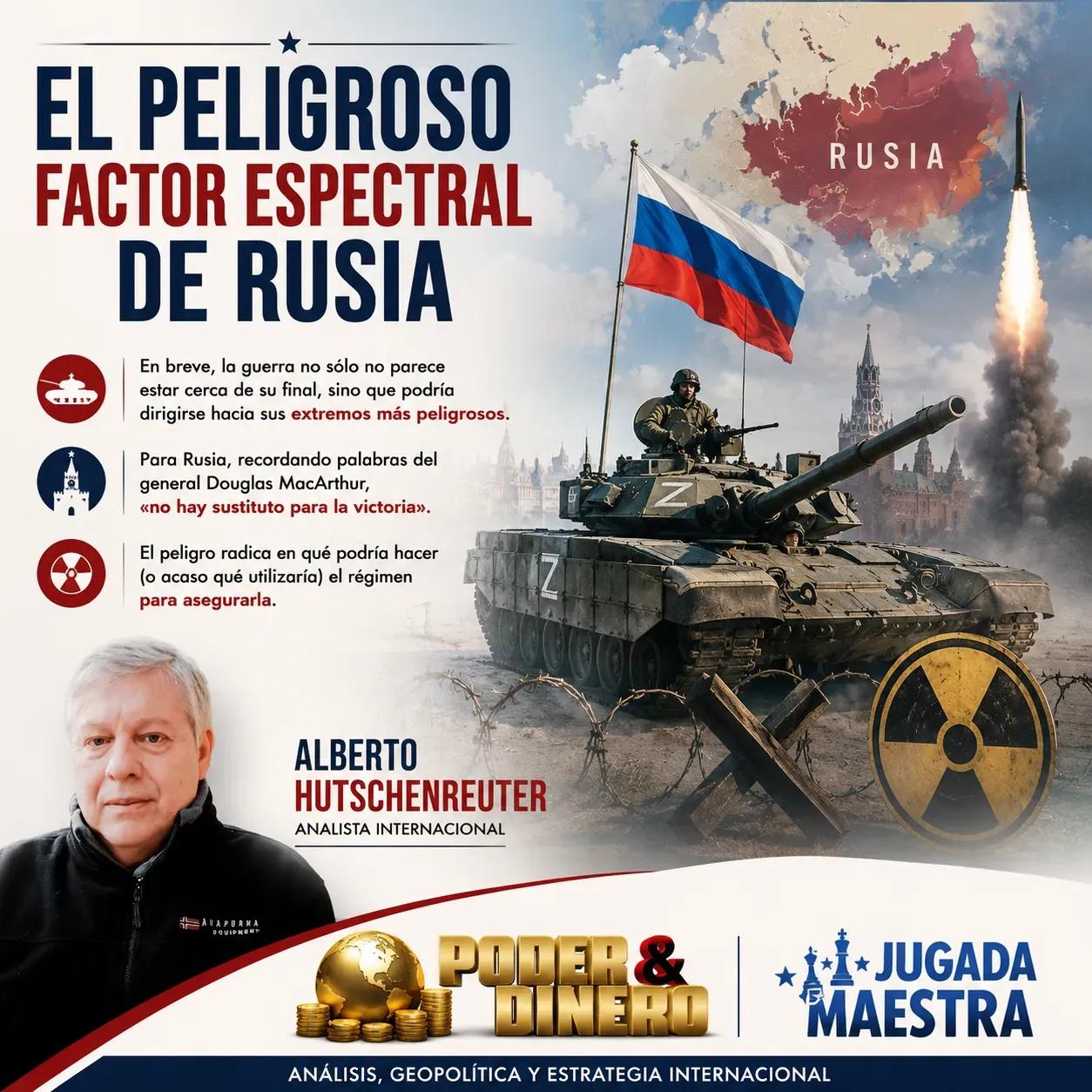
In short, the war not only does not seem close to its end, but could be heading towards its most dangerous extremes. For Russia, recalling the words of General Douglas MacArthur, «there is no substitute for victory». The danger lies in what it could do (or perhaps what it would use) the regime to secure it.
Alberto Hutschenreuter holds a PhD in International Relations (summa cum Laude) from USAL. He has been a professor at UBA, ISEN, the Air War College, and other educational centers. He has written numerous articles and books on international issues and geopolitics.

Comments