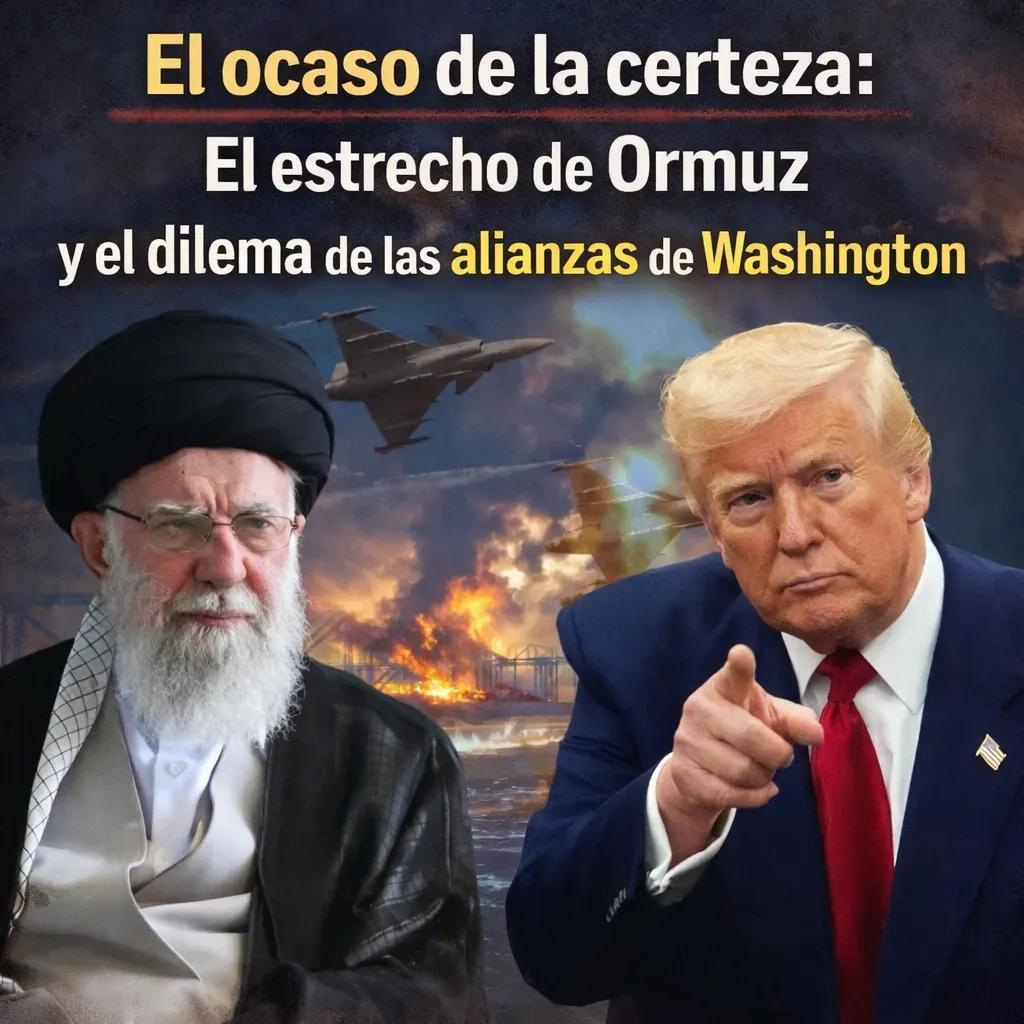
The war that President Donald Trump launched against Iran, under the promise of a swift and decisive resolution, has mutated into a strategically complex labyrinth with alarming intricacy. This unexpected turn is marked by unprecedented urgency: the need to garner international support to sustain a military effort that no longer seeks only victory but the survival of the planet's most vital energy artery, the Strait of Hormuz. What was initially proposed as a surgical offensive to dismantle Iranian military power has ended up transforming into a systemic crisis where Washington discovers it can no longer ride solo without facing prohibitive risks and costs that erode its own economic stability.
The most dramatic symptom of this stalemate is the operational collapse in Hormuz, a turning point that has shaken the foundations of global trade. Market indicators reveal a dismal reality: crude flow has plummeted from 19.5 million barrels per day to a residual half a million, a free-fall triggered by the panic of international insurers who have pulled their coverage in the face of an unsustainable risk. In this scenario of paralysis, the void has been filled by ships operating in the shadows of the Western financial system, primarily vessels linked to Chinese interests, injecting a geoeconomic variable that raises alarms in the Oval Office.
In light of this precariousness, Trump has had to make a move that reflects both his desperation and material limitations, formally requesting his NATO allies and Asia-Pacific powers to send fleets to form a naval rescue coalition. This request has exposed vulnerable flanks that few suspected; not only the technical difficulty of clearing an area saturated with mines and asymmetric drones but also a troubling shortage of specific means in the United States Navy, which after years of prioritizing other fronts, has seen its capacity for maritime demining diminished.
However, the echo of this call in allied capitals has been one of glacial coldness or, in the most severe cases, outright rejection. Kaja Kallas, the European Union's High Representative for Foreign Affairs, left no room for ambiguity in declaring: “This is not Europe’s war, and we did not start it. No one wants to actively participate in this war”. In the same line, Germany has raised an impassable diplomatic wall. A spokesperson for the German government was blunt in stating: “As long as this war continues, there will be no participation at all, not even in any attempt to keep the Strait of Hormuz open by military means,” which represents a harsh blow to the security architecture that Washington intended to lead.
This German resistance is not whimsical; it is based on the deep discomfort generated by the lack of prior consultations from the Trump administration before igniting the wick of conflict. Adding to this is the visceral fear of a regional detonation that destroys European energy security at a moment of internal economic fragility, coupled with public opinion that rejects any echo of past war adventures. The sentiment of caution has spread like wildfire to Japan and Australia, nations that have preferred to safeguard their own diplomatic balances and supplies rather than dive into a low-horizon, high-risk operation.
France, under Emmanuel Macron's leadership, has attempted to sketch a more sophisticated but equally vigilant position. Although the Élysée contemplates the possibility of maritime escorts, Macron made it clear that their priority is global security and that they will not participate “in a horizon-less escalation”. Meanwhile, the United Kingdom navigates an uncomfortable ambivalence; despite its closeness to Washington, doubts about the mission’s viability and the ghost of failed interventions keep London in a state of reflective paralysis.
While Western powers calculate their steps, Gulf countries observe the fire from a stifling proximity. Saudi Arabia has hardened its rhetoric, with Crown Prince Mohammed bin Salman warning that “global energy security cannot become hostage to instability”. Nonetheless, behind the official rhetoric lies a real anxiety over the vulnerability of their infrastructures and the financial bleeding that the drop in their exports entails. In the United Arab Emirates, the closure of Hormuz has struck at their logistical heart, leading their authorities to remind that the stability of the Gulf is an international interest that transcends regional concerns.
Qatar, true to its role as a balancer, insists that “there is no sustainable military solution to this crisis,” desperately calling for the reopening of diplomatic channels with Tehran. In a similar tone, Kuwait and Oman have multiplied their mediation efforts, warning that the prolongation of the blockade not only ruins exporters but threatens to trigger internal social eruptions. Even Bahrain, Washington's most unconditional ally, has begun to admit that the current situation “is not sustainable over time.”
This paralysis at the heart of the Gulf generates a butterfly effect that hits Latin America in contradictory ways. The blockage of Hormuz has skyrocketed oil prices and increased maritime shipping costs, jeopardizing critical supply chains, from fertilizers to industrial metals. For Latin American countries, the crisis threatens to lead to a stagflation episode similar to that of the 1970s, a scenario that deeply worries political leaders and economists alike. While some regional exporters might see a nominal increase in their revenues, the exponential rise in risk and the disruption of global trade negate any immediate benefit.
At the root of this crisis lies an orphaned strategy. As analyst Thomas L. Friedman has noted, the Trump administration has oscillated between different goals without defining a coherent course, undermining the trust of its allies. The security pillar that the United States guaranteed for decades in the Gulf is cracking under the weight of its inability to keep the strait open. The allies' refusal to come to the rescue is an exercise in realism; French General Michael Yakovleff summed it up with irony: “Joining Trump’s coalition today is like buying a ticket for dinner and dancing on the Titanic's deck after it struck the iceberg”.
This war, which was born to reaffirm American hegemony, has ended up exposing its seams, a lesson that powers like Russia and China are processing with utmost attention. Iran, despite the punishment received, has demonstrated a remarkable capacity to alter the global balance through asymmetric tactics. The margin for maneuver for Washington is shrinking; every day without a solution not only exacerbates the economic crisis but erodes the credibility of the United States as a guarantor of international order. We may be witnessing the passage to a global system that is less dependent on Washington and more fragmented, where alliances are no longer taken for granted, and where regional actors themselves begin to explore alternatives to a dependence that no longer offers certainties.
Adalberto Agozino is a Doctor of Political Science, International Analyst, and Lecturer at the University of Buenos Aires.

Comments