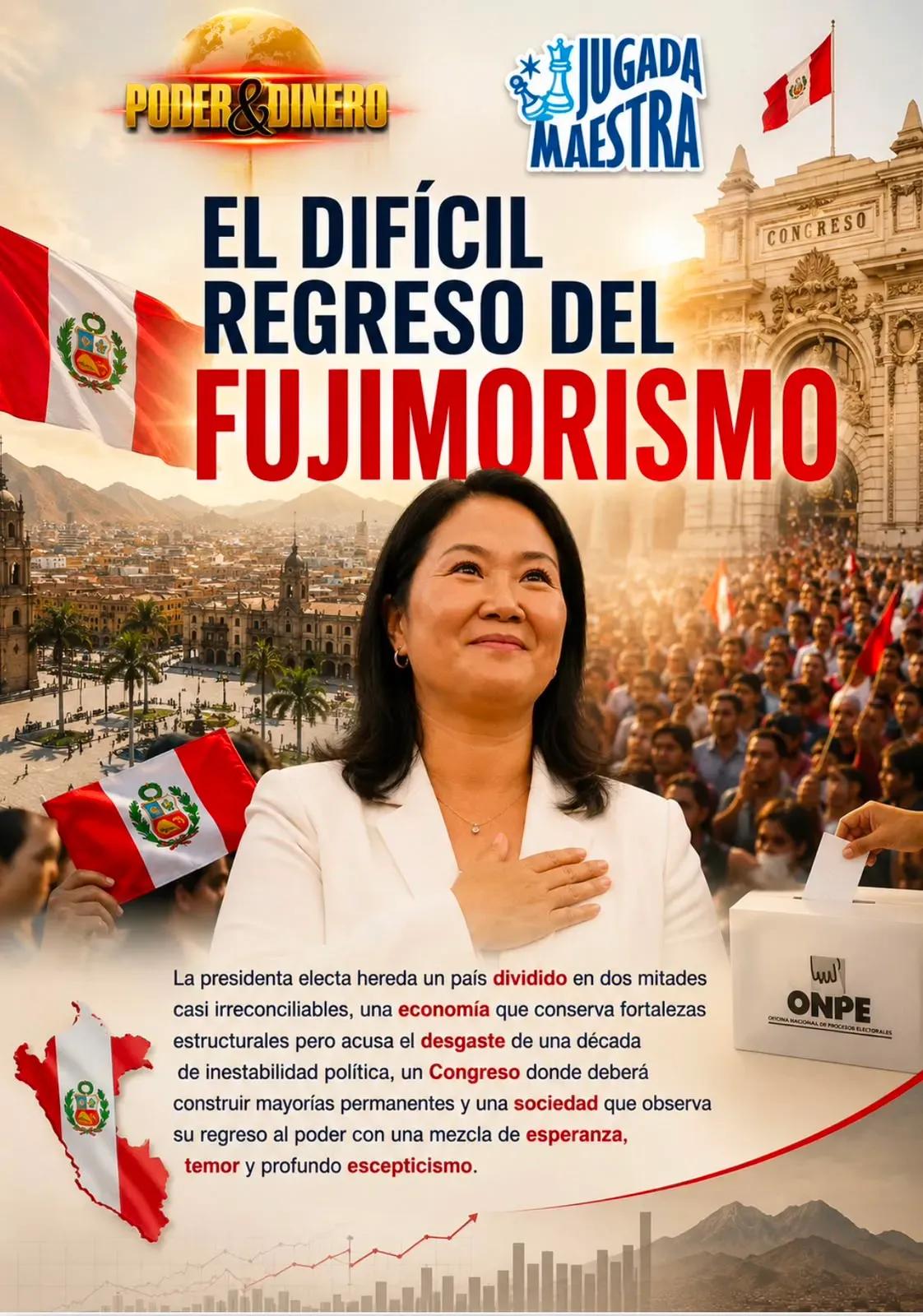
Twenty-six years after the fall of the regime led by her father, the Fujimori surname is once again established in the Government Palace of Lima. Keiko Fujimori's victory in the 2026 presidential elections represents one of the most significant political events in Peru's recent history. It not only signifies the return to power of the most influential political force of the last three decades but also the provisional closure of a political cycle marked by institutional fragmentation, the uninterrupted succession of presidents, the erosion of citizen trust in democratic institutions, and the exhaustion of the so-called anti-Fujimorism as the main organizing factor of Peruvian politics.
The official confirmation of the results by the National Office of Electoral Processes, following an exceptionally prolonged count due to the razor-thin margin between the two candidates, ended the electoral process, although it did not succeed in closing the political controversy. Roberto Sánchez continues to denounce irregularities in the processing of ballots from abroad and refuses to recognize the political legitimacy of the new president. The electoral authorities, however, rejected all challenges presented and ratified the victory of the candidate from Fuerza Popular.
The final difference barely exceeded forty-nine thousand votes out of more than eighteen million valid votes cast. Rarely in Peruvian republican history has a government begun its term with such solid legal legitimacy and such disputed political legitimacy.
Paradoxically, Keiko Fujimori herself is fully aware of this contradiction. Her victory does not express a majority adherence to the political project of Fujimorism but rather the result of a deeply polarized society that continues to vote more against its opponents than in favor of those who ultimately get elected.
The elected president arrives in power after four presidential attempts over fifteen years. She lost to Ollanta Humala in 2011, to Pedro Pablo Kuczynski in 2016, and to Pedro Castillo in 2021. Throughout that period, the so-called anti-Fujimorism managed to articulate a heterogeneous coalition made up of liberal, leftist, centrist, and even conservative sectors that shared a single priority: to prevent the return to power of the movement founded by Alberto Fujimori. That coalition ended up disintegrating under the weight of the Peruvian political crisis itself.
The successive governments that followed Ollanta Humala's term were unable to rebuild citizen trust. Pedro Pablo Kuczynski ended up resigning under pressure from Congress. Martín Vizcarra was impeached through the disputed figure of permanent moral incapacity. Manuel Merino barely stayed in power for a few days before being forced to resign due to intense social mobilization. Francisco Sagasti led a precarious transition. Pedro Castillo starred in a failed self-coup attempt before being impeached and imprisoned. Dina Boluarte governed under historically low approval levels while facing serious social protests and accusations of excessive use of force.
In just a decade, Peru has seen nine presidents. This extraordinary institutional deterioration has profoundly modified the electorate's priorities. The main problem has ceased to be the memory of Alberto Fujimori's regime to become the state's inability to guarantee order, stability, and security.
Political scientist José Incio has argued that anti-Fujimorism has ceased to function as a dominant political identity because new generations have begun to value promises of stability more intensely than warnings about the country's authoritarian past. In a similar vein, Ricardo Cuenca interprets Fujimori's victory as the product of collective exhaustion in the face of years of permanent uncertainty. For a considerable part of the electorate, the candidate ceased to represent the greatest risk to become the lesser evil.
This does not mean that Peruvian society has reconciled its relationship with Alberto Fujimori's political legacy. On the contrary. The figure of the former president continues to deeply divide public opinion.
For millions of Peruvians, he continues to be the leader who militarily defeated Sendero Luminoso and the Túpac Amaru Revolutionary Movement, stabilized an economy devastated by hyperinflation, and laid the foundations for the extraordinary economic growth experienced by the country in the following decades.
For other millions, he remains responsible for the self-coup of 1992, serious human rights violations, political control of the Judiciary, Congress, and the media, as well as the gigantic web of corruption organized around Vladimiro Montesinos. Keiko Fujimori inevitably carries both memories.
Throughout the campaign, she championed the economic and security achievements made by her father's administration but sought to distance herself from his authoritarian practices. She promised to fully respect the constitutional order, strengthen democratic institutions, and simultaneously combat corruption and organized crime. The challenge lies precisely in convincing an extraordinarily distrustful society of that promise.
Diverse polls conducted during the campaign showed that negative perceptions of Fujimori continued to far exceed her favorable image. No recent Peruvian president has come to power carrying such high levels of social rejection. The paradox is remarkable.
She had never before managed to win a presidential election, but probably never before had she raised so few positive expectations among those who ultimately ended up voting for her. The explanation lies less in the strength of Fujimorism than in the extraordinary fragmentation of the Peruvian political system. The first electoral round revealed a telling factor. Keiko Fujimori obtained barely around seventeen percent of valid votes, becoming the most voted candidate within a universe of thirty-five presidential candidates. Roberto Sánchez barely reached twelve percent. Together, they gathered less than a third of the electorate.
In any other political system, such a result would have been interpreted as evidence of extreme weakness. In contemporary Peru, it constitutes, on the contrary, a demonstration of the degree of atomization reached by political representation.
The practical disappearance of large national parties has produced a scenario in which almost all political organizations possess personalized leaderships, scarce territorial implantation, and extremely fragile structures. Governments come to power without sufficiently solid parliamentary bases and must continuously negotiate with groups whose internal cohesion often changes within a matter of months. This phenomenon constitutes perhaps the greatest institutional challenge that the new president will face. The electoral victory does not mean the end of the Peruvian political crisis. In many respects, it barely inaugurates a new stage of it.
The society remains divided almost exactly in half. The electoral map reproduces ancient territorial fractures between Lima and the Andean regions, between the coast and the interior, between urban sectors relatively integrated into the formal economy and vast rural areas where the state continues to be an extremely limited presence. The territorial legitimacy of the new government also presents ambiguities.
Although Fujimori ultimately prevailed in the national result thanks to decisive support from Peruvians abroad, within Peruvian territory, the distribution of votes again showed a deeply fragmented geography. The southern Andean regions continue to be particularly resistant to Fujimorism, while the central and northern coasts once again became one of its main electoral strongholds.
This geographical fracture transcends partisan preferences. It expresses different models of economic development, different perceptions of the state, and often incompatible historical memories. Governing this country will require something more complex than merely managing a parliamentary majority. It will require rebuilding a political community whose cohesion has been deteriorating for more than a decade. And that will probably be the toughest test of the second Fujimorism.
Governing with a political minority: Keiko Fujimori's true challenge
If Keiko Fujimori's electoral victory ended a long personal wait of fifteen years, the effective exercise of power will begin immediately under conditions that are far from favorable. The greatest challenge of her administration will not be the opposition from the left nor the persistence of anti-Fujimorism. Her main problem will be to build governability in a political system whose dominant characteristic has ceased to be ideological confrontation and has become institutional fragmentation.
The data that best summarizes this reality often gets overshadowed by the result of the runoff. Fujimori arrives at the Presidency after having obtained barely around seventeen percent of the votes in the first round. Although this percentage was enough to lead an extraordinarily atomized competition, it reveals that the new president starts from a reduced political base. Her definitive victory in the second round responded much more to the logic of rejection towards Roberto Sánchez than to a majority adherence to her government program. This circumstance will condition her entire administration.
In Latin American presidential systems, it is relatively common for a president to come to power without a legislative majority. What is exceptional in the Peruvian case is that the president does not have consolidated social support to compensate for this parliamentary weakness either. Electoral legitimacy exists, and no one can dispute it from a legal point of view. Political legitimacy, on the other hand, must be constructed daily through tangible results. Peru's recent experience is a constant warning.
Since Pedro Pablo Kuczynski's resignation in 2018, practically no president has managed to fully exercise the mandate for which he was elected. The constitutional figure of vacancy due to permanent moral incapacity has ended up becoming a political pressure instrument that has profoundly altered the balance between the Executive and Congress. What originally appeared as an exceptional control mechanism has ended up being used as an ordinary tool to resolve political conflicts. This precedent will inevitably condition the conduct of the new government.
However, there are significant differences compared to the presidents who preceded her. Various analysts, including Ricardo Cuenca and José Incio, agree that Keiko Fujimori faces an institutional risk lower than that faced by Pedro Pablo Kuczynski, Martín Vizcarra, or Pedro Castillo. The reason is simple. Unlike those presidents, Fujimori will not govern in front of a structurally hostile Congress.
Fuerza Popular will not have its own majority capable of unilaterally imposing its legislative agenda. However, it will have the largest parliamentary group and, above all, an extensive negotiating experience accumulated over more than a decade of intense parliamentary activity. No other political organization in Peru possesses such capacity to build situational alliances. The very evolution of the political system favors that possibility.
The Peruvian Congress has undergone a profound transformation since the beginning of the decade. The reinstatement of bicameralism again modifies the incentives for political negotiation. The new Senate acquires considerable weight within the legislative process and concentrates particularly relevant institutional powers for governmental stability. In that scenario, the capacity to weave cross-party agreements takes on even greater value than mere accumulation of seats.
Keiko Fujimori knows better than any other Peruvian leader the internal workings of Parliament.
For years she was accused precisely of exercising disproportionate influence over national political life from Congress. Her opponents hold her responsible for having promoted the confrontation strategy that ultimately precipitated the fall of several presidents. Her supporters, on the contrary, argue that such actions responded to the need to control weak governments incapable of combating corruption.
Whatever the interpretation, there is a fact that is hard to dispute. The future president understands precisely the parliamentary dynamics that destabilized her predecessors. That experience can simultaneously become her greatest strength and her main risk. Strength, because it will likely prevent her from reproducing the mistakes that ended up politically isolating other presidents. Risk, because a large part of society fears that Fujimorism will reproduce from the Executive the same concentration of power that it historically exercised from the Legislative. The issue transcends mere parliamentary arithmetic.
What will truly be at stake will be the political system's ability to abandon the permanent logic of institutional confrontation.
In recent years, Peru has lived immersed in an almost permanent conflict between state powers. Presidents and congressmen frequently acted as irreconcilable adversaries rather than as institutions required to cooperate within the constitutional framework. That dynamic paralyzed
En las democracias parlamentarias el gabinete constituye una prolongación natural del gobierno. En el Perú contemporáneo se ha convertido además en una señal política dirigida a los mercados, al Congreso y a la comunidad internacional.
Los mercados financieros observarán especialmente la continuidad de la autonomía del Banco Central de Reserva, el respeto por la disciplina fiscal y la preservación del modelo de economía social de mercado que permitió al Perú convertirse durante más de dos décadas en una de las economías más estables de América Latina. En ese aspecto, la presidenta electa parece haber comprendido el mensaje.
Durante toda la campaña evitó cualquier planteamiento que pudiera interpretarse como una ruptura con el consenso macroeconómico construido desde comienzos del siglo XXI. Por el contrario, prometió fortalecer la inversión privada, garantizar la seguridad jurídica, acelerar las asociaciones público-privadas, simplificar la burocracia administrativa y preservar la independencia de las principales instituciones económicas.
La reacción inicial del sector empresarial ha sido moderadamente favorable. No responde únicamente a afinidades ideológicas. También refleja el convencimiento de que un gobierno encabezado por Fujimori ofrecerá mayor previsibilidad regulatoria que las alternativas representadas por la izquierda radical. Esa percepción constituye uno de los principales activos políticos con los que inicia su mandato.
Adalberto Agozino es Doctor en Ciencia Política, Analista Internacional y Docente de la Universidad de Buenos Aires

Comments