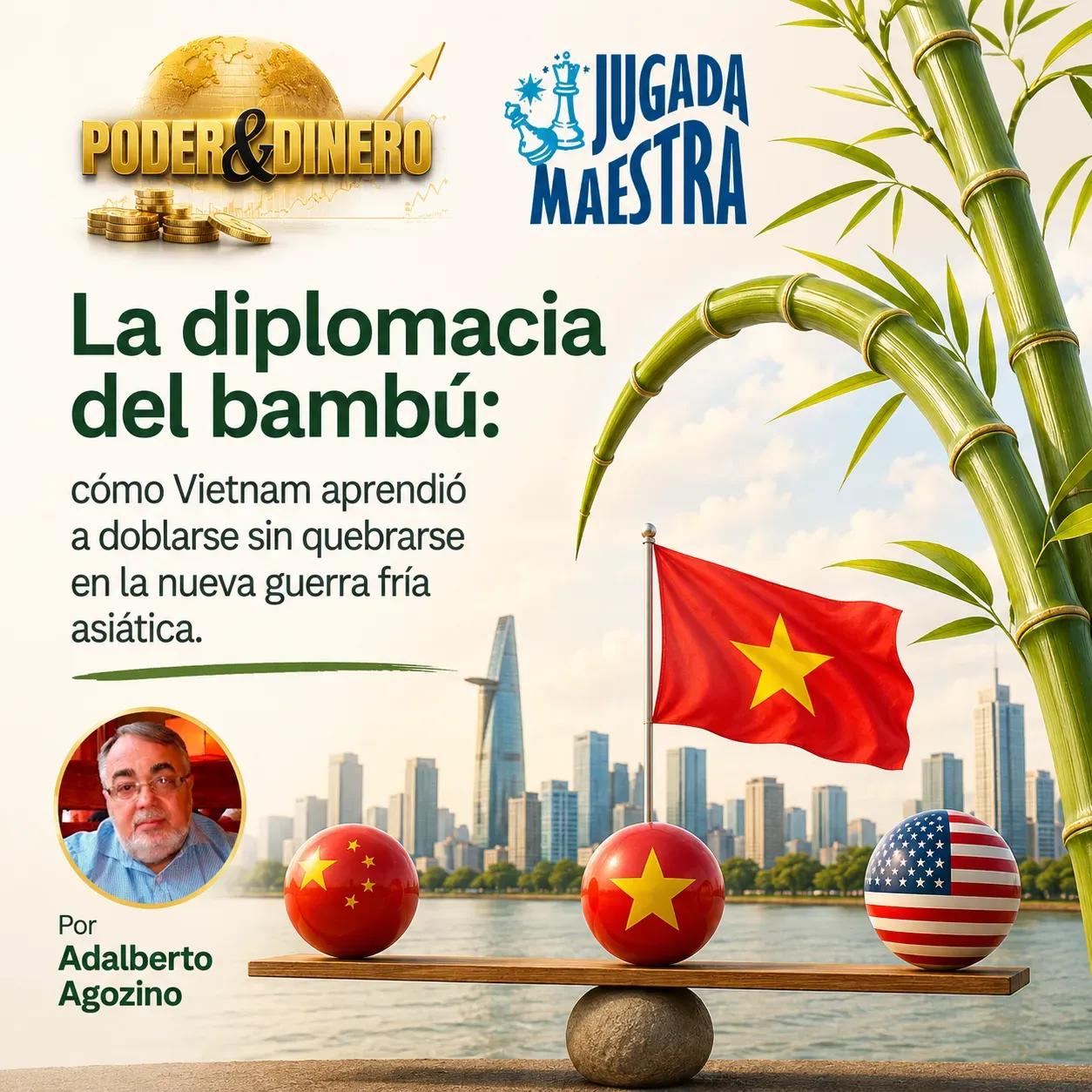
For much of the 20th century, Vietnam was synonymous with war, resistance, and revolution. First, it fought against French colonialism, then against the United States, and later resisted the Chinese invasion of 1979. Today, however, the Socialist Republic of Vietnam is experiencing a very different story. Transformed into one of the most dynamic economies in Asia and an increasingly influential diplomatic actor, Hanoi has developed a foreign policy doctrine that seeks to resolve one of the fundamental dilemmas of our time: how to survive among great powers without becoming a satellite of any of them.
The Vietnamese response to this challenge is known as “bamboo diplomacy”, a strategic concept associated with the late General Secretary of the Communist Party of Vietnam, Nguyen Phu Trong, who elevated this metaphor to the rank of official foreign policy doctrine. According to the image used by the Vietnamese leader, the nation must resemble bamboo: having deep roots, a solid trunk, and flexible branches capable of adapting to the strongest winds without breaking.
The metaphor, seemingly simple, encapsulates an elaborate political and geopolitical philosophy. The roots represent the non-negotiable defense of national sovereignty, political independence, and the permanent interests of the Vietnamese state. The trunk symbolizes strategic autonomy and institutional continuity. The flexible branches express the adaptability to changing international circumstances. In other words, Vietnam reserves the right to cooperate with all without fully aligning with anyone.
This doctrine did not arise from nothing. It is the result of centuries of accumulated historical experience. Vietnam has lived much of its existence under the shadow of great empires and regional powers. For over a thousand years, it coexisted with Chinese influence; subsequently, it faced European colonialism; then it was the scene of one of the major confrontations of the Cold War. This historical memory generated a profound national consciousness regarding the need to preserve political independence from any external power.
The intellectual foundations of bamboo diplomacy can also be found in the thoughts of Ho Chi Minh. The Vietnamese revolutionary leader argued that national independence must be combined with a pragmatic openness to the world. His ideas were reinterpreted decades later following the launch of the economic reforms known as Doi Moi in 1986, which gradually transformed a centralized economy into a market-oriented economy without abandoning the political monopoly of the Communist Party.
The fall of the Soviet Union constituted a decisive turning point. Hanoi then understood the risks of excessively depending on a single power. The international isolation that followed the collapse of the socialist bloc forced Vietnamese leaders to completely rethink their international insertion. The Resolution Number Thirteen of the Politburo in 1988 introduced the principle of “more friends and fewer enemies,” laying the foundation for a multidirectional foreign policy that would eventually crystalize decades later in bamboo diplomacy.
The practical application of this strategy can be clearly observed in how Vietnam simultaneously manages its relations with China and the United States. No other country in Southeast Asia faces such a complex challenge. China is Vietnam's main trading partner and shares with it a long land border, an intense economic relationship, and an ideological affinity derived from their respective communist political systems. However, it is also its main strategic competitor due to territorial disputes in the South China Sea.
The United States, for its part, was Vietnam's great military enemy during the war that culminated in 1975. Half a century later, both countries maintain an increasingly close relationship in economic, technological, and security matters. Hanoi views Washington as an indispensable counterbalance to the growing Chinese power but carefully avoids any move that could be interpreted as a formal military alliance against Beijing.
The extraordinary diplomatic skill of Vietnam was demonstrated in 2023. In September of that year, U.S. President Joe Biden visited Hanoi and elevated bilateral relations to the level of Comprehensive Strategic Partnership. Just three months later, Chinese President Xi Jinping was received with identical honors and signed dozens of cooperation agreements. Vietnam managed to deepen its ties with both rival superpowers simultaneously without committing to either of them.
General Colonel Nguyen Chi Vinh summarized this philosophy with a phrase that has become famous: “Vietnam is not neutral; it is independent.” The difference is fundamental. Hanoi rejects the idea of passive neutrality. Its strategy consists of actively engaging with all relevant powers, multiplying economic and diplomatic alliances, and maximizing its maneuvering margins.
The so-called "four no's" policy constitutes one of the fundamental pillars of this approach. Vietnam refuses to participate in military alliances, refuses to align with one country against another, does not allow foreign military bases on its territory, and rejects the use or threat of use of force in international relations. These principles were formalized in the 2019 Defense White Paper and represent the institutional expression of Vietnamese strategic autonomy.
The economic importance of this strategy is also remarkable. Thanks to its ability to maintain fluid relations with rival geopolitical actors, Vietnam has become one of the main destinations for foreign investment in Asia. U.S., Japanese, South Korean, European, and Chinese companies are simultaneously participating in the country’s industrial development. Hanoi has signed trade agreements with both Western economies and Asian blocs led by China, avoiding dependence on a single market.
The result has been spectacular. In just four decades, Vietnam went from being a war-devastated economy to transforming into a global manufacturing platform specialized in electronics, semiconductors, textiles, digital technologies, and industrial exports. The country has successfully integrated into global value chains without relinquishing the internal political control exercised by the Communist Party.
For many international analysts, bamboo diplomacy constitutes one of the most significant diplomatic innovations to emerge in the Global South in recent decades. Professor Kishore Mahbubani has maintained on various occasions that middle and small countries will need to develop sophisticated forms of strategic autonomy to navigate the growing Sino-American rivalry. Vietnam frequently appears as one of the most successful examples of this trend.
Similarly, experts from the Institute of Southeast Asian Studies believe that Hanoi has managed to turn its geographical vulnerability into a strategic advantage. Instead of choosing between China and the United States, it has opted to benefit from both ties while simultaneously strengthening its national capacity.
However, bamboo diplomacy also faces considerable challenges. Tensions in the South China Sea remain a permanent source of friction with Beijing. The war between Russia and Ukraine forced Hanoi to carefully balance its traditional relations with Moscow and its growing ties with the West. Similarly, conflicts in the Middle East have tested Vietnam's ability to maintain balanced positions in increasingly polarized scenarios.
Additionally, there is uncertainty generated by the evolution of the technological competition between the United States and China. Vietnam aspires to become a high-income technological power by 2045, a goal that requires simultaneous access to markets, investments, and technologies from multiple power centers. Any significant fracture in the international system could hinder that objective.
The arrival of To Lam to leadership has also opened a new stage. The leader seeks to accelerate economic modernization, promote digital transformation, develop advanced technology industries, and turn Vietnam into a medium power of global relevance. To achieve this, he needs to preserve exactly what bamboo diplomacy has guaranteed for years: regional stability, access to foreign investments, and strategic autonomy in the face of great powers.
Beyond Vietnam, the significance of this doctrine lies in offering a possible answer to one of the great questions of contemporary international politics. As the rivalry between Washington and Beijing redefines the balance of power in the Indo-Pacific, numerous countries are attentively observing the Vietnamese experience. From Southeast Asia to Africa and Latin America, governments of different political orientations are studying how to preserve margins of autonomy in an increasingly competitive world.
In this sense, bamboo diplomacy transcends Vietnamese borders. It represents the aspiration of middle states not to be mere pieces on a board designed by others. It is the expression of a deeply rooted conviction in Vietnam's history: national survival depends not only on military strength or economic power but also on the ability to adapt to changes without renouncing fundamental principles.
Like the bamboo that inspires its name, Vietnam has learned that sometimes the best way to resist is not to remain rigid in the face of the storm but to bend just enough to survive it. In an era marked by geopolitical uncertainty, that lesson may be more valuable than ever.

Adalberto Agozino is Doctor in Political Science. Professor at the National Gendarmerie University Institute and the National Defense Faculty of Argentina. Director of the Argentine Institute of Geostrategic Studies. Editor of Alternative Press Agency. Expert on Maghreb issues

Comments