The operation in which Nemesio Oseguera, “El Mencho,” leader of the Jalisco New Generation Cartel, was killed, was presented as a strategic triumph of the Mexican state in cooperation with intelligence from the United States. Although it is quite striking that one of the most wanted criminals in the region was eliminated, for whose capture a reward of 15 million dollars was offered, something very interesting happened afterward.
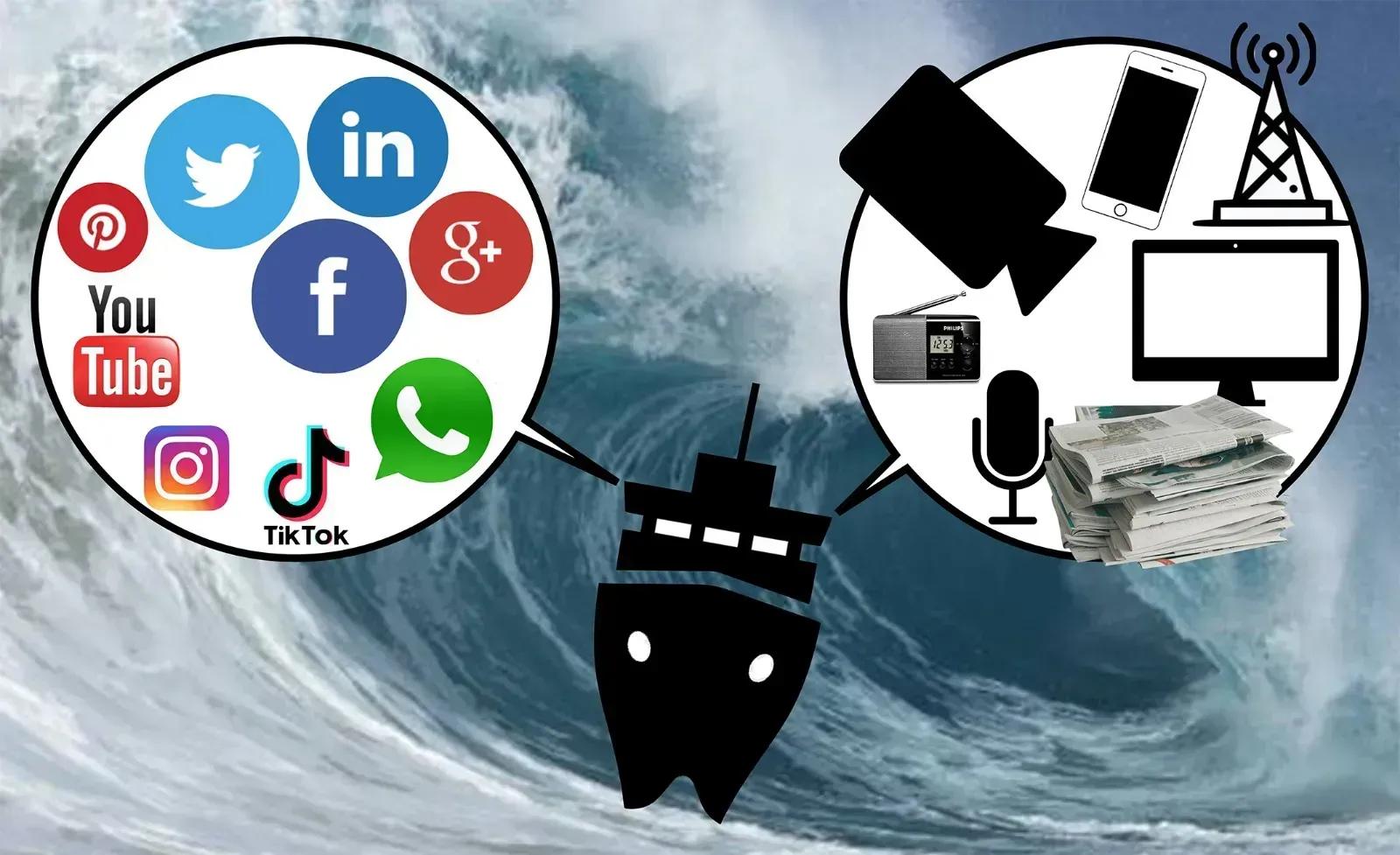
Within hours, social media was flooded with images of chaos: blockades, fires, rumors of cities out of control. Many scenes were real and some, false or exaggerated. The effect, however, was the same: a feeling of fear and a state that had lost control. Organized crime not only disputes territory but also the narrative.
The world is rife with open conflicts and information wars. Just naming two recent cases suffices. The conflict in the Middle East is real, but fake images abound. The dispute in the United States over the restrictive use of Anthropic escalated to the Secretary of Defense, who labeled the company as risky for the supply chain.
It is becoming increasingly evident that power is also played out in the realm of perception. From the monopoly of violence to the monopoly of perception, Max Weber defined the modern state as the institution that monopolizes the legitimate use of physical coercion within a given territory. Carl Schmitt emphasized that the state is essentially defined by its ability to decide on states of exception, that is, in moments of crisis.
If thought around the modern state revolved around the monopoly of force, territorial control, coercive capacity, and clear hierarchies, the contemporary challenge seems to be different. Throughout the 20th century, various authors showed that power is not exhausted in force. Michel Foucault envisioned, alongside coercion, a diffuse power that shapes behaviors and perceptions.
Pierre Bourdieu developed his idea of symbolic power as the capacity to impose a legitimate view of the social world. And Manuel Castells described power over communication in the digital age. Territorial control vs. interpretation. Today, many criminal organizations also operate as narrative producers.
They do not need to control every street to project power; it is enough for them to install the idea that they could do so. The subsequent reaction to the operation in Mexico displayed that logic. Networks and disinformation, mixed with real scenes of chaos, sought to amplify fear and erode the state's capacity to maintain order.
In the digital age, power is not only occupied; it is communicated, interpreted, and contested in real-time. Contemporary organized crime operates on various levels. On one hand, it acts socio-economically, as it offers income, belonging, prestige, or protection where the formal market or the state does not generate sufficient opportunities.
The most novel level is the narrative level, where the naturalization of illegality and the inevitability of violence coexist with the idea that the state cannot cope or that real order is decided elsewhere. And the most visible level is the classic one in security analysis: that of violence, territorial control, and intimidation capacity.
The state measures control in operations, arrests, and square kilometers, behind which lies a conception of power that is merely coercive in the style of the 20th century. Organized crime, on the other hand, aims for control through the alternative provision of public goods (security, medical care) and private ones (jobs), through fear and the circulation of information.
Organized crime does not need to replace the state; it is enough for it to coexist with one perceived as fragile. Argentina and social capture. Looking at what is happening in Mexico does not imply assuming that Argentina is going through the same stage. Organized crime operates in enclaves such as Rosario, some areas of the Buenos Aires conurbation, or certain border regions, and in economic networks where it finds opportunities in ancillary activities: logistics and money laundering.
The country does not currently present, at least for now, cartelized structures with territorial control or violence on the scale of Colombia, Mexico, or Ecuador. Precisely for this reason, the discussion is urgent. Regional experience shows that the problem rarely begins with extreme violence. First, economic networks are woven; then, social capture occurs through employment, belonging, and protection, and only afterward does the open dispute for territory arrive.
The risk today is that intermediate stage: that organized crime silently advances in social legitimacy. In Argentina, institutional decisions can still define the course. The local debate is concentrated on the ideological dichotomy of hardline vs. guaranteeism. A structural prevention requires refined public policies that exceed the punitive realm: financial intelligence, port and logistical control, federal coordination, economic traceability, and focused social policies.
Returning to the realm of ideas, many states continue to think from an industrial matrix based on territory, law, police, and military. In connected societies, where power circulates through networks and narratives, the central dispute is no longer just about who controls the territory, but who controls the perception of who controls it.
In the 21st century, we have left behind the oft-repeated phrase "history is written by the winners." In times when wars and conflicts are also fought in the informational realm in real-time, the dispute for perception becomes even more evident. That is to say: sovereign is he who maintains the monopoly of the perception of control.
Juliana Montani
Holds a degree in Political Science from the University of Buenos Aires (UBA), specializing in International Relations, diploma from the INCAP School of Government. Analyst at the Institute of International Security and Strategic Affairs (ISIAE/CARI).

Comments