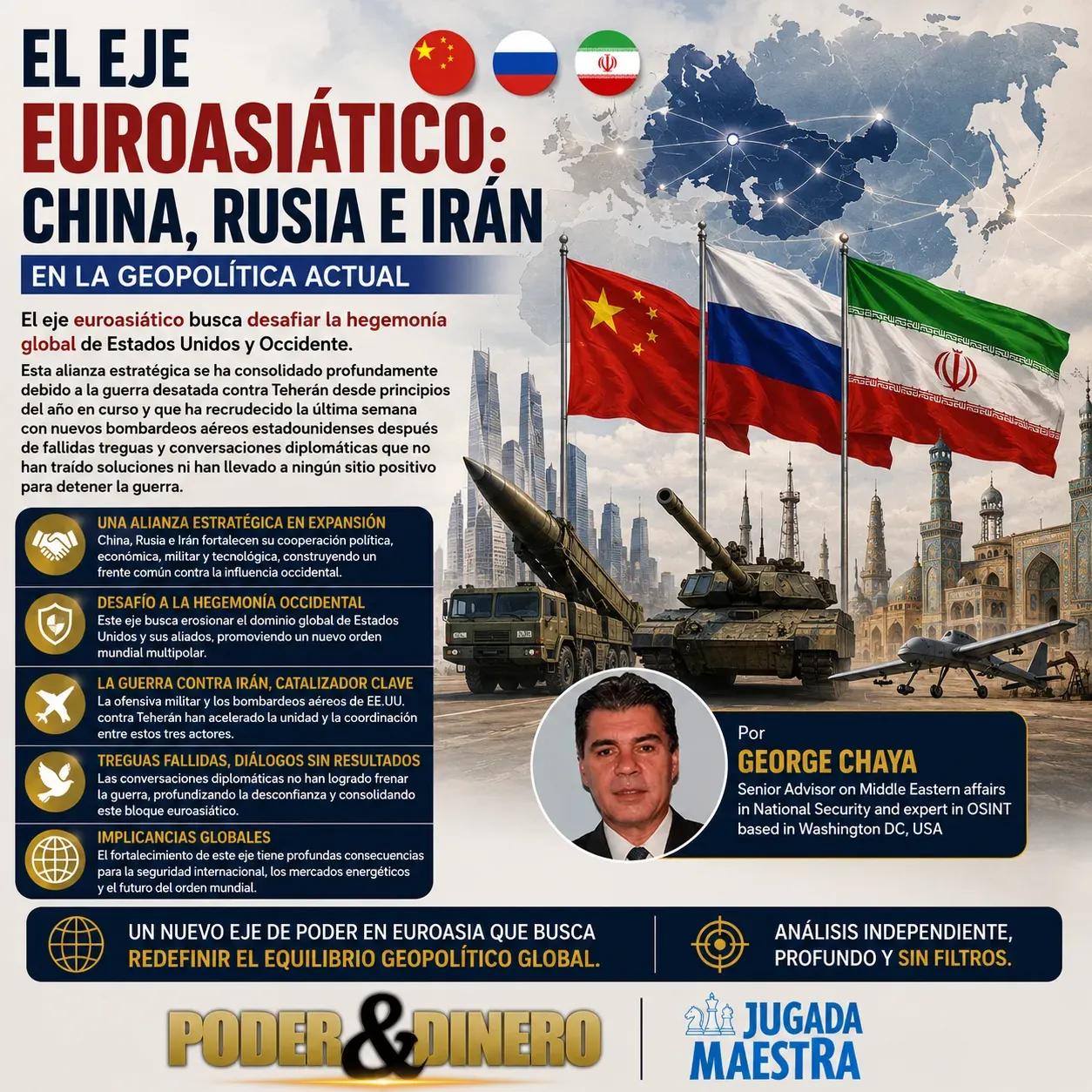
The Eurasian axis seeks to challenge the global hegemony of the United States and the West in general. This strategic alliance has been deeply consolidated due to the war unleashed against Tehran since the beginning of this year, which has intensified in the last week with new U.S. airstrikes after failed ceasefires and diplomatic talks that have not brought solutions or led to any positive outcome to stop the war.
Thus, the perspective expands that the three mentioned countries act under a logic of “successive complementary grievances” against Western sanctions and pressures. In this scenario, China's technical support supplying through its companies dual-use technology, and components for missiles and geospatial intelligence to strengthen Tehran's capabilities has been recognized by Western intelligence agencies.
On the other hand, the Caspian Sea route, used by both Russia and Iran, is the ideal maritime corridor for direct transfer and exchange of weapon systems. According to Ukrainian intelligence, Iran supplies drones and missiles to Moscow to sustain its war over Kyiv via this maritime route, while Moscow reciprocates by sending advanced defensive systems.
The significant role of multilateral platforms helps the three countries coordinate their agenda through blocs such as the Shanghai Cooperation Organization and what remains of the BRICS group, whose aim remains to advance in global de-dollarization processes. The Islamic Republic of Iran is essential for the viability of the Chinese initiative of the Belt and Road for the development of the North-South International Transport Corridor driven by Russia. Hence the constant Tension in the Strait of Hormuz where the alliance closely monitors instability in that strategic energy maritime passage, where Iran has imposed and is trying to maintain military control against U.S. CENTCOM.
The impact of this scenario on Latin America is constituted in joint operations in key sectors; China does so through investments in infrastructure, Russia focused on misinformation and private technological assistance aimed at gathering and distributing information, and Iran through alternative financial networks in countries such as those known as the Triple Frontier (Brazil, Paraguay, and Argentina) and currently also with Nicaragua.
The big question is how the relationship of the three with the United States will end in the short term. In the short term, the relationship of China, Russia, and even Iran with the United States will not have a definitive “end,” but it is very possible that it will be structured under a tense dynamic of military containment, forced negotiations, and extremely fragile ceasefires destined to fail.
However, the Donald Trump administration seeks to avoid absolute wear on multiple fronts and continues prioritizing direct diplomacy and economic benefit. Thus, the immediate outlook for each of the three countries is divided as follows: Iran with an unstable ceasefire and low-intensity war. A final pact to end the war in 2026 seems complex; the formal relationship is governed by a ceasefire constantly violated and by the continuity of hostilities despite transitional agreements, and bombings on Iran persist intermittently in the Strait of Hormuz. Iran continues to attempt to impose fees and control maritime traffic, which generates surgical reprisals from the U.S. air and naval forces.
In summary, in the short term, the United States will attempt to keep China under a controlled economic competition scheme, freeze the conflict with Russia through lengthy negotiation tables in Europe, and militarily contain violent outbreaks from Iran without completely breaking the fragile diplomatic channels established.
Professor George Chaya is a Senior Advisor on Middle Eastern affairs in National Security and expert in OSINT based in Washington DC, USA.

Comments