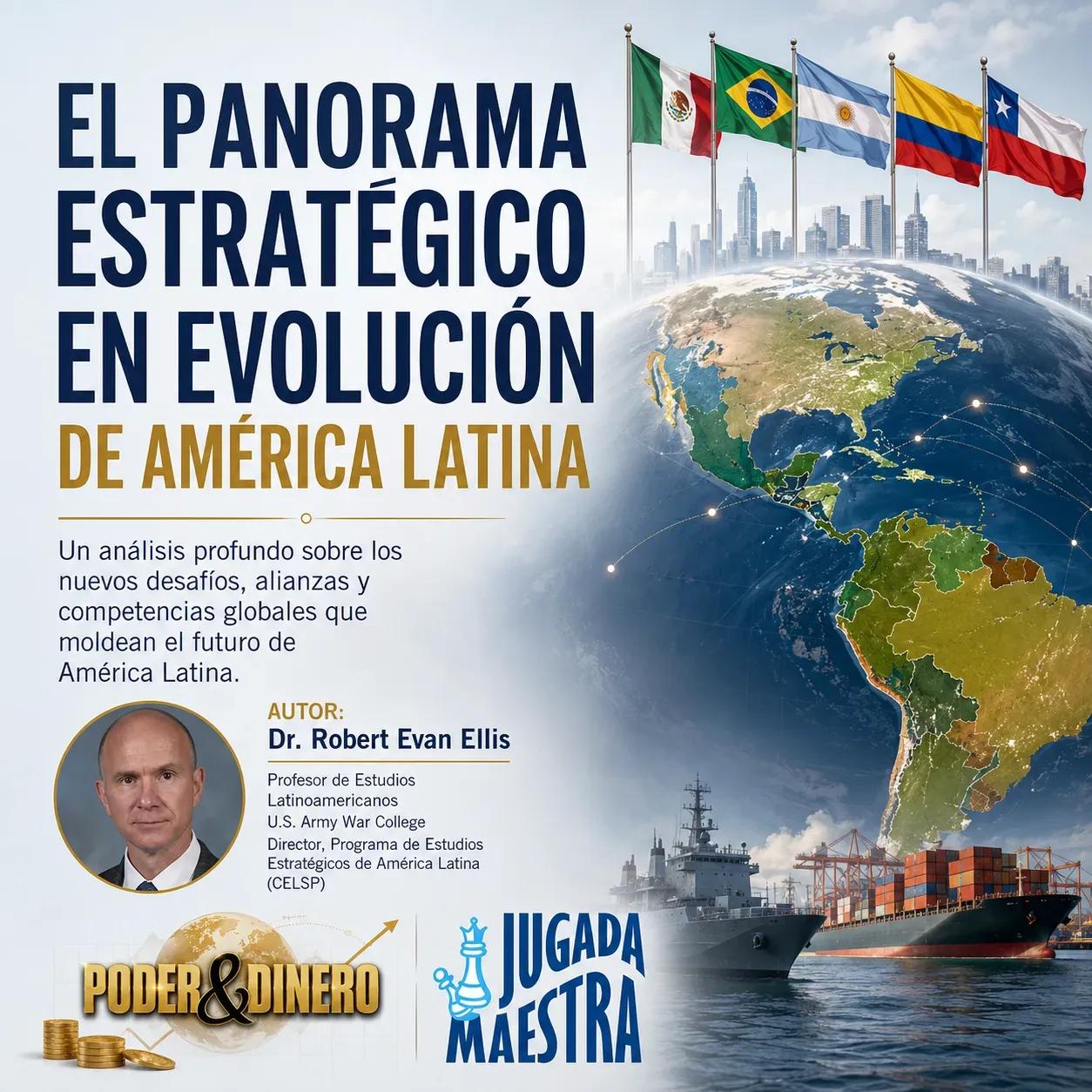
Latin America and the Caribbean are the regions that most directly impact the security and prosperity of the United States, both positively and negatively, through the flow of people and goods. This interdependence includes supply chains that are fundamental to the U.S. economy and its global competitiveness, but also potential threats such as drug trafficking, other criminal activities, and the access of U.S. geopolitical adversaries—such as the People's Republic of China (PRC)—to the region.
Currently, a large majority of Latin American countries are willing to work with the United States on security and other matters of mutual interest. Many of them have even partially reduced their security cooperation with the People's Republic of China and limited collaboration in other sensitive areas in response to pressure from Washington.
However, behind this apparent willingness to cooperate, the region today faces a dangerous convergence of tensions that threatens to weaken its political stability, erode its traditional favorable orientation towards the United States, and reduce the constraints on deepening ties with Washington's strategic adversaries.
Democracy, China, and the United States
A new regional survey, called "AMLAT Radar", reveals that just over half of Latin American citizens consider it acceptable to stray from democratic processes if non-democratic alternatives promise to more effectively resolve the structural problems facing their countries.
For decades, the population of the region has been losing confidence in their governments' ability to address fundamental issues like corruption, insecurity, and the lack of economic and social opportunities.
Similarly, confidence in traditional democratic participation mechanisms has also deteriorated due to the impact of social media and artificial intelligence.
The growing use of platforms like TikTok, WhatsApp, and Instagram as primary sources of information has contributed to creating an increasingly fragmented and polarized information environment, where people consume news tailored to their own biases and interests. At the same time, the rapid development of artificial intelligence deepens the already existing difficulty in distinguishing between what is true and what is false.
Ambiguous perceptions of democracy in Latin America also seem to have been reinforced by the significant changes experienced in U.S. discourse, policies, and actions, historically considered the main reference of the liberal democratic system.
Meanwhile, the People's Republic of China has significantly expanded its trade and economic presence in the region, seeking to position itself as an alternative partner and promoting its concepts of global governance—less interventionist in appearance—as an alternative to the so-called "rules-based international order".
Although most Latin Americans continue to show some skepticism regarding China, at the same time many perceive the economic opportunities that this country offers. As a consequence, the debate about democracy and about the role of the United States in the region has been profoundly influenced by the image of the so-called "Chinese model".
This model seems to offer economic growth, administrative efficiency, and political stability, although it does so at the expense of individual rights and freedoms through an authoritarian system supported by advanced control technologies.
Reflecting this change in perception, the AMLAT Radar survey shows that, for the first time, China surpasses the United States as the preferred development model among Latin Americans.
36% of respondents consider China to be the best example of development, seven percentage points more than in the survey conducted in 2022, while the preference for the United States dropped thirteen percentage points.
In terms of trade, 49% of participants consider China to be the best economic partner, compared to just 26% who choose the United States.
The difference is even more pronounced in the technology sector: 67% identify China as the best ally for the development of digital technologies, while only 19% opt for the United States.
Even in the field of educational and cultural cooperation—traditionally considered one of the main instruments of U.S. "soft power"—40% of respondents point to China as the preferred partner, while only 18% choose the United States.
Beyond the debate on democracy and the strategic competition between Washington and Beijing, the war in Iran has also begun to exert pressure on Latin America through rising international oil prices.
Net fuel-importing countries, especially those in Central America and much of the Caribbean, are among the most affected.
The rise in fuel prices particularly harms truckers and taxi drivers, who have to face these increased costs directly, while also raising household energy expenses due to the rising costs of gas and heating fuel.
In countries like Chile and Bolivia, the situation has worsened due to the recent removal of fuel subsidies implemented by previous governments, precisely at a time when international prices are rising again.
As already happened after Russia's invasion of Ukraine in 2022, these increases have begun to generate social protests in various countries in the region.
Transnational Organized Crime
Complementing economic instability and other destabilizing factors, transnational organized crime (TOC) has become one of the main elements undermining both government stability and citizens' trust in Latin American democracy, mainly by fueling corruption and public insecurity.
The corrosive effect of organized crime is not limited solely to drug trafficking. It also includes the lucrative economies derived from illegal mining, human trafficking and smuggling, extortion, as well as other activities developed by criminal organizations.
There are also less visible crimes—such as illegal logging and the clandestine trade of exotic flora and fauna species—that play an important role within the region's illicit economies.
The explosion of cocaine production in Colombia, particularly during Gustavo Petro's government, has had repercussions throughout Latin America.
This increase has favored the expansion of drug trafficking routes through Venezuela, Ecuador, Mexico, Central America, and the Caribbean.
At the same time, cocaine produced in Colombia, Peru, and Bolivia, along with synthetic drugs such as methamphetamines, flows increasingly towards markets in Europe and Oceania, where selling prices are considerably higher.
The expansion of these markets has strengthened drug trafficking routes from South America to Europe and Asia, attracting a wide variety of international criminal organizations.
Among them are Mexican and European facilitators, as well as major South American organizations like the First Command of the Capital (PCC), the Red Command (CV), and numerous associated gangs, alongside violent local organizations.
The consequence has been an increase in corruption, a greater struggle for control over drug trafficking routes, and rising violence in various regions of South America that often receive insufficient attention from Washington.
Although U.S. military actions succeeded in removing Nicolás Maduro from power in Venezuela, criminal networks linked to drug trafficking, illegal mining, human trafficking, extortion, and other illegal activities continue to operate.
Permanent interdiction operations conducted by the United States in the Caribbean and the Eastern Pacific—which at the time of writing this article had destroyed 50 vessels used for drug trafficking and caused 186 deaths—have significantly reduced these activities.
Nevertheless, trafficking has simply changed routes.
Currently, a significant part of these operations has moved through more southern corridors, crossing through the interior of Venezuela, Colombia, Brazil, Peru, Bolivia, and Argentina, before heading towards Europe.
Likewise, although U.S. actions and greater control of the southern border have contributed to reduce overdose deaths in the United States, shipments of fentanyl and other synthetic drugs continue to supply European and Oceanian markets.
Migration
The exodus of approximately nine million Venezuelans has generated enormous social pressures on the countries that have received them, including Colombia, Ecuador, Peru, Chile, and various Caribbean nations.
There are no near prospects that the political conditions in Venezuela will allow the mass return of these migrants.
At the same time, the ongoing crisis caused by gang territorial control in Haiti, along with the strong economic pressure exerted by the United States on Cuba, continues to represent a significant risk of new waves of migration from both countries, impacting the Caribbean and the rest of Latin America.
Technology and Cryptocurrencies
Technological advancements and the emergence of new networks used by criminal organizations have further increased the challenges faced by the region.
Among these innovations stands out the growing use of cryptocurrencies.
Although technically the operations conducted through digital assets can be tracked, doing so requires specialized technical capabilities and resources that most Latin American police agencies still do not possess.
Similarly, the growth of trade and financial flows between Latin America and China creates new opportunities for money laundering.
This represents a significant challenge for financial intelligence units and other agencies tasked with combating organized crime, due to the little knowledge and limited access they have regarding banks and companies based in the People's Republic of China.
Criminal organizations also show troubling innovations in the use of unmanned vehicles (drones).
Initially employed for surveillance tasks, they are now also used to transport illicit goods and even to execute lethal attacks against both rival organizations and against police and military forces in countries like Mexico and Colombia.
The growing availability of high-capacity commercial drones manufactured in China—especially by companies like DJI—adds to the dissemination of knowledge acquired during the war in Ukraine regarding the military use of these systems.
In fact, some Latin American criminal organizations have sent members to that conflict in order to gain experience in the tactical handling of drones.
As a consequence, Latin American authorities face increasingly greater losses, while their ability to respond effectively remains limited by budgetary constraints, complex bureaucracies, and the slow incorporation of costly anti-drone systems, as well as by difficulty adapting their operational doctrines to an environment characterized by the massive use of unmanned aerial vehicles.
About the Author
Dr. R. Evan Ellis is a Latin America Research Professor at the U.S. Army War College, one of the leading academic institutions of the United States Army dedicated to studying strategy and international security.
He is internationally recognized as a specialist in:
Relations between Latin America and China.
Hemispheric security.
Transnational organized crime.
Geopolitics of the Western Hemisphere.
Defense and military cooperation in Latin America.
He has published numerous books and articles on the growing presence of China in Latin America, the impact of organized crime, and the evolution of the regional strategic environment.

Comments