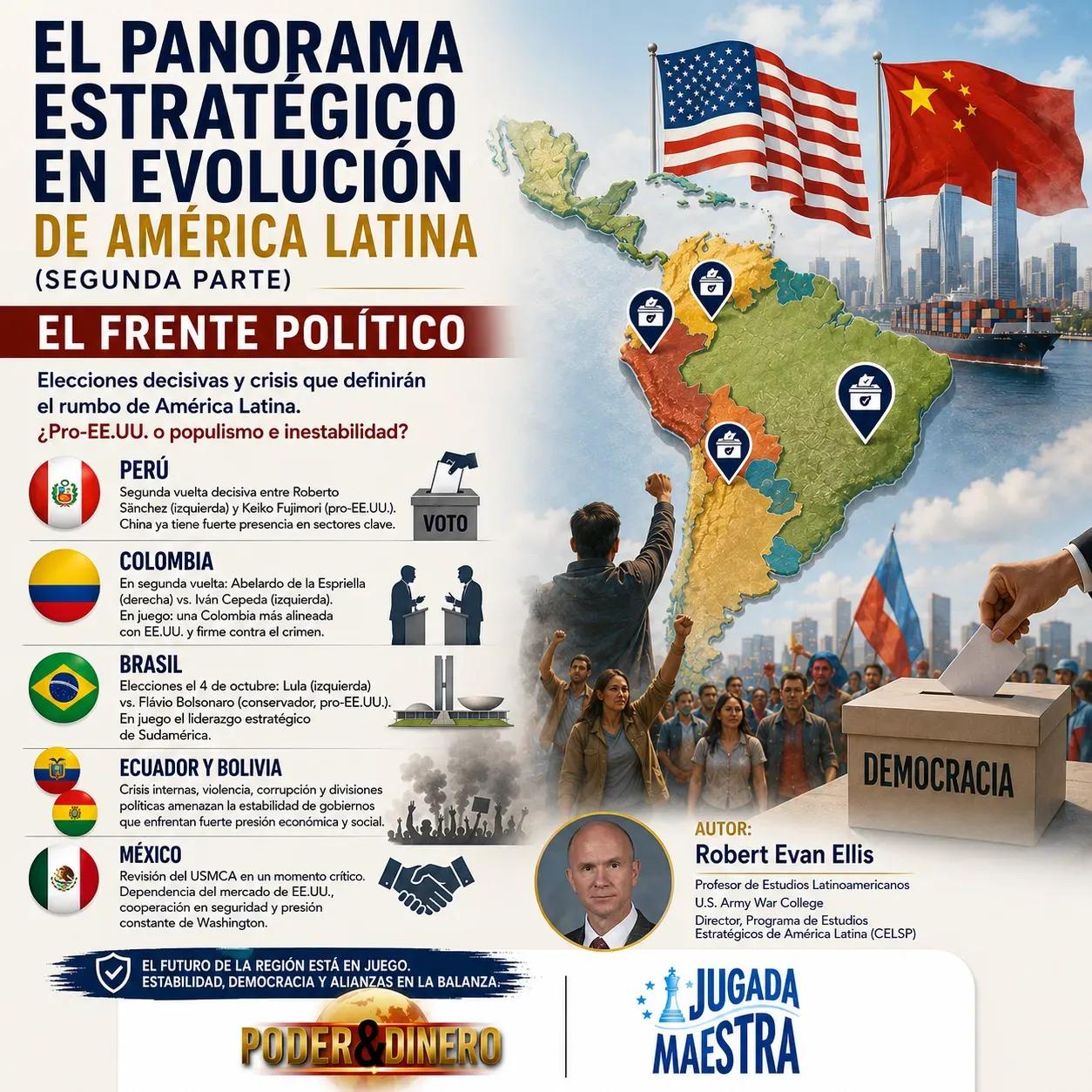
The political front
In the political arena, several strategically key countries in the region are facing very tight elections and/or crises that could determine whether they maintain a favorable orientation toward the United States or, conversely, evolve towards populist or dysfunctional governments.
Peru
The leftist candidate Roberto Sánchez unexpectedly secured second place in the first round of the elections on April 12, which forced a vote recount and generated concerns among right-wing sectors about possible electoral manipulation.
The result of the second round, held on June 7 between Sánchez and the pro-American conservative candidate Keiko Fujimori, will have a profound impact on the country's direction. China already has a significant presence in sectors like ports, mining, telecommunications, and other strategic areas, while governance continues to be severely affected by coca crops, illegal mining, extortion, and violence from criminal organizations.
Colombia
On May 31, during the first round of presidential elections, voters selected the right-wing candidate Abelardo de la Espriella to contest the second round on June 21 against Iván Cepeda, representative of the Historical Pact, the movement of leftist leader Gustavo Petro.
De la Espriella achieved a better result than the polls anticipated. If he succeeds in defeating Cepeda in the second round, Colombia will likely adopt a position closer to the United States, accompanied by a more aggressive policy against organized crime and a strengthening of security cooperation with Washington.
Brazil
The elections on October 4 show a statistical tie between the leftist president Luiz Inácio "Lula" da Silva, 80 years old, and Flávio Bolsonaro, conservative and pro-American leader, and son of former president Jair Bolsonaro, who is currently imprisoned.
These elections are particularly relevant for the strategic future of South America, as Brazil accounts for approximately half of the continent's population and land area—bordering all South American countries except two—and has armed forces whose size exceeds that of all other military forces in South America combined.
According to the author, Lula has played a central role in attracting about 40% of Chinese trade and investment in Latin America, in addition to fostering military and space cooperation with Beijing and strengthening coordination with China in multilateral forums such as the United Nations and the BRICS (Brazil, Russia, India, China, and South Africa, later expanded with Egypt, Ethiopia, and Indonesia).
Under his leadership, Brazil has also established itself as one of the most critical Latin American countries of U.S. policies, taking advantage of the autonomy margin provided by its lower dependence on the North American market.
Ecuador and Bolivia
Although neither country will hold presidential elections in the short term, both are going through crises that could jeopardize the continuity of their respective governments.
In Ecuador, the successive states of exception decreed by President Daniel Noboa and his close alignment with the United States have not convinced a significant part of the population that his administration can break the vicious cycle of drug trafficking and gang violence affecting the country.
Additionally, the National Electoral Council has advanced the local election calendar by three months, setting it for November 2026, a decision that could strengthen opposition sectors critical of the United States and politically limit the actions of Noboa's government.
In Bolivia, the recently elected president Rodrigo Paz seems to be losing ground in his efforts to break the cycle of dollar shortages, liquidity constraints, corruption, and social conflicts that have paralyzed the economy.
His own vice president, Edmundo Lara, and the conservative-oriented party headed by Jorge "Tuto" Quiroga have become some of his main adversaries. At the same time, allegations involving ministers from his cabinet are eroding public trust in a government that presented itself as a transparent alternative, increasing the risk that a U.S.-friendly administration may fail to complete its mandate.
Mexico
Although the upcoming elections are still relatively far away, Mexico is going through a decisive strategic moment due to the revision of the United States-Mexico-Canada Agreement (USMCA).
The country's economic and political future is closely linked to that agreement, given that more than 80% of Mexico's exports are destined for the U.S. market.
Aware of this dependency, President Claudia Sheinbaum has maintained close cooperation with Washington, even accepting politically sensitive measures, including the reception of migrants deported from third countries, the deployment of the National Guard to control migratory flows, the extradition of criminals wanted by U.S. justice, and a firmer policy against cartel leaders, such as "El Mencho", head of the Jalisco New Generation Cartel (CJNG).
Additionally, her government imposed tariffs of up to 50% on products from China and other Asian countries, responding to allegations that Chinese companies use Mexico as a platform to enter the U.S. market.
Despite this cooperation, the United States has maintained political pressure, including an accusation filed in April 2026 against the governor of Sinaloa, Rubén Rocha Moya.
The author warns that if the revision of the USMCA fails or if bilateral security cooperation becomes politically unsustainable for Sheinbaum, Mexico could face severe economic deterioration resulting from the loss of privileged access to the U.S. market and a decrease in investments, further weakening the incentives that have sustained bilateral cooperation in security, migration, and policy toward China.
Weathering the storm
Latin America, a fundamental region for the security and prosperity of the United States, continues to face a combination of informational, economic, criminal, and political pressures that mutually reinforce each other.
According to the author, these tensions could reverse the current predominantly favorable orientation toward Washington and pave the way for a much quicker approach to China than many analysts consider possible.
As has happened repeatedly throughout history, Ellis concludes, Latin America ends up asserting its weight when Washington ignores—or fails to adequately understand—the issues affecting its neighbors.
Dr. R. Evan Ellis
Professor of Latin American Research
U.S. Army War College

Comments