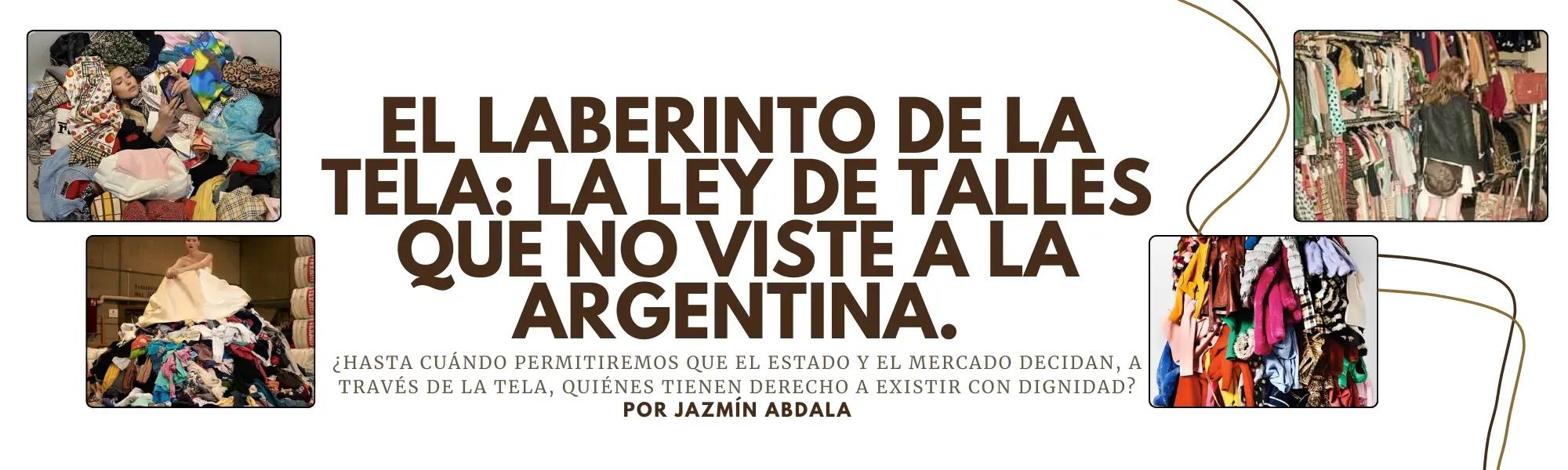
Someone must have slandered Josef K., because without having done anything wrong, one morning he was arrested. The initial sentence of The Trial by Franz Kafka is not a literary relic from the last century; it is the daily chronicle of any Argentine trying simply to cover their nakedness today. In Argentina in 2026, the arrest is not physical, but it is just as suffocating. The system does not lock you in a cell; it confines you to a one-square-meter fitting room, under an inquisitive dichroic light designed to highlight every contour, every mark, every gram of existence that dares to overflow the permitted margins. There, the body is the accused, and the verdict is exclusion. Entering a clothing store today is to submit to a summary trial where the rules are invisible, the judges are marketing managers who never show their faces, and the defense is nonexistent. We are guilty of inhabiting a breathing body that changes and does not shrink before the dictatorship of industrial sizing.
This labyrinth is not a product of chance; it is a perfectly designed architecture of humiliation. Kafka described endless hallways and dusty offices where the law was always a step beyond what could be reached. In our commercial avenues, that unattainable law is called SUNITI (Unified Standardized Clothing Size Identification System). Law 27.521 was a conquest of activism, a promise of bodily citizenship that today languishes in the office of some bureaucrat who decided that our identity can wait. While the INTI and the Secretary of Commerce pass the responsibility back and forth in a ping pong of neglect, the market has established its own aesthetic penal code. It is Foucault's "panopticon" brought to the storefront: we monitor ourselves, we measure ourselves against mannequins of alien proportions, and we punish ourselves when the fabric doesn’t give way. But violence is not just the absence of a garment; it is the nomenclature used to label us as livestock.
The industry has created a semantics of rejection that is, in itself, a manifesto of violence. Up to size 48, the system grants you the status of “normal.” You are a person who deserves to be dressed, someone who fits within the cost structure and the brand’s mystique. But starting at size 50, the language becomes a weapon: you become a “Special Size.” And if your body dares to keep existing up to size 60, you are “Super Special” or “Extra Special.” What is special about having a diverse body? Since when has the right to clothing become a charitable concession for those who have “exceeded” the limit? These labels are not just names; they are walls. They are a form of symbolic apartheid that divides society between those who belong and those who are a technical anomaly, a factory defect that the industry tolerates with disdain. It is the State that, by omission, allows us to be called “special” as if our morphology were a pathology that needs to be treated delicately.
But cruelty reaches its peak when symbolic violence turns into economic violence. There is an unwritten rule, a monetary penalty for every centimeter of fabric that dares to exceed the boundary of size 48. It is the "over-size tax." If you are “special,” you pay the price of your “specialty.” It is extortion: either you pay a premium for the same garment that someone thinner bought ten meters back, or you are left naked. There is no market logic to justify it; the cost of a few extra grams of cotton is negligible compared to the profit margin of the brands. It is a punishment, a fine for not disciplining the body, for not shrinking to fit the mold. It is an abusive practice that violates the "dignified treatment" of the Constitution and the very Law of Sizes, but it is executed in broad daylight with the complicity of a system that looks the other way. How can it be that in a country with advanced laws against discrimination, the price of jeans depends on the width of a hip? It is a form of economic and aesthetic violence that disciplines through the wallet, reminding you with every purchase receipt that your body is an economic burden.
In The Trial, Kafka suggests that justice is not something to be reached, but something in front of which one waits forever. Argentines are in that waiting room, watching how the Anthropometric Study—which has already demonstrated that we are not like European models, that we are shorter and curvier—is ignored by an industry that prefers to keep selling a lie. The sizing policy in Argentina reflects a state neglect that borders on perversity. It is not just that "there is no clothing"; it is that the search for a t-shirt is allowed to become a traumatic experience that erodes the mental health of an entire generation. There is nothing more Kafkaesque than the notion of "one size fits all," that figment which pretends that a single measurement can cover the infinite diversity of a people. One size fits all is the denial of the other, it erases the existence of those who are not the "ideal." It is a tool of social control that tells the young person: "If you don’t fit here, the problem is you, not the garment."
This situation is a breeding ground for shame and self-hatred. While officials email each other about regulations that never arrive, there are teenagers crying in fitting rooms in Palermo or Flores because they feel like their body is a mistake. That tear is a political statement. That frustration is the result of a system that has decided that the profitability of brands is more important than the identity of its citizens. The State is the invisible judge that signs the verdict every time it allows a store not to display the sizing chart or allows a brand to charge an "extra" for a size 54. The impunity with which the textile industry operates is a symptom of a society that still believes that the body is something that must be corrected and not celebrated.
The SUNITI Law should not be a suggestion; it should be the end of impunity. But the law alone is not enough if we do not understand that we are facing a form of systemic violence. Every time we accept that a garment is more expensive for being larger, every time we resign ourselves to buying in "special sizes" stores because in "normal" ones we are looked at with disgust, we are feeding this labyrinth. We are validating that our existence has a surcharge. The pressure felt in the chest when the salesperson says to you, before you even open your mouth, "I have nothing for you," is the exact moment when democracy fails. It is the moment when the citizen realizes they have no rights at the counter.
Kafka ended his novel with the execution of Josef K. "like a dog," with shame surviving him. We cannot allow shame to be the feeling that survives our consumer experience. Textile exclusion is an open wound in the social contract. It is not a matter of fashion; it is a matter of power. It is deciding who has the right to walk the street with dignity and who must hide under garments they did not choose, simply because they were the only ones that "fit." State neglect is, at its core, a form of bodily censorship.
Today, in front of the fitting room mirror that serves as a court without appeal, in front of the labels that call us "special" to remind us that we are outcasts, and in front of the prices that sanction us for every centimeter of flesh, one must ask: How long will we accept that our identity is a variable for adjustment in a company's balance, and how much longer will we allow the State to be the silent accomplice that lets us die of shame in the labyrinth of fabric?
Bibliography and Sources:
I. Literary and Theoretical References
Kafka, Franz (1925). The Trial (Der Prozess). A fundamental work for analyzing bureaucracy, alienation, and the vulnerability of the individual before invisible and arbitrary power systems.
Foucault, Michel. Discipline and Punish. (As a theoretical support on the "disciplining of bodies" and how institutions—in this case, the fashion industry—seek to normalize and standardize the human body).
II. Regulations and Official Data (Argentina)
National Law 27.521. Unified Standardized Clothing Size Identification System (SUNITI). Passed in 2019 and regulated by Decree 375/2021.
National Institute of Industrial Technology (INTI). Results of the First Argentine Anthropometric Study (EAAr). Statistical data on the actual body dimensions of the Argentine population obtained through 3D scanning.
Secretary of Commerce. Current resolutions regarding the implementation of sizing charts and the regulation of dignified treatment of consumers.
III. Civil Society Research
AnyBody Argentina (2022). Clothing Sizes Survey in Argentina. Annual report revealing that 70% of the population has difficulties finding clothing and analyzing the psychological impact of exclusion.
Bellamente Foundation. Documentation on “Aesthetic Violence” and how beauty standards and lack of sizes affect the mental health and body image of youth.
IV. Investigative Journalism
Figueroa, Gimena (2024). "There is a law, but more than 70% of Argentines cannot find sizes in stores: why it is 'stalled'." Published in El Destape. (Key source for understanding the current conflict between the INTI and Consumer Defense).

Comments