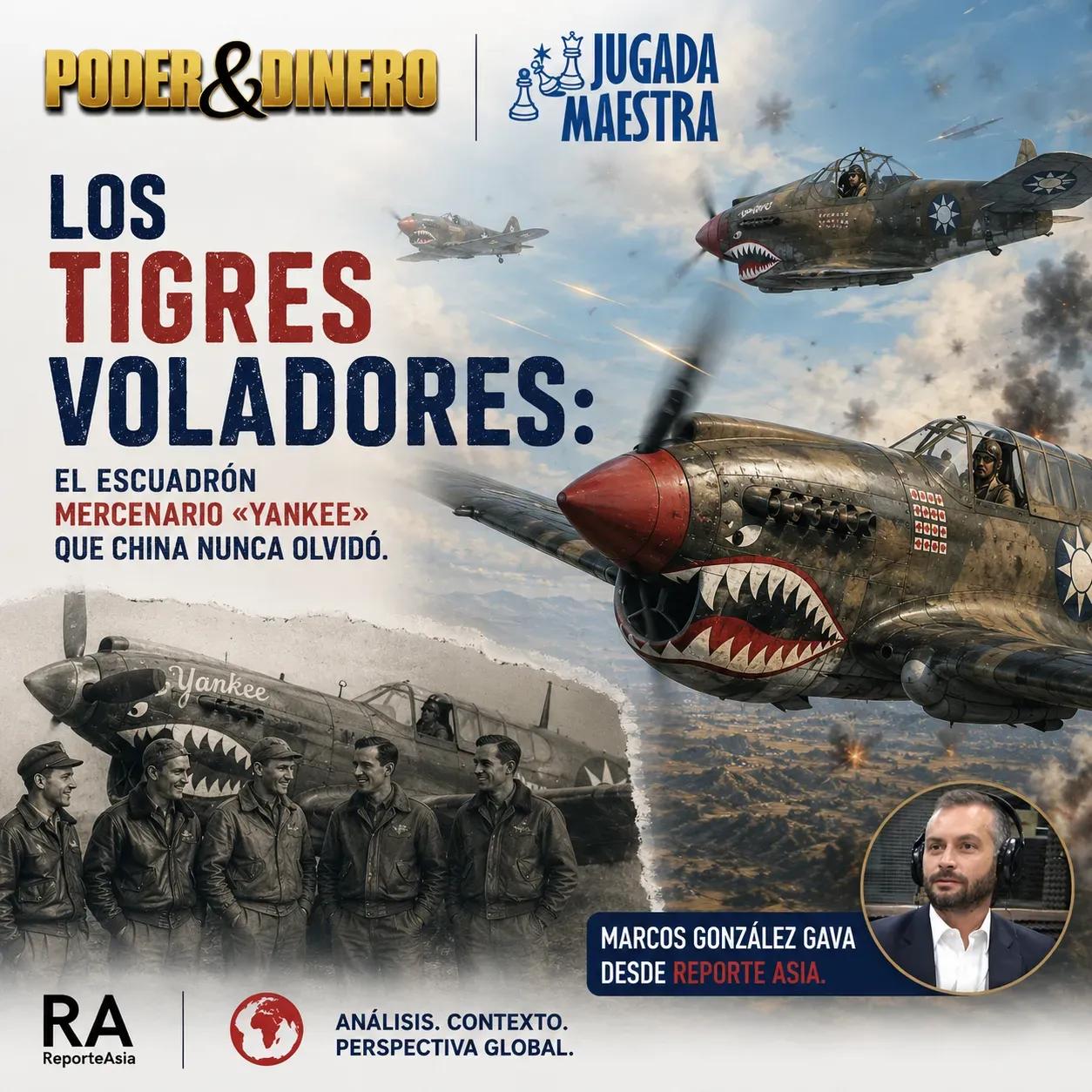
Seventy years after its dissolution, the tactics and lineage of the American Volunteer Group (AVG) continue to thrive in the United States Air Force.
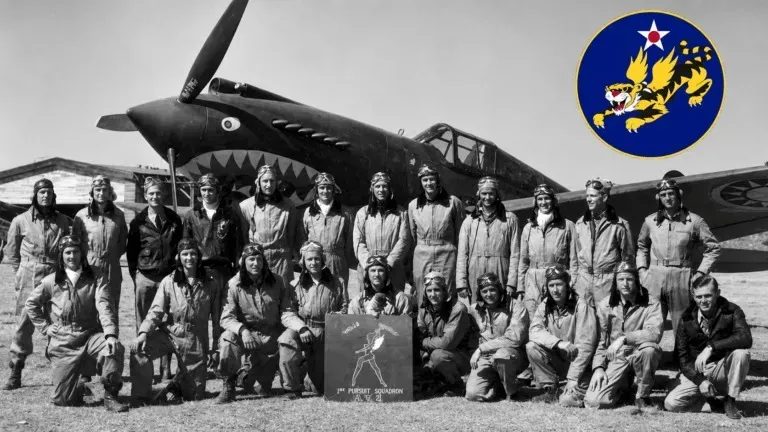
Before Washington officially entered World War II, a group of American mercenaries was already fighting in the skies of Asia under the Chinese flag. The First American Volunteer Group—renamed by the Chinese as “Flying Tigers” (飛虎隊) after their first victory in combat—became one of the most curious anomalies of the conflict: civilian pilots, hired and paid by the government of Chiang Kai-shek, operating aircraft with shark teeth painted on their fronts.
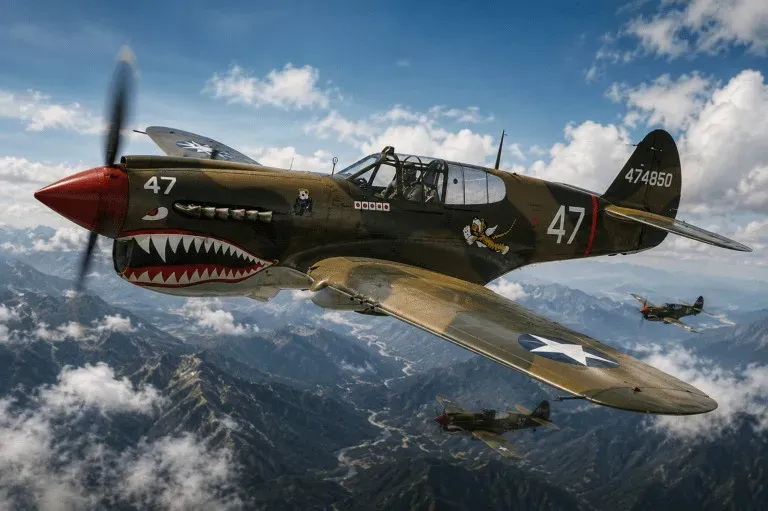
The arsenal of the American Volunteer Group (AVG) was dominated by the Curtiss P-40B Tomahawk.
Mercenaries with civil passports
The legal status of the group was, in itself, a piece of diplomatic engineering. The pilots came from the Army, the Navy, or the Marine Corps, but each had to resign from their service to join as civilian contractors for the Central Aircraft Manufacturing Company (CAMCO), a nominally Chinese firm that actually operated as a front to channel recruitment.
The contract did not mention the true purpose of the hiring or that CAMCO acted as an agent for the Chinese government; during their service, none of them were members of the U.S. or Chinese armed forces, and they were not subject to the discipline or jurisdiction of those armies' courts-martial. This scheme allowed Washington to officially maintain its neutrality— the U.S. had not yet entered the war— while its pilots fought nonetheless, now without uniform or active rank.
When the Army and Navy refused to release pilots to serve in China, the management reached up to the Secretaries of War and the Navy, who finally authorized CAMCO to recruit directly at U.S. military bases.
How it worked and who stood out
The pilots of the Flying Tigers received a generous base monthly salary from the Chinese government of between 600 and 750 dollars (depending on their rank as flight or patrol leaders), but the real incentive was a bonus of 500 dollars for each Japanese aircraft destroyed (equivalent to almost 11,000 dollars today), a fortune that greatly motivated legendary combat aces like Robert Neale (the group's top scorer with 13 confirmed victories), David Lee "Tex" Hill, and Charles Older, who led the three squadrons of the AVG (Adam & Eves, Panda Bears, and Hell’s Angels).
The original group consisted of a total of 311 official members hired over its year of existence (1941-1942). This covert force was made up of 100 pilots secretly recruited from the various branches of the U.S. Armed Forces (60 from the Navy and the Marine Corps, and 40 from the Army Air Corps) along with about 200 ground staff members dedicated to engineering, armament, administration, and medical services, a team that also included two American women and a select group of eleven Chinese-American specialists.
The aircraft used
The AVG's arsenal was dominated by the Curtiss P-40B Tomahawk, supplemented at the end of the campaign by the improved P-40E Kittyhawk, a robust and heavily armed fighter that became the emblem of the Flying Tigers.
Beyond this legendary combat fighter, the group operated a very small number of Curtiss CW-21 Demon interceptors that suffered early failures, used Republic P-43 Lancer aircraft for high-altitude photographic reconnaissance missions, and relied on transport twin-engine aircraft like the Douglas C-47 Skytrain for logistical transfer of mechanics, spare parts, and vital supplies between their bases in Burma and China.
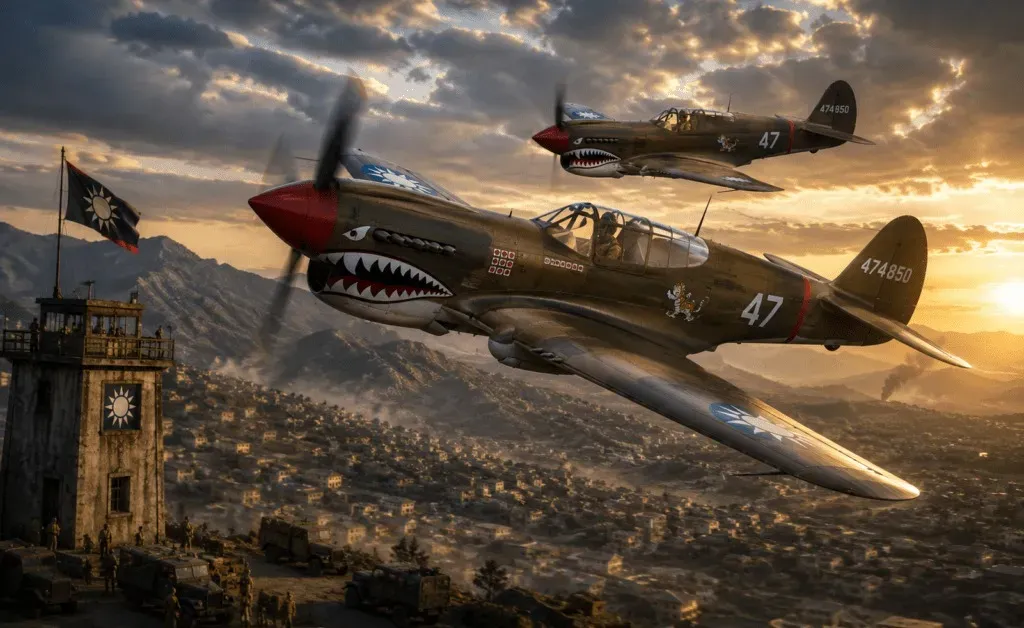
Before Washington officially entered World War II, a group of American mercenaries was already fighting in the skies of Asia under the Chinese flag.
A baptism of fire with time running out
On December 20, 1941, just twelve days after Pearl Harbor, ten Japanese bombers headed for Kunming without fighter escort, as they had done for a year without real opposition. This time, four P-40 Tomahawks awaited them. The pilots shot down four bombers without losing any of their own aircraft, while the survivors dropped their bombs and returned to Hanoi. It was the group's first combat sortie and sealed their nickname for posterity.
The defense of Rangoon, between December 1941 and March 1942, tested the group under much more adverse conditions: defending the entry port to the Burma Road, the artery that kept the Chinese war effort alive, against Japanese waves significantly superior in numbers. Burma fell just the same, but the aerial resistance delayed the advance and allowed for an orderly Allied evacuation.
The doctrine behind the myth
The true architect of these results was Claire Lee Chennault, a retired military officer from the Army Air Corps whom China had hired in 1937 as an advisor, no less than by by Soong May-ling (also known as Madame Chiang Kai-shek), the wife of the Chinese nationalist leader Chiang Kai-shek, who led the Nationalist Government Aviation Committee.
The American was in charge of evaluating, reorganizing, and training the nascent Air Force of the Republic of China in the face of the imminent Japanese aggression. Chennault had written in 1933 “The Role of Defensive Pursuit,” a manual that would make him a reference for fighter tactics throughout the war.
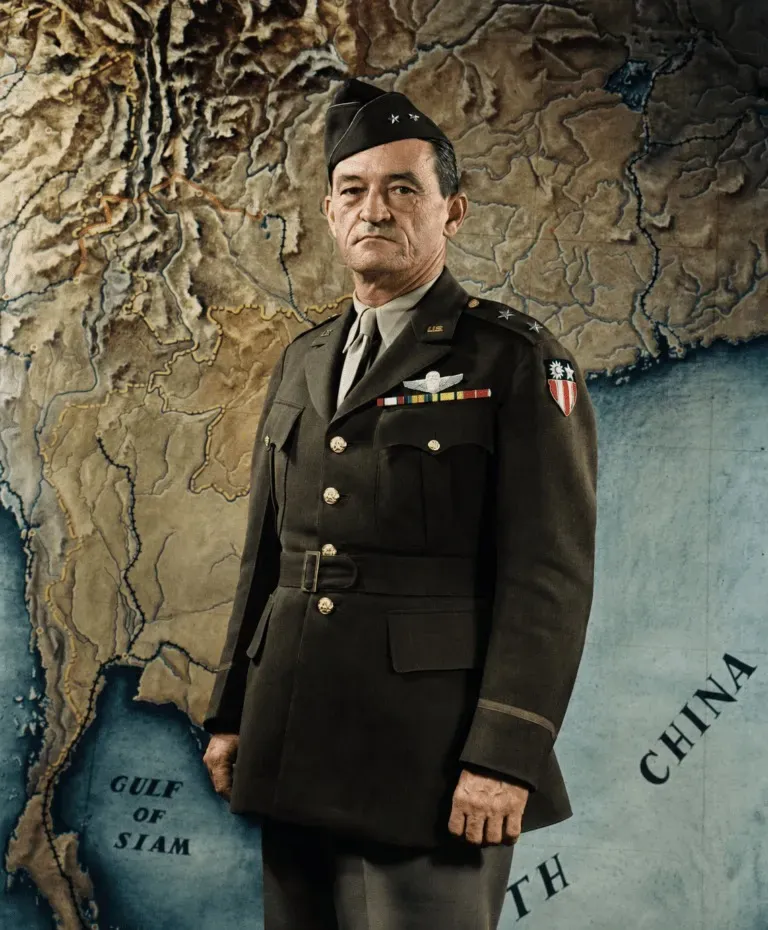
Claire Lee Chennault.
His central contribution was recognizing that the P-40 could not win a close combat against the much more maneuverable Japanese fighters, so he prohibited the traditional “dogfight.” In a traditional close fight, the Mitsubishi A6M Zero was technically far superior to the Curtiss P-40: the Japanese airplane was much lighter, more maneuverable, accelerated quickly, and climbed to great heights with extreme ease.
He therefore ordered to fly in pairs and avoid individual duels against the Zeros and the torpedo bombers "Kate" or Nakajima B5N. His pilots learned to attack in diving runs from above (dive-and-zoom) and then pull away to reposition for a new pass, instead of getting entangled in turns with the enemy.
The Americans took advantage of the armor, weight, and great drop speed of the P-40 to dive from greater heights onto the enemy, firing devastating bursts in a single pass and immediately pulling away using the momentum. These attacks were always conducted in coordinated teams of two aircraft (leader and wingman), ensuring mutual protection and destroying the Japanese formation without giving them a chance to counterattack.
This tactic added a silent yet decisive innovation: a network of ground observers who transmitted in real-time the positions of incoming Japanese aircraft, giving the group early warning that compensated for their numerical inferiority.
This principle—distributed surveillance plus reaction speed—anticipates, in a rudimentary version, the logic of current air command and control systems.
The numbers of a legend
Between December 1941 and July 1942, the AVG claimed the destruction of 296 Japanese aircraft in China and Burma, although the exact figures have been reviewed by historians in recent decades.
The most cited estimates speak of nearly 300 Japanese aircraft destroyed, compared to a loss of only 69 of their own aircraft (and just 14 pilots fallen in combat), a balance that—exact or not—fed the myth almost immediately.
From Chennault to the A-10: a lineage that continues to fly
On July 4, 1942, the group dissolved and was absorbed by the Air Forces of the United States Army as the 23rd Fighter Group.
But that lineage did not remain in the history books: today it is the 23rd Wing, based at Moody, Georgia, the unit that maintains the tradition of painting shark teeth on its aircraft, now applied to the A-10 Thunderbolt II. According to their own mechanics, they are the only ones in the entire U.S. Air Force authorized to apply that design to their aircraft.
The gesture is not just aesthetic. In April of this year, the unit presented an A-10 fully repainted in the historical AVG colors as a tribute to David Lee “Tex” Hill, one of the aces of the original squadron. The non-commissioned officer in charge of corrosion control for the unit pointed out that seeing the modern plane next to the historical P-40 in the base's air park allows for an immediate connection between both eras.
After eighty years since their first combat sortie, the Flying Tigers continue to be synonymous, for China, with an exceptional military cooperation in its history with Washington; and for the U.S. Air Force, a doctrine and an aesthetic that it chose not to let die.
Marcos González Gava is Co-Founder of Reporte Asia, a specialist in financial and commercial business, and cultural affairs of the People's Republic of China.


Comments