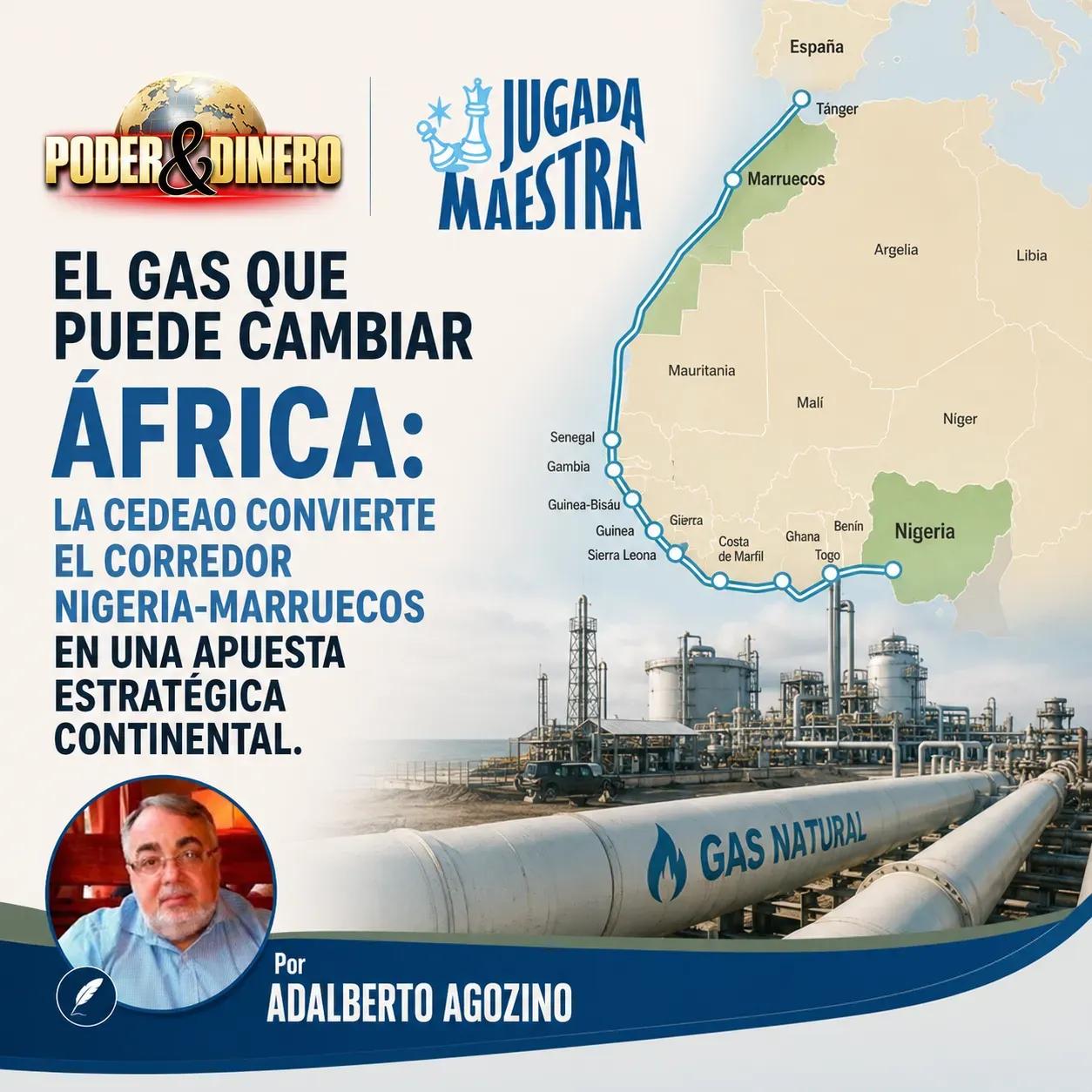
For decades, African economic integration has stumbled upon a recurring obstacle: the inadequacy of infrastructure capable of connecting national markets and transforming the continent's abundant natural resources into a genuine competitive advantage. Nigeria's enormous gas reserves, the energy deficits of several West African countries, and the growing European demand for alternative supplies seemed to form an obvious equation. However, turning that opportunity into a political reality required more than engineering and financing. It necessitated a diplomatic architecture capable of reconciling the interests of thirteen coastal states, several landlocked countries, regional organizations, international financial entities, and national energy companies.
This complex process reached a turning point during the sixty-ninth summit of ECOWAS held in Freetown, Sierra Leone. There, heads of state and government signed the Intergovernmental Agreement that regulates the development of the Nigeria-Morocco Atlantic Gas Pipeline, granting the project institutional legitimacy that far exceeds the technical dimension that characterized its initial phases.
From a strictly legal perspective, the signing establishes the common legal framework for the development of the infrastructure. However, from a political standpoint, it signifies something much deeper. The initiative ceases to be an endeavor promoted exclusively by Morocco and Nigeria to become a project collectively assumed by the main economic integration organization of West Africa. This change substantially alters the international perception of the work and significantly strengthens its credibility with potential financers and investors.
The planned pipeline will stretch approximately 6,800 kilometers along the African Atlantic coast from the gas fields of the Niger Delta to Morocco, crossing thirteen countries before linking with the Maghreb-Europe Gas Pipeline and, from there, with the continental European network. The infrastructure will have the capacity to transport around 30 billion cubic meters of natural gas annually. According to current forecasts, approximately half of that volume will supply both the Moroccan and European markets, while the rest will be allocated to the growing internal consumption of West Africa.
Beyond its physical dimensions, the project constitutes a structural intervention on the regional economy. The stated objective is to create a true integrated natural gas market that facilitates electricity production, stimulates the establishment of energy-intensive industries, and allows for more efficient use of African natural resources. In other words, the pipeline aims to become a catalyst for the industrialization process that many African governments consider essential to reduce dependence on unprocessed raw material exports.
Economy
The countries directly traversed by the pipeline route —Nigeria, Benin, Togo, Ghana, Ivory Coast, Liberia, Sierra Leone, Guinea, Guinea-Bissau, Gambia, Senegal, Mauritania, and Morocco— will be the immediate main beneficiaries. However, the project design incorporates from its outset a significantly broader regional dimension. Through future interconnections, the landlocked states of the Sahel will also be able to access supply, considerably expanding the impact economic of the infrastructure on the entire West Africa.
Precisely this integrative vocation explains the practically unanimous support received during the Freetown meeting. Liberian President Joseph Boakai defined the initiative as “a historic and transcendental advance” that demonstrates the capacity of African nations to prioritize cooperation over political fragmentation. His words reflect a widely shared perception among many African leaders: the true value of the project lies as much in the physical infrastructure as in the model of regional cooperation it represents.
A similar assessment was expressed by Omar Alieu Touray, president of the ECOWAS Commission, describing the Nigeria-Morocco Atlantic Gas Pipeline as one of the most transformative initiatives undertaken by the organization since its creation. In his opinion, the infrastructure will decisively contribute to strengthening energy security, increasing business competitiveness, and consolidating a shared economic future for a population exceeding 440 million inhabitants.
The consensus reached during the summit should not be interpreted merely as a symbolic endorsement. In practical terms, ECOWAS's adherence opens the door to the next phase of the project: the establishment of the company responsible for the construction and operation of the pipeline, which will be based in Casablanca, as well as the creation of a Superior Pipeline Authority, which will be established in Abuja and will assume regional governance of the infrastructure. Both bodies will constitute the institutional core responsible for coordinating future investments, overseeing technical development, and preparing the Final Investment Decision that will allow the execution of the work to begin.
Equally relevant is the fact that the main studies on engineering, environmental impact, and technical feasibility have already been completed. This circumstance considerably reduces the uncertainty associated with large infrastructure projects and positions the initiative to advance toward its operational phase once the institutional procedures provided by the participating states conclude.
Nevertheless, the most significant aspect of the agreement reached in Freetown likely lies in its geopolitical dimension. For years, numerous African integration projects were limited by the absence of effective coordination mechanisms political among various national governments. On this occasion, ECOWAS has chosen to turn the pipeline into a genuine regional policy, granting it a legitimacy that transcends national political cycles and strengthens its long-term stability.
Politics
Specialized analysts agree that this institutional change constitutes one of the main assets of the project. The signing of the agreement by the heads of state themselves —and not merely by sectoral ministers or technical officials— implies a much higher degree of political commitment. In diplomatic terms, this means that the infrastructure becomes part of the strategic integration agenda of West Africa and ceases to depend solely on the will of two promoting governments.
One of the most striking aspects of the evolution of the Nigeria-Morocco Atlantic Gas Pipeline lies in how Morocco has managed to transform a bilateral proposal into a project assumed by the main regional integration organization of West Africa. When King Mohammed VI and then Nigerian President Muhammadu Buhari promoted the initiative during the Moroccan monarch's visit to Abuja in 2016, few analysts imagined that a decade later the project would be institutionally supported by the entirety of ECOWAS.
This evolution was not the result of a single negotiation, but rather of a sustained diplomatic strategy over time. From the first cooperation agreements between Morocco's National Office of Hydrocarbons and Mines (ONHYM) and the Nigerian National Petroleum Company (NNPC), Rabat opted to present the pipeline not merely as a piece of infrastructure intended solely to export gas to Europe, but as a tool to accelerate African industrialization and strengthen regional integration. This narrative allowed for the progressive incorporation of other West African governments, which began to view the project as an opportunity to address structural deficits in energy access and attract industrial investments.
The political continuity of the project is another of the elements that explain its consolidation. After the death of former President Buhari, the new Nigerian leader, Bola Ahmed Tinubu, decided to maintain Abuja's support for the initiative, ensuring that one of the continent's main gas producers continued to be committed to a project intended to modify Africa's energy geography. This continuity has significantly reduced the political uncertainty that usually accompanies large transnational infrastructure projects.
Moroccan diplomacy has also sought to insert the pipeline within a broader vision of continental cooperation. The initiative has been linked with other projects promoted by Rabat to reinforce African Atlantic connectivity, including the so-called Atlantic Initiative designed to facilitate access to the ocean for several Sahelian countries through Moroccan logistical infrastructures. From this perspective, the pipeline ceases to be merely a conduit for transporting hydrocarbons and becomes integrated into a strategy aimed at strengthening regional supply chains, trade, and industrialization.
International relations
The director general of ONHYM, Amina Benkhadra, has repeatedly defended this interpretation. In her view, the infrastructure “embodies Africa's shared ambition to build a more integrated, industrialized, and prosperous continent”, while contributing to improving energy security, creating economic opportunities, and fostering sustainable growth. Her argument reflects a view widely shared by many African leaders, who consider stable access to energy as an indispensable condition for reducing dependence on raw material exports and moving towards economies with greater added value.
The political support received in Freetown illustrates this convergence of interests. The president of Liberia, Joseph Boakai, described the project as a “transformative investment” for the collective future of West Africa, while Ghana's Minister of Foreign Affairs, Samuel Okudzeto Ablakwa, stated that no industrialization strategy can prosper without massive investments in energy infrastructure. Representatives from Sierra Leone, Gambia, and the ECOWAS Commission itself expressed similar sentiments, agreeing to present the pipeline as a tool to strengthen regional cohesion and improve the competitiveness of African economies.
Nevertheless, the project's reach transcends the African sphere. For Europe, which has been undergoing a process of diversifying its energy supply sources for several years, the future connection of the pipeline with the Maghreb-Europe system could open a new supply route from sub-Saharan Africa. Although the first commercial flows will still take several years to materialize, the infrastructure enhances Europe’s strategic options and strengthens Morocco's position as an energy node between the two continents.
The project also carries a significant financial dimension. Its estimated cost is around $25 billion and will require a complex combination of public resources, private capital, and multilateral institutions. Nigeria has committed a significant stake through the NNPC, while various international entities, including the Islamic Development Bank, the OPEC Fund for International Development, the European Investment Bank, and Gulf financiers, have participated in different phases of the preliminary studies or have expressed interest in future financing. This diversity of actors reduces the risk of dependence on a single financier and gives the project a potentially more solid economic base.
Despite the optimism shown during the Freetown summit, many specialists remind us that the real challenge begins now. Constructing almost seven thousand kilometers of infrastructure across multiple jurisdictions will require unprecedented political coordination, high-security standards, and sustained financing mobilization over several years. The maritime areas of the Gulf of Guinea, periodically affected by piracy and organized crime phenomena, also present additional challenges for the future protection of the pipeline. Additionally, there is a need to maintain political cohesion among participating states during an execution process that is expected to last more than a decade.
Politics
Observers also emphasize that the ultimate success will depend less on declarations... policies that have the capacity to materialize the commitments made. The effective creation of the managing company in Casablanca, the establishment of the Superior Authority of the Gas Pipeline in Abuja, the attraction of investments, and the adoption of the Final Investment Decision will be the true indicators of the project's progress over the coming years.
From a geopolitical perspective, the accession of ECOWAS also represents a diplomatic victory for Morocco. Without being part of the regional organization, Rabat has managed to position itself at the center of one of the largest economic integration projects driven by West Africa. This outcome confirms the capacity of Moroccan diplomacy to develop sectorial alliances with the countries of the region through economic and energy instruments, even outside of its still pending application for membership in ECOWAS itself.
Ultimately, the Atlantic African Pipeline symbolizes a deeper transformation than the mere construction of energy infrastructure. The decision made in Freetown demonstrates that a growing part of West Africa aspires to turn economic integration into a mechanism for structural development, supported by major regional projects capable of overcoming the limitations of national markets. If this ambition manages to translate into concrete works, the pipeline could become one of the major milestones of African cooperation in the 21st century. If, on the contrary, financial, technical, or political difficulties delay its execution, the initiative will risk joining the long list of megaprojects conceived to transform the continent that never fully materialized. For now, the signing of the Intergovernmental Agreement by the ECOWAS member states represents, at least, the most solid institutional step taken to date to bring that ambition closer to reality.
Adalberto Agozino holds a PhD in Political Science, is an International Analyst, and a Lecturer at the University of Buenos Aires.

Comments