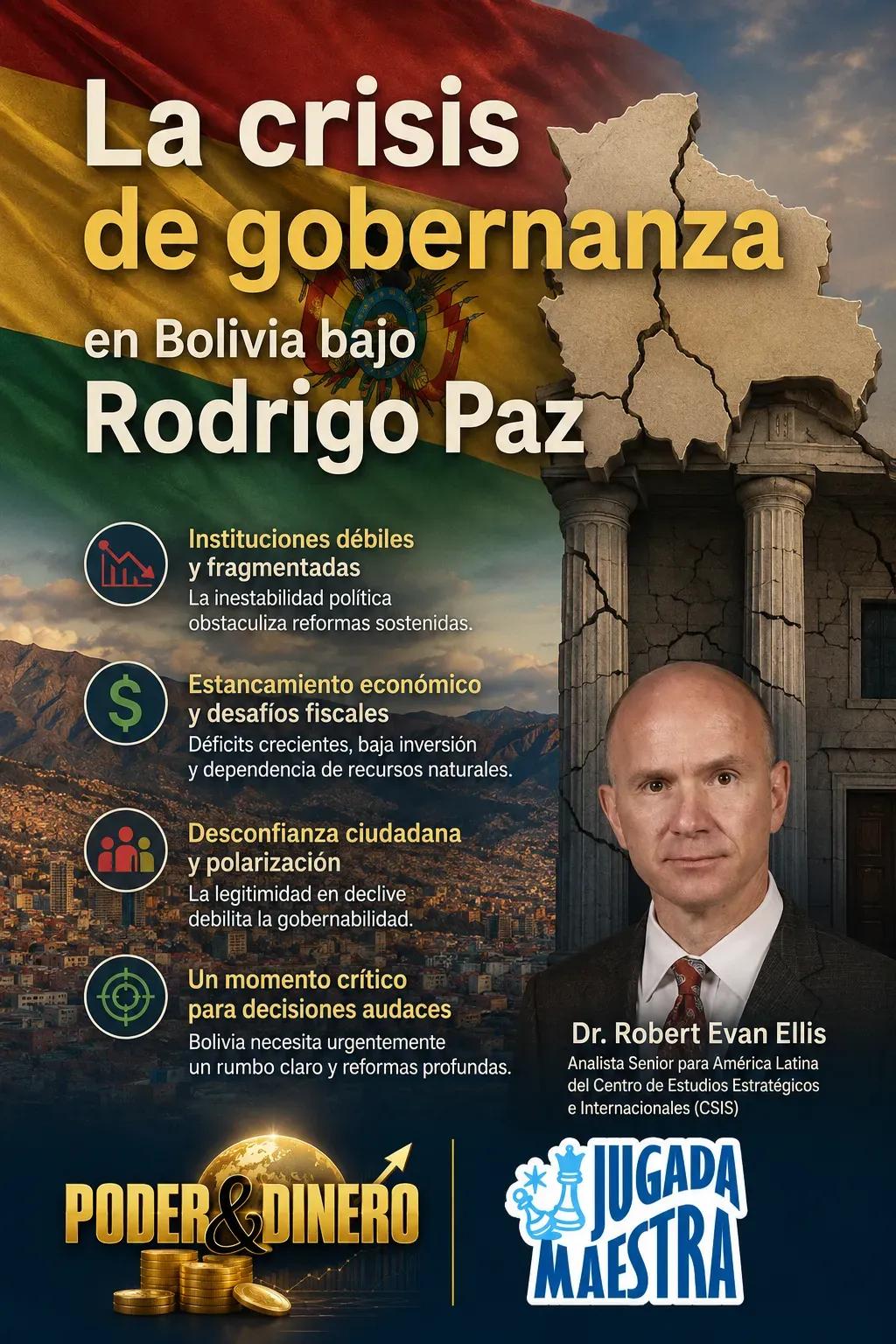
During the last two months, the Bolivian government led by Rodrigo Paz Pereira has had to face a combination of social protests, institutional crisis, and actions by criminal organizations and political actors interested in destabilizing its administration. Although the president will likely manage to overcome the immediate conjuncture, the author warns that political and economic pressure could force him to step down before the end of 2026.
A crisis that transcends Bolivia
According to Ellis, the eventual fall of the government would have consequences that go far beyond the Bolivian borders. Bolivia occupies a strategic position in South America, and institutional deterioration could affect regional security, strengthen transnational criminal organizations, and weaken democratic stability in neighboring countries.
The risk of escalating violence
The report states that one of the greatest challenges for President Paz is responding to protests without provoking a spiral of violence.
The use of the Armed Forces to control social conflict could worsen the political situation, generate new mobilizations, and accelerate a crisis of governance instead of resolving it.
A State under multiple pressures
The author identifies several factors that converge simultaneously:
prolonged social mobilizations;
institutional weakness;
economic difficulties;
political fragmentation;
the presence of criminal organizations capable of influencing the stability of the State.
The combination of these elements makes governance an extraordinarily complex challenge for the Bolivian administration.
The importance of the relationship with the United States
Ellis points out that the Rodrigo Paz government represents an opportunity to rebuild relations between Bolivia and the United States.
From his perspective, political, economic, and technical support from Washington would contribute to strengthening Bolivian democratic stability and would complement other U.S. initiatives in the Western Hemisphere, particularly regarding security and the fight against organized crime.
A strategic opportunity for Washington
The report considers that the Bolivian situation constitutes an important test for U.S. foreign policy in Latin America.
A potential success of the Paz government would demonstrate that close cooperation with the United States could translate into greater institutional stability, economic growth, and democratic strengthening. In contrast, a failure would have geopolitical repercussions that would benefit actors opposed to U.S. interests.
Conclusion
For Dr. Robert Evan Ellis, Bolivia is going through one of the most delicate moments in its recent history. The continuity of the government will depend on its ability to contain social conflict, regain citizen trust, stabilize the economy, and prevent the crisis from leading to a process of political violence.
The author concludes that the outcome of this situation will not only define Bolivia's political future but will also have implications for democratic stability and security across South America, becoming a strategically relevant issue for the United States and the entire continent.
Evan Ellis is a senior (non-resident) associate researcher of the Americas Program at the Center for Strategic and International Studies (CSIS) and a research professor on Latin America at the U.S. Army War College.

Comments