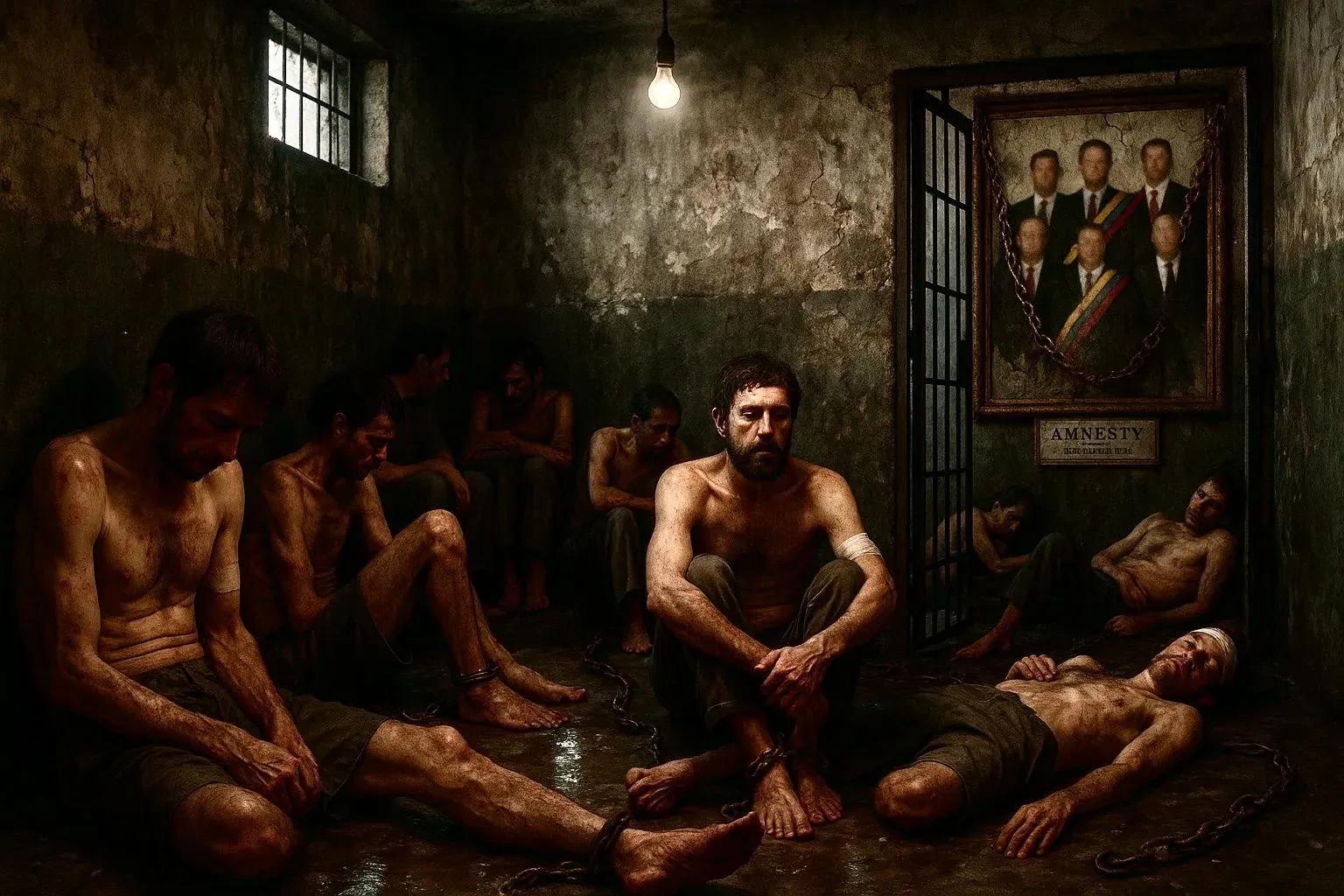
For years, chavismo publicly denied the existence of political prisoners in Venezuela, insisting that it only imprisoned "terrorists" and "criminals." BBC News Mundo recalled this when it reviewed how, after years of denial, the chavista National Assembly itself ended up approving an amnesty law for political prisoners on February 19, 2026. Today, that same power promotes and celebrates a "historic" amnesty law that, according to its official discourse, marks the beginning of an era of peace and reconciliation by releasing hundreds of detainees for political reasons, as noted by CNN en Español in its "key points" report on February 19, 2026.
The National Assembly, still under chavista hegemony, approved the Amnesty Law for Democratic Coexistence, and the Executive hastily enacted it, something reflected in the statement from the National Assembly itself on February 19, 2026, and in the Contrapunto report on its publication in the Official Gazette. However, international media, specialized organizations, and human rights bodies agree that the law is born and will be applied within a justice system controlled by the same power that carried out the repression, which means its real scope will depend less on the text and more on the political will of the regime, as highlighted by CNN en Español, El País, the UN High Commissioner, and Access to Justice. In that context, the amnesty appears as an ambivalent gesture: it alleviates many victims, but preserves the control structure and turns freedom into a political management tool.[bbc +6]
Content and design of the new amnesty law
The Amnesty Law for Democratic Coexistence covers events that occurred between January 1, 1999, and January 30, 2026, that is, the entire chavista period from Hugo Chávez's arrival to power to the first steps of the new stage after Nicolás Maduro's downfall, according to the official project disseminated by the National Assembly and analyzed by El País on February 20, 2026. The project, available on the parliamentary portal, states that its purpose is to grant a "general and full" amnesty to people prosecuted or convicted for political or related crimes, within the framework of episodes of violence and political confrontation, with the declared purpose of "promoting social peace and democratic coexistence," wording cited by both BBC News Mundo and the institutional note of the National Assembly. According to this text and the analyses published by BBC News Mundo (February 19, 2026), CNN en Español (February 19, 2026), and El País (February 20, 2026), the law establishes three central effects: the extinction of criminal, disciplinary, and civil actions linked to the amnestied events; the inclusion of ongoing processes and firm convictions, as well as personal precautionary measures such as the prohibition of leaving the country or the regime of periodic appearances; and the elimination of backgrounds and administrative or police records related to those events, in order to formally clear the beneficiaries' history. In legal terms, it is a large-scale erasure, but the implementation of that erasure is in the hands of courts, prosecutors, and security bodies whose lack of independence has been repeatedly documented by the UN High Commissioner in its statement of February 19, 2026, and by Access to Justice in its analysis of February 20, 2026.
Direct beneficiaries: real scope for prisoners and exiles
Reports from BBC News Mundo (February 19, 2026), CNN en Español (February 19, 2026), and El País (February 20, 2026) agree that the law could benefit hundreds of political prisoners imprisoned in different waves of repression since the early 2000s. Among them are opposition leaders, activists, students, union members, and protesters accused of crimes such as incitement, conspiracy, rebellion, or treason to the homeland, in the context of protests and acts of disobedience against the chavista power, as CNN en Español detailed in its key points note. In addition, the text allows Venezuelans in exile facing arrest warrants or criminal proceedings for political reasons to apply for amnesty, either directly or through legal representatives, opening the door for their return without the immediate risk of detention for those events, as emphasized by BBC News Mundo and El País. From a human perspective, these effects are significant: families that have gone years without seeing their loved ones can hold a founded expectation of reunification, people living under a presentation regime or with travel prohibitions could regain some of their freedom of movement, and politically disqualified figures de facto by the criminal threat could recover, at least partially, their ability to participate in public life. However, these same sources emphasize that the positive impact is conditioned by the way the regime controls the timing and selection of cases, as well as by the maintenance of other persecution tools, such as administrative disqualifications and media criminalization campaigns that El País and CNN en Español document in their February 2026 coverage.
Key exclusions: military, security forces, and "uncomfortable" opponents
The most controversial core of the law is in the article that defines the crimes excluded from the amnesty. CNN en Español, in its analysis of February 19, 2026, summarizes that Article 9 expressly prohibits its application to persons accused or convicted of serious human rights violations, crimes against humanity, and war crimes, in accordance with Article 29 of the Venezuelan Constitution and the standards of the Rome Statute. Also excluded are intentional homicide, certain high-severity crimes, drug trafficking, and psychotropic substances with high minimum penalties, crimes of corruption against public property, and participation in "armed or violent actions" against the country or the population, especially if they involve support or intervention from foreign states or entities, as explained by El País in its piece "who can apply, who is excluded, and how it is applied." In principle, this architecture seems to respect the constitutional and international limits, since neither the Venezuelan Constitution nor international law allows for amnesty for crimes against humanity, genocide, or serious human rights violations; this is reminded by Amnesty International's country report on Venezuela (AMR 53/006/2009) and its statement of July 2025 regarding forced disappearances as crimes against humanity. The problem lies in who qualifies the facts and people. Access to Justice, in its report of February 20, 2026, highlights that the Venezuelan penal justice system has been systematically used to persecute opponents by disguising political cases as common or "terrorism" crimes, while serious abuses committed by state agents are rarely investigated as crimes against humanity. In this context, the category of "armed or violent actions" may serve to exclude from the amnesty a large part of the imprisoned military accused of plots, uprisings, or attempts to disavow Maduro and chavismo, even when many of those processes are marked by allegations of evidence fabrication and lack of guarantees, as well as to keep certain opposition leaders who have been attributed with "violent conspiracy" actions or alleged calls for foreign intervention outside, as reconstructed by El País. The result is an amnesty that, while freeing many civil political prisoners, consolidates a dividing line: certain opponents and a significant number of military personnel and police are left outside its reach, either by being considered "too dangerous" or by functioning as scapegoats for a system that needs to show some degree of sanction without compromising political and military leaders.
Conditional freedom: from prisoners to “open-air hostages”
Another central element pointed out by CNN en Español and the Office of the UN High Commissioner is that many of the recent releases have occurred under precautionary measures, turning the beneficiaries into legally released individuals but not fully free. Among the most common conditions are the prohibition of leaving the country, hindering the search for asylum or the option of refuge from potential new persecutions; the prohibition of offering statements to the media or participating in public and political events, which limits their ability to denounce what they have lived and to reintegrate fully into civic life; and the obligation to periodically present themselves before courts or prosecutors, keeping the files active and the latent risk of revocation of freedom, as detailed by CNN in its "key points" of February 19, 2026. The OHCHR already warned in its statement of February 19, 2026, that the Venezuelan state has systematically used the penal justice system to pursue critics and opponents in a context of lack of judicial independence. Leaving the execution of the amnesty in the hands of those same institutions implies that many people will go from formal prisoners to legal hostages, whose situation will depend on the discretionary interpretation of judges and prosecutors aligned with the political power, as Access to Justice also refers to in its analysis. In human terms, this translates to monitored freedom: people can return to their homes, but live with the uncertainty of a possible new detention, moderating their discourse, restricting their movements, and calculating every public step to avoid triggering the repressive machinery again, a scenario described in various testimonies collected by international media.
Practical procedure for applying the amnesty in the courts
The text of the law, disclosed by the National Assembly in its project of February 6, 2026, establishes that the amnesty is not applied ex officio automatically, but through requests presented before the competent courts. It can be requested by the prosecuted or convicted person, their defense, or the Public Ministry when it recognizes that the case fits the law's assumptions, even if the person is outside the country and acts through a representative, as specified by the project and the analysis of CNN en Español. With ongoing processes, the control or trial court decides, and with firm convictions, the execution court acts, according to the procedural structure described in the legal text. The judge must verify whether the case corresponds to crimes and dates covered by the amnesty and whether the person is not in any exclusion assumptions; if applicable, they must issue an order to dismiss the case or a substitute sentence declaring the criminal responsibility extinguished, ordering the cessation of personal coercive measures and lifting precautionary measures derived from the amnestied events, steps indicated both by the legal text and by the summaries from CNN and El País. El País notes that a fifteen-day deadline was set for the courts to rule on requests, although Venezuelan experience shows that procedural deadlines are rarely respected uniformly. The law also orders the elimination of related records and backgrounds, which requires coordination among courts, the Public Ministry, and administrative bodies; Access to Justice warns in its note of February 20, 2026, that the effectiveness of this cleaning will depend on that articulation and the willingness of the bodies involved.
Crimes against humanity: constitutional and international limits
A central aspect of any amnesty is the treatment of crimes against humanity and other serious violations of human rights. The Venezuelan Constitution, in its Article 29, establishes that crimes against humanity, genocide, and serious human rights violations are imprescriptible and cannot be subject to amnesty or pardon, something Amnesty International reminds in its country report on Venezuela. The Office of the UN High Commissioner has reiterated that amnesties that prevent the investigation and punishment of crimes against humanity, war crimes, and serious human rights violations are incompatible with the international obligations of states, a warning included in its declaration on the Venezuelan law on February 19, 2026. Furthermore, Amnesty International has documented cases of forced disappearances, extrajudicial executions, torture, and mass arbitrary detention in Venezuela, labeling them as possible crimes against humanity under the Rome Statute, particularly in its statement of July 28, 2025, regarding forced disappearances. The new amnesty law formally incorporates this prohibition, excluding from its scope serious human rights violations and crimes against humanity, as highlighted by CNN and El País. However, in a context where the main accused of having committed or tolerated these crimes retain strong influence over the judicial apparatus, the practical question is who will actually be investigated and judged. If the same bodies that facilitated impunity for years continue to decide which events qualify as crimes against humanity and who their perpetrators are, the risk is that the exclusion from amnesty will be used selectively, consolidating a de facto impunity for certain high-ranking officials while concentrating responsibility at mid and low levels or even on some opponents labeled as “violent,” as Access to Justice warns in its comparative analysis of amnesties.
Conclusion: the logic of political blackmail
InThe Amnesty Law for Democratic Coexistence represents, at the same time, a necessary relief and an instrument of power. From a human rights perspective, it is undeniable that its application can change the lives of hundreds of families who have been waiting for years for the release of their loved ones detained for political reasons, as highlighted by BBC News Mundo and CNN en Español in their reports on February 19, 2026. From a political and institutional perspective, however, the norm is far from signifying a break with the model of persecution and control built by Chavismo. The design of the law and, above all, the hands that apply it allow the regime to grant conditional freedom to part of the civil opposition, selectively exclude military personnel, police, and uncomfortable opponents, project an image of openness and willingness to dialogue externally without dismantling the structures of persecution, and shield itself behind the limits of international law regarding crimes against humanity without necessarily advancing toward real accountability for those who designed and executed the repression policy, as summarized by El País, Amnesty International, and the OHCHR. In this scenario, the amnesty of 2026 seems less like a closing of a cycle and more like a reconfiguration of the same system, which now manages freedom as a political resource: it releases to alleviate pressure, excludes to conserve power, and conditions to maintain the possibility of punishment. In that sense, speaking of The Great Blackmail is not just a metaphor; it describes a mechanism in which the regime converts the freedom of its victims and part of its own operators into bargaining chips, without truly relinquishing control of justice or the ability to persecute anyone who may become inconvenient tomorrow.
**References**
TalCual. (2026, February 20). Read and download here the full text of the Amnesty Law for Democratic Coexistence. TalCual.
Asamblea Nacional de la República Bolivariana de Venezuela. (2026, February 19). AN approves the Amnesty Law for Democratic Coexistence.
Contrapunto. (2026, February 19). Amnesty Law for Democratic Coexistence published in the Official Gazette.
BBC News Mundo. (2026, February 19). The National Assembly of Venezuela approves an amnesty law for political prisoners.
CNN en Español. (2026, February 19). How far does the amnesty law go in Venezuela: key points.
El País. (2026, February 20). Amnesty law in Venezuela: who can apply, who is excluded, and how it is applied.
Acceso a la Justicia. (2026, February 20). Amnesty Law for Democratic Coexistence.
Office of the United Nations High Commissioner for Human Rights. (2026, February 19). Venezuela's amnesty law must be applied to all unlawfully prosecuted victims and be consistent with international human rights law.
Amnesty International. (2025, July 28). Venezuela: enforced disappearances constitute crimes against humanity.
Amnesty International. (2009). Venezuela [Country report AMR 53/006/2009].
**About the Author:**
William L. Acosta is a graduate of PWU and Alliance University. He is a retired police officer from the New York Police Department, a former U.S. Army serviceman, and the founder and CEO of Equalizer Private Investigations & Security Services Inc., a licensed agency in New York and Florida with international outreach. Since 1999, he has led investigations in narcotics cases, homicides, and missing persons, in addition to participating in criminal defense at both state and federal levels. A specialist in international and multi-jurisdictional cases, he has coordinated operations in North America, Europe, and Latin America.

Comments