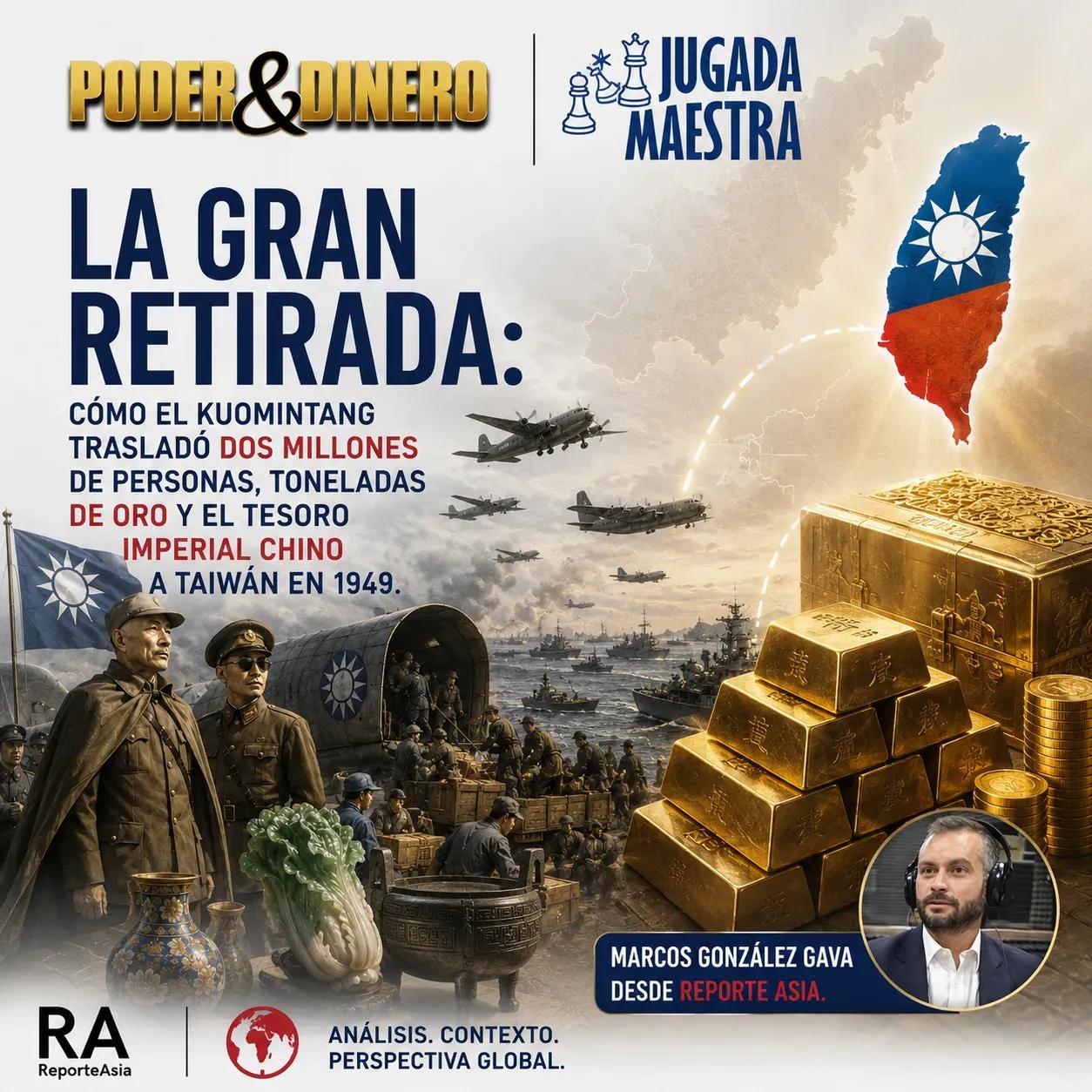
Between 1948 and 1949, the military and economic defeat of the Kuomintang against the People’s Liberation Army led to one of the most extraordinary logistical operations of the 20th century: the relocation of an entire state—troops, officials, gold reserves, and the Chinese imperial heritage—across the Taiwan Strait, under the subsequent protection of the United States during the Cold War.
On December 10, 1949, Chiang Kai-shek and his son Chiang Ching-kuo headed to Chengdu airport—the last provisional capital of the nationalist government on the mainland—to take a flight to Taiwan. With the People’s Liberation Army troops advancing on the city, both left Chinese continental soil. Neither would ever return.
This departure was the final act of an operation planned for sixteen months that mobilized approximately two million people, transported between 113 and 115 tons of gold, and relocated the largest collection of imperial art in Chinese history. This outcome was the direct consequence of the systemic collapse of the Kuomintang on the mainland, a process that combined economic crisis, military corruption, and a communist strategy that managed to capitalize on both weaknesses.
The nationalist collapse on the mainland
By mid-1948, the offensive of the People’s Liberation Army led by Mao Zedong had already made the course of the civil war evident. Behind that military advance was a collapse on several fronts simultaneously.
The Kuomintang government had tried to contain inflation by launching a new currency, the gold yuan, in August 1948, forcing the population to hand over their gold, silver, and foreign currency to the state in exchange for supposedly backed bills. The measure almost immediately failed: in Shanghai, the exchange rate against the dollar went from 4 million gold yuan per dollar in August 1948 to 95 million per dollar in April 1949, while the city’s wholesale price index multiplied more than four thousand times during that same period. This hyperinflation destroyed the economic support of the urban middle class, its most stable social base.
At the same time, Chiang Kai-shek’s generals operated with chronic inefficiency and fund embezzlement, a lack of cohesion that led to massive defections to the communist side at the most critical moments of the conflict. Much of the U.S. military aid, intended to support the nationalist war effort, ended up in the pockets of high-ranking party officials instead of reaching the front.
One of the most documented cases is that of General Mao Bangchu, a senior official in the Republic of China Air Force, whom Chiang’s own government accused of failing to account for 19,440,000 dollars of official funds—a figure equivalent to about 180 million dollars today—costing him the removal from all his positions.
Mao Zedong, for his part, deployed a strategy that combined military encirclement of urban centers from rural areas with a concrete promise: agrarian reform, which allowed him to consolidate the support of millions of peasants before taking the large cities.
The result of that combination was a succession of nationalist defeats that accelerated in just four months: Beijing fell on January 31, 1949, Nanjing—then the capital of the Republic of China—on April 23, and Shanghai, the financial heart of the country, on May 27.
In light of this collapse, the nationalist government successively relocated its headquarters to Canton, Chongqing, and finally Chengdu, in a retreat that repeated the same territorial collapse pattern on a state scale.
It was precisely in this context of accelerated defeat that the Chinese Communist Party, despite being aware of the flights and transfers to Taiwan, did not regard the island as a priority strategic objective. Returned by Japan to Chinese sovereignty in 1945, Taiwan did not feature as a central concern in Mao's plans, an omission that would prove decisive for the subsequent course of Asian geopolitics.
Planes: an airlift sustained for 16 months
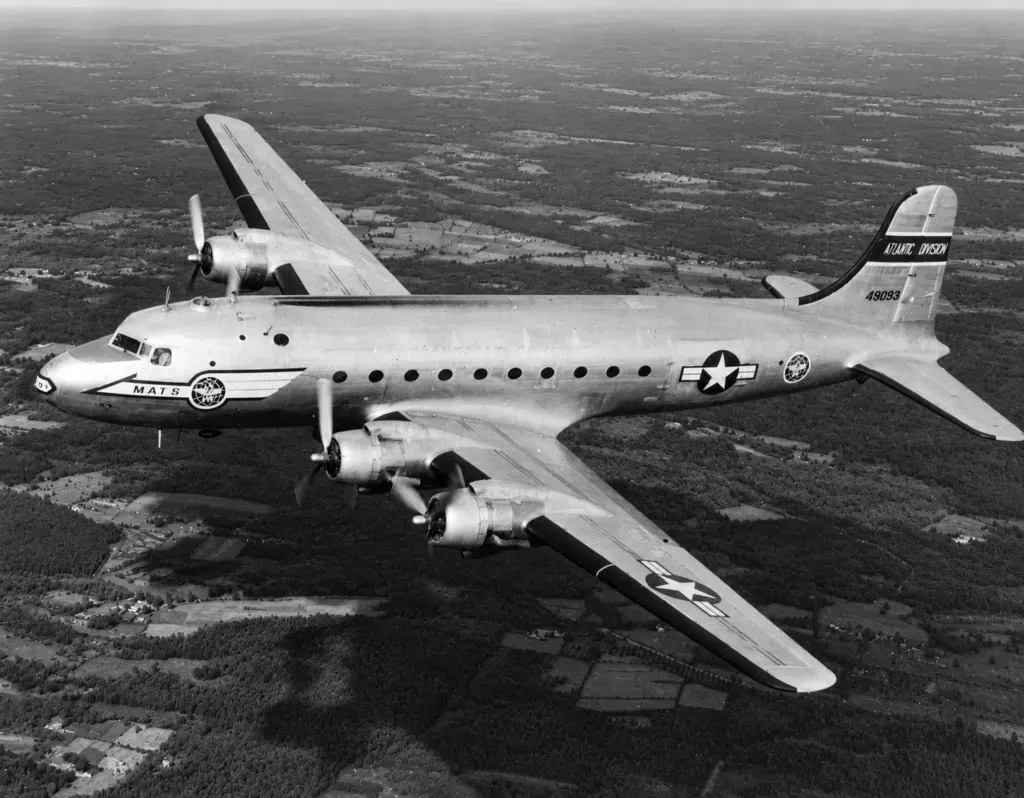
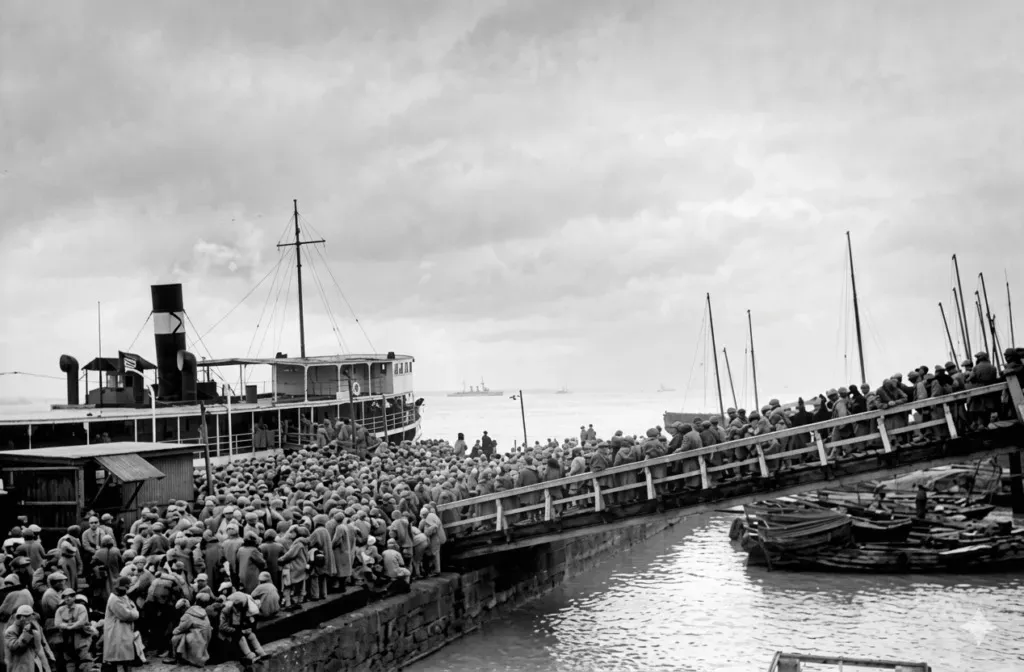
Over the course of four months starting from August 1948, the Republic of China Air Force was overwhelmed to Taiwan by means of more than 80 flights and 3 ships.
The air operation continued steadily: according to historian Chen Chin-chang, an average of 50 to 60 planes flew daily between Taiwan and the mainland transporting fuel, ammunition, and personnel from August 1948 to December 1949.
During that same period, approximately 300,000 soldiers were transported by plane to the island.
Ships: 26 warships and a civilian fleet
The naval dimension of the operation included the transfer of 26 warships from the National Revolutionary Army, which became part of the navy of the new Republic of China in Taiwan. Commercial and civilian vessels were added for the transportation of troops, officials, academics, and refugees.
Most of the troops embarked from ports in southern China, particularly from Guangdong and Sichuan provinces.
In this context, the Taiwan Strait, approximately 180 kilometers at its narrowest point, was continuously traversed for more than a year by a heterogeneous fleet transporting people, materials, and state documents.
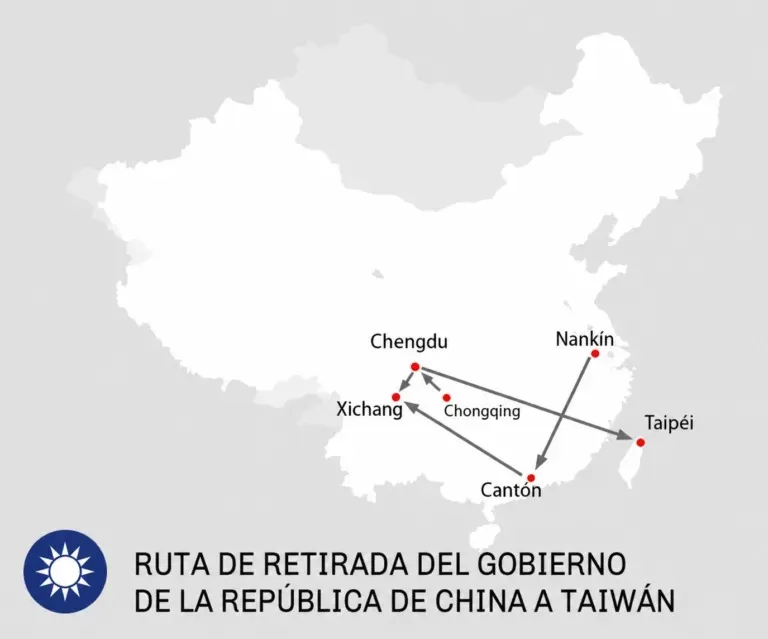
Map of the Kuomintang's retreat to the Taiwan Strait between 1948 and 1949. The nationalist capital successively moved from Nanjing to Canton, Chongqing, and Chengdu as the People’s Liberation Army advanced, until Chiang Kai-shek and his government finally crossed to Taipei.
The gold: state reserves
Among the assets relocated was the gold from the National Bank of the Republic of China. Estimates vary according to sources, but historical records indicate that between three and five million taels were mobilized, equivalent to between 113 and 115 tons.
The operation was kept under strict secrecy: according to declassified documents decades later, even the Minister of Finance did not have complete information about the final amounts transferred. The Generalissimo kept the records as military secrets, and the files were only made accessible to the public more than 40 years after his death in 1975.
These reserves had a concrete function in the subsequent economic policy: it is estimated that 800,000 taels were allocated to stabilize the Taiwanese economy, which had been undergoing an extremely severe hyperinflation since 1945. Six months after the operation was completed, the new Taiwanese dollar was launched, replacing the previous one at a rate of 1 to 40,000.
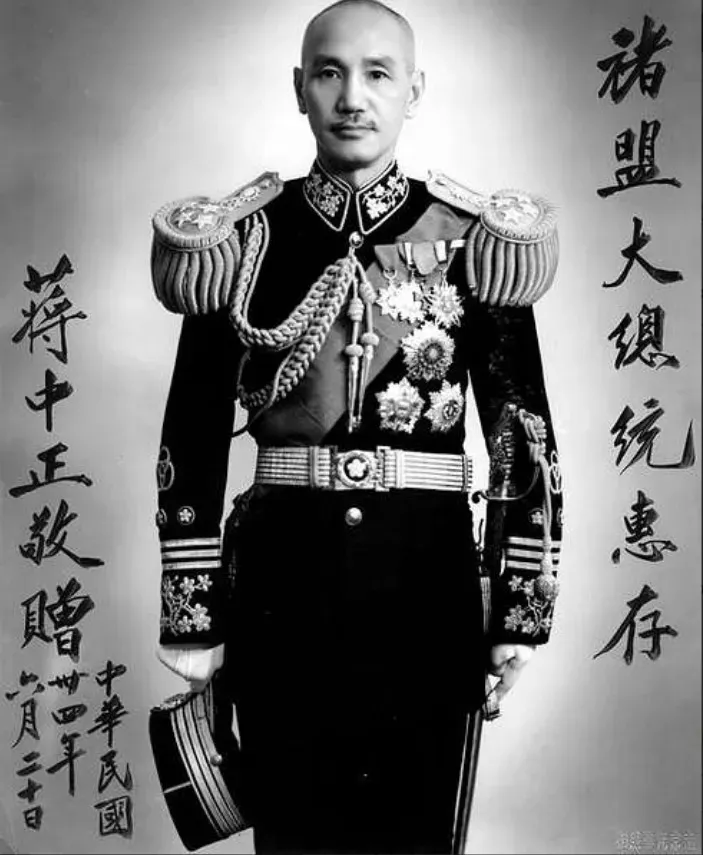
Chiang Kai-shek poses in an official portrait dedicated and signed with his formal name, Chiang Chung-cheng (蔣中正). The inscription indicates that the photograph was respectfully gifted for preservation and is dated June 20, 1951, already in Taiwan, less than two years after the nationalist withdrawal from the mainland.
The cultural heritage
The KMT relocated more than 600,000 pieces from the collection of the Palace Museum in Beijing to Taiwan, representing the twenty percent most valuable of the entire collection. Among the objects are the so-called Three Treasures of the National Palace Museum of Taipei: the Meat-shaped Stone, the Jadeite Cabbage, and the Mao Gong Ding cauldron.
The cultural operation involved the participation of Fu Ssu-nien, director of the Institute of History and Philology, who coordinated the relocation of scholars, books, documents, and manuscripts. The collection is now housed at the National Palace Museum in Taipei. The question of ownership of these pieces remains one of the unresolved points of tension between the People's Republic of China and Taiwan.
Refuge and consolidation in Taiwan (1949-1975)
The result of the operation was a significant demographic transformation of the island. Approximately two million people—soldiers, officials, intellectuals, merchants, and families—settled in a territory that at that time had just over six million inhabitants. The coexistence between the newcomers from the mainland and the local Taiwanese population generated social and cultural tensions that extended for decades.
To consolidate that control over a local population that had not been consulted about its new political situation, the nationalist government imposed martial law in 1949, marking the beginning of the period known as the “White Terror”: a systematic repression against local dissidents, with thousands of detentions and executions, aimed at centralizing the absolute power of the new regime. That martial law lasted for 38 years, until 1987, making it one of the longest periods of exception in contemporary history.
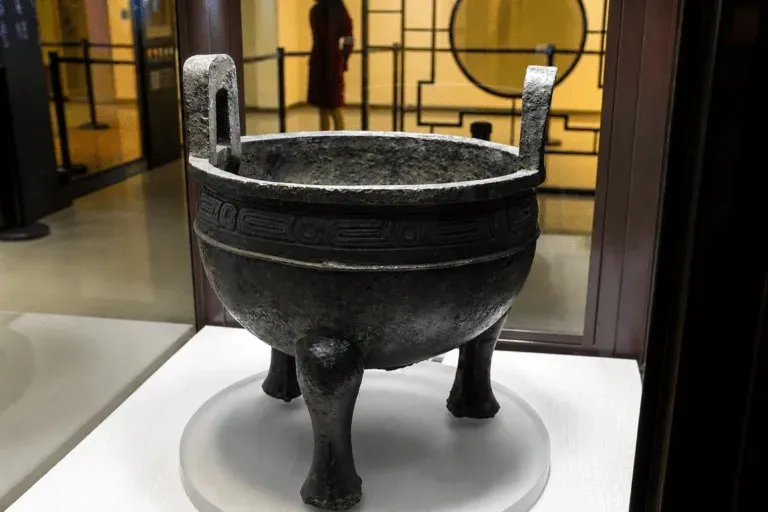
The Mao Gong Ding (毛公鼎 or Cauldron of Duke Mao) is an ancient bronze tripod ritual cauldron (ding) belonging to the Western Zhou dynasty. Unearthed in the 19th century, it is world-renowned for housing the longest bronze inscription from ancient China, with nearly 500 characters.
Chiang Kai-shek ruled the island until his death in 1975 under the name of the Republic of China, formally maintaining the aspiration of recovering the mainland—an objective that was never realized—and asserting to the world that his government, and not that of Beijing, represented all of China.
This position was additionally internationally supported, with its limitations: the United Nations recognized Chiang's administration as the legitimate government of China until 1971, when Resolution 2758 transferred that recognition to the People's Republic.
The role of the United States and the Cold War
The survival of the nationalist regime in Taiwan cannot be explained without U.S. support. Washington had already provided, during World War II and the post-war period, instructors and air units that trained and transported the contingents of the Kuomintang.
After the founding of the People's Republic, the United States deepened that link with billions of dollars in economic assistance and advanced military equipment, with the explicit goal of containing communist advances in East Asia.
This departure was the final act of an operation planned for sixteen months that mobilized approximately two million people, transported between 113 and 115 tons of gold, and relocated the largest collection of imperial art in Chinese history.
The turning point came with the outbreak of the Korean War in 1950, which prompted Washington to mobilize the Seventh Fleet to the Taiwan Strait, effectively neutralizing any attempts at a communist invasion of the island.
This naval protection was formalized in 1954 with the signing of the Mutual Defense Treaty between the United States and the Republic of China—signed on December 2 of that year in Washington—which safeguarded Taiwanese security under the U.S. military umbrella until its termination in 1979, when Washington established diplomatic relations with Beijing.
The strategic rivalry: Chiang Kai-shek versus Mao Zedong
The confrontation between the two leaders exceeded the military. Despite having cooperated briefly in the 1920s and in the face of the Japanese invasion in the 1930s, Chiang always internally defined communists as a “heart disease” of the Chinese political body. That hostility was based on a fundamental ideological divergence: Chiang's regime was structured under an authoritarian and capitalist nationalism, while Mao implemented a doctrine of peasant revolution based on Marxism-Leninism.
The two also resorted to sustained psychological warfare in their public speeches: the Generalissimo labeled Mao's forces as “bandits,” while Mao called the nationalist leader a “lackey of imperialism.” This rhetorical confrontation also reflected a real contrast in leadership styles: Chiang centralized decisions in a military leadership weakened by corruption and desertions, while Mao decentralized his influence by directly mobilizing the rural population through land redistribution, a strategy that ultimately proved decisive for the outcome of the civil war.
In conclusion, it is important to highlight that the state built from that retreat of the Kuomintang to “Ilha Formosa” underwent, in the following decades, a process of accelerated industrialization that turned it into one of the most dynamic economies in Asia and one of the central foci of regional and global geopolitics to this day.
Marcos González Gava is Co-Founder of Reporte Asia and a specialist in financial and commercial business and cultural affairs with the People's Republic of China.
Comments