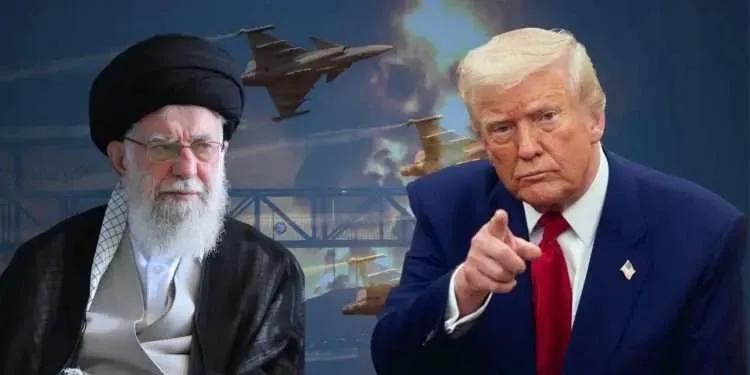
From Washington, the prospect of a military intervention in Iran is not explained solely by the Islamic regime's nuclear program or its historical antagonism with Israel. Behind the growing tension lies a much broader equation: the dispute for global hegemony with China, the security architecture of the Middle East, the control of critical energy routes, and the U.S. need to prevent the consolidation of hostile power poles capable of challenging the international order that emerged after the Cold War.
A year ago, upon returning to the White House, President Donald Trump warned that the United States was beginning to show clear signs of wear in its competition for global primacy against China. It was not just about economic or trade indicators, but about a deeper strategic perception: the sustained advance of Beijing over areas traditionally considered part of the U.S. sphere of influence.
The Asian giant has built its international projection on a combination of economic expansion, securing strategic raw materials, and financial penetration into emerging markets. Latin America, Africa, and, to a lesser extent, the European Union became privileged scenarios for this silent offensive. Through investments in infrastructure, soft loans, and energy agreements, China has been consolidating a network of dependencies that increasingly unsettled Washington.
However, Beijing never conceived its expansion as an exclusively economic phenomenon. As U.S. Admiral Alfred Thayer Mahan warned more than a century ago, “factories and merchant fleets only thrive when backed by naval power”. China seems to have taken this maxim literally: as it extended its trade routes, it rapidly developed its military capacity, especially its oceanic fleet, and forged strategic alliances with regimes willing to question the order led by the United States.
In military terms, this architecture fundamentally relied on Vladimir Putin's Russia, but also on Iran, North Korea, and a constellation of governments hostile to Washington in Latin America, such as Cuba, Venezuela, and Nicaragua. Economically, China promoted the BRICS bloc as an alternative platform to the dollar-dominated financial system, incorporating regionally significant countries like India, Brazil, and South Africa, along with allies more aligned with Beijing. During Alberto Fernández's government, Argentina flirted with this orbit, becoming the only South American country to host a Chinese space base on its territory.
Convinced that a direct confrontation with China would be costly and uncertain, Trump opted for an indirect strategy: to weaken its alliance framework. In an initial phase, he aimed to reduce Chinese commercial presence in South America and decrease U.S. dependence on rare earth minerals from the Asian giant, considered critical inputs for the technology and military industry. To do this, he did not hesitate to resort to all the tools of hybrid warfare, combining diplomatic pressure, selective tariffs, and demonstrations of force.
Washington forced Panama to review the agreements that allowed Chinese companies to operate infrastructure linked to the interoceanic canal, decisively backing Argentine President Javier Milei — in a key country due to its lithium and strategic mineral reserves — and toughening its policy towards Venezuela and Cuba, two historical allies of Beijing in the Western Hemisphere. As former Secretary of State Mike Pompeo summarized at the time, “China cannot be allowed to control the resources and routes that sustain the global economy.”
This regional activism did not prevent Trump from projecting power in other scenarios. He pressured his NATO partners to raise defense spending to 5% of GDP, a demand that, as he himself stated, aimed to “correct decades of imbalances.” He authorized selective strikes against Iranian facilities, pushed for a peace plan for Gaza, supported the new balance of power in Syria — which drastically reduced Russian military presence in Tartus and Hmeimim — and played a significant role in negotiations between Moscow and Kyiv. This was accompanied by an unprecedented arms sale to Taiwan, openly defying warnings from Beijing.
The pattern is clear: behind many of the international maneuvers of the Trump Administration lies a common denominator, the systematic erosion of Chinese influence. Instead of a head-on clash between superpowers, Washington chose to weaken the most fragile links in the network woven by Beijing while attempting to draw Russia into a more ambiguous position regarding the West.
In this context, the growing confrontation between the United States and Iran must be understood. However, reducing it to the logic of rivalry with China would be insufficient. There are regional and strategic factors that make Tehran a central target of U.S. foreign policy.
The Shiite Iran has been, for decades, a deeply destabilizing actor in the Middle East and the declared enemy of the State of Israel, Washington's main ally in the region. For over twenty years, Tehran has built a network of militias and armed organizations aimed at encircling Israel through what its own strategists termed a “ring of fire”: Hezbollah in Lebanon, Hamas in Gaza, Shiite militias in Iraq, the Houthis in Yemen, and Revolutionary Guard forces deployed in Syria. This strategic corridor, which connected Iran to the Mediterranean, began to fracture in 2024, following Hezbollah's defeat, the fall of Bashar al-Assad's regime, and Israeli bombings that severely damaged Iranian defense systems.
Additionally, there is the Iranian nuclear program, considered by Israel as an existential threat. The international agreement to oversee Tehran's nuclear activities was virtually deactivated, and in 2024 then-Secretary of State Antony Blinken warned that Iran could produce enough fissile material for a nuclear weapon within weeks. “The current situation is not positive,” he said then. For Jerusalem, the risk does not only lie in a potential Iranian bomb but in the domino effect it would trigger in the region: Saudi Arabia, Egypt, and Turkey could be pushed to develop their own nuclear arsenals.
The possibility of an Israeli attack on Iranian nuclear facilities has been a constant concern, though limited by operational factors and the fear of greater retaliation: the closure of the Strait of Hormuz, through which nearly 20% of the world's oil passes. A prolonged blockade of that passage would have devastating consequences for the global economy, a scenario that Washington observes with extreme concern.
Iran has also developed a military industry capable of producing ballistic missiles and sophisticated drones, some of which have proven effective in the Ukraine conflict in service of Russia. As former National Security Advisor John Bolton warned, “allowing Iran to consolidate that capability is to accept a permanent source of instability.”
On top of all this is a decisive factor: oil. With more than 208 billion barrels of proven reserves, Iran is the third country with the largest reserves in the world. Although sanctions have limited its export capacity, China has become its main client, absorbing a large part of Iranian crude, often through opaque mechanisms aimed at circumventing international restrictions. Controlling — directly or indirectly — the energy flows of Iran and Venezuela would give the United States a formidable strategic advantage in its contest with Beijing.
Conclusion:
The potential U.S. military intervention in Iran cannot be understood as an impulsive reaction or as an isolated episode. It is the result of an accumulation of strategic interests: curbing Chinese expansion, ensuring Israel's security, preventing uncontrolled nuclear proliferation, and preserving control over the world's main energy corridors. In this intersection of power, oil, and geopolitics, Tehran appears to Washington not only as a regional adversary but as a key piece on a global chessboard where the United States resists yielding its central place.
Adalberto Agozino is a Doctor of Political Science, International Politics and Geopolitics Analyst, and a Professor at the University of Buenos Aires, with significant fieldwork in Argentina and abroad.

Comments