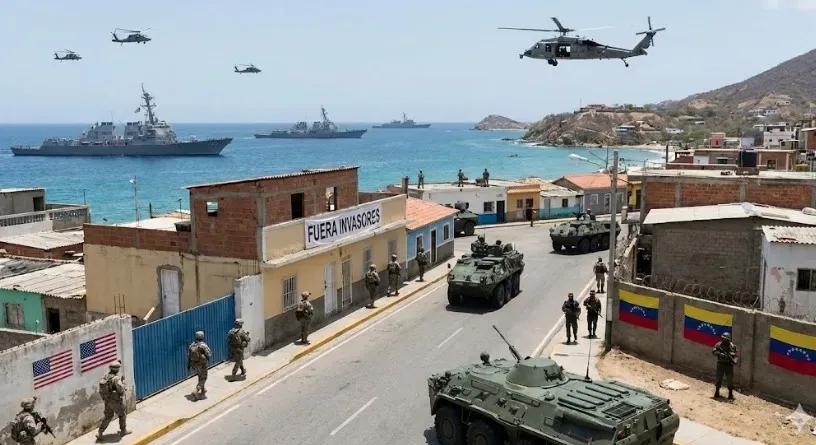
The eventual invasion of the United States into Venezuela would not be just another episode of geopolitical tension: it would constitute a frontline break of International Law and a precedent of enormous gravity for the global system built after World War II.
Since 1945, the international order has been sustained —at least formally— on a basic principle: the prohibition of the use of force against the territorial integrity or political independence of States, enshrined in Article 2.4 of the United Nations Charter. This principle is not rhetorical: it is the foundation that distinguishes modern international law from the law of the strongest.
A direct military intervention, without authorization from the UN Security Council and without an immediate situation of legitimate self-defense, would constitute an act of aggression, classified as an international crime both by the UN Charter itself and the Rome Statute of the International Criminal Court.
The demolition of the principle of sovereignty
The usual argument to justify this type of action —“humanitarian intervention,” “restoration of democracy,” “fighting regional threats”— has already been used in Iraq, Libya, and Afghanistan. In all cases, the result was the same: destroyed States, millions of dead, massive displacements, and regional chaos, without the promised democracy ever appearing.
Applying the same scheme to Venezuela implies something even deeper: the annulment of the principle of sovereignty as a universal norm. If a power can invade another State for political, economic, or ideological reasons, then International Law ceases to be law and becomes a selective tool of power.
For Latin America, this is especially serious. The region has a history marked by interventions, induced coups, and external tutelage. An open invasion would reaffirm the idea that the continent remains a zone of influence, not a collection of sovereign States equal under the law.
The precedent that threatens everyone
The problem is not just Venezuela. The problem is the legal and political precedent that would be established.
If it is accepted that a power can intervene militarily because a government is “unacceptable,” “uncomfortable,” or “aligned with strategic rivals,” then no peripheral State is safe. Today it is Venezuela; tomorrow it could be any country that decides to control its resources, regulate external capital, or maintain an autonomous foreign policy.
In that context, International Law ceases to protect the weak and begins to legitimize domination, returning to a pre-modern logic where force defines legality.
Resources, geopolitics, and moral discourse
It is no coincidence that Venezuela is one of the countries with the largest energy reserves in the world. It is also no coincidence that the discourse of “security” and “democracy” emerges strongly when strategic resources and disputes between great powers are at stake.
The problem is not to discuss the Venezuelan political regime —that is part of the internal and regional debate— but to normalize that the solution is military, external, and unilateral. When missiles replace diplomacy, law ceases to exist.
A warning for the global order
An invasion of the United States into Venezuela would not only be a humanitarian and regional tragedy. It would be a direct blow to the international legal system, accelerating its decomposition and pushing the world toward a scenario of permanent confrontation between blocs.
Defending International Law does not mean defending governments, but rather defending minimal rules of coexistence among States. When those rules are broken from above, the message is clear: the world enters a stage where force becomes the sole arbiter.
And when that happens, no one —not even the powers— comes out unscathed.

Comments