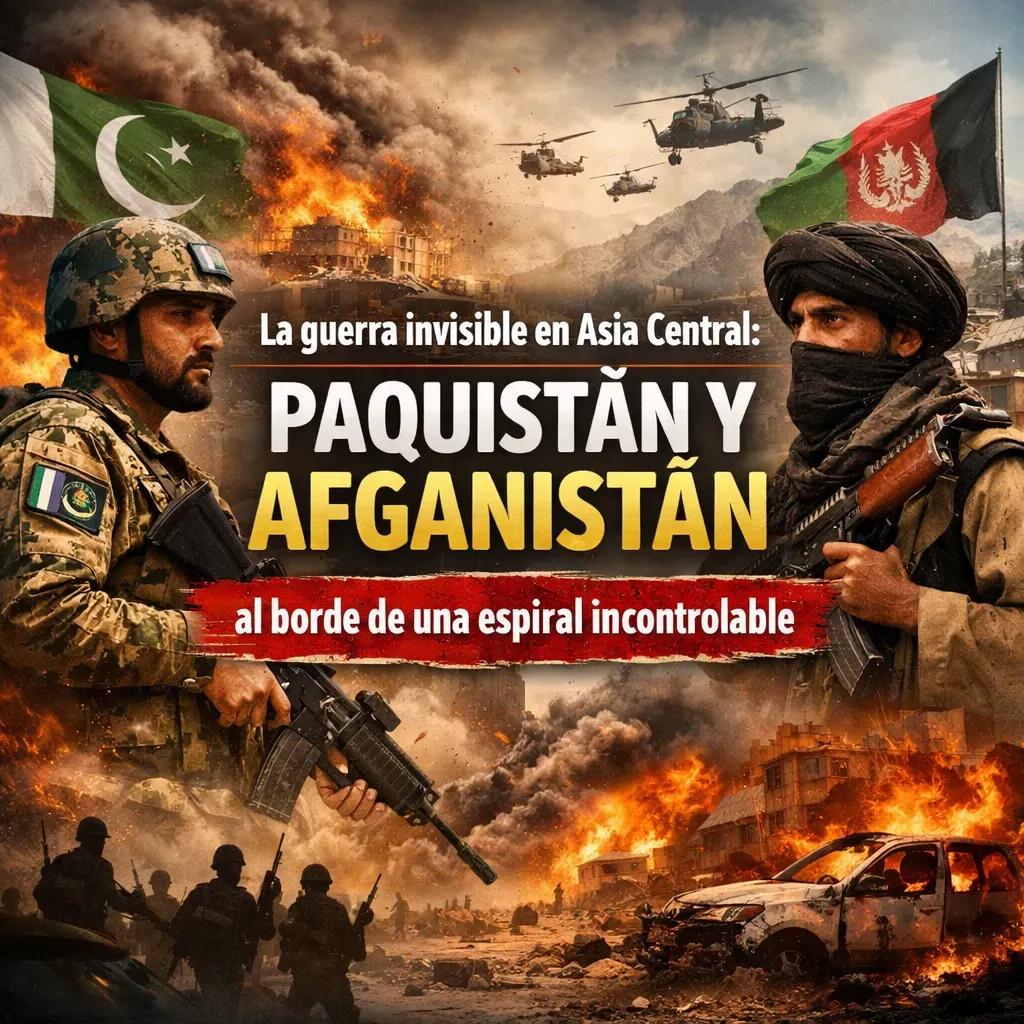
The current crisis between Islamabad and Kabul is far from a sudden outbreak. On the contrary, it constitutes the culmination of a historically ambiguous relationship, marked by mutual instrumentalization, structural distrust, and a geography that has favored both infiltration and conflict. For decades, Pakistan conceived of the Taliban as an instrument of strategic depth against India. However, that geopolitical calculation has turned against it: the current Taliban power presents itself as an autonomous actor, ideologically inflexible and increasingly unwilling to submit to the pressures of its former main support.
In recent months, tension has reached alarming levels. The Pakistani air force has carried out bombings on Afghan territory—including areas near Kabul and eastern provinces like Paktika and Nangarhar—under the pretext of neutralizing bases of the Tehreek-e-Taliban Pakistan (TTP). From Kabul, authorities have denounced these incursions as acts of direct aggression, emphasizing that they have caused civilian casualties, including women and children, in addition to generating new population displacements.
The spokesperson for the Afghan Ministry of Defense, in statements broadcast by regional media, accused Islamabad of “violating national sovereignty and indiscriminately attacking the population.” In response, the Pakistani Ministry of Foreign Affairs has insisted on the right to legitimate self-defense against insurgent groups that—according to it—operate with impunity from Afghan territory. In an appearance before Parliament, the then Pakistani Prime Minister, Shehbaz Sharif, firmly stated that “Pakistan will not allow its territory to be destabilized by terrorist organizations that find refuge on the other side of the border.”
The core of the dispute remains the Durand Line, a border of over 2,600 kilometers drawn in 1893 by the British Empire. For Pakistan, the heir to that delimitation, it is a legitimate and unalterable international border. For Afghanistan, however, it represents a colonial imposition that artificially fractures the Pashtun ethnicity, settled on both sides of the divide. This territorial fracture has fueled persistent tensions, insurgencies, and difficult-to-control cross-border flows for decades. With the return of the Taliban to power in Kabul in 2021, following the withdrawal of the United States, the issue has taken on an even more critical dimension: it is no longer just a historical dispute, but an immediate security problem for Islamabad.
The Taliban movement, which emerged in 1994 in southern Afghanistan, is the result of a complex combination of factors: the power vacuum following the war against the Soviet Union, logistical support from Pakistan, and the ideological influence of Deobandi-oriented Islamic religious schools. Its political project revolves around the establishment of an Islamic emirate governed by a strict interpretation of Sharia. During their first government, from 1996 to 2001, they imposed a deeply restrictive system—especially for women—and offered refuge to organizations like Al Qaeda, which triggered the US military intervention following the September 11 attacks. Two decades later, they have returned to power combining tactical pragmatism with notable doctrinal rigidity.
Currently, their challenge is not limited to governing a devastated country but also managing their foreign relations without renouncing their ideological identity. It is precisely in this delicate balance that their complex relationship with Pakistan is inscribed.
The most explosive element of the conflict is the presence of the Tehreek-e-Taliban Pakistan, an insurgent organization that shares ideological roots with the Afghan Taliban, but whose goal is to overthrow the Pakistani state. Islamabad accuses Kabul of tolerating—if not supporting—the TTP's activities in its territory. Taliban authorities deny these accusations, although doubts persist about their real capability or political will to control this group. While some analysts point to an ideological affinity that complicates a clear break, others argue that the problem lies in the lack of effective control over peripheral regions.
From a conventional military viewpoint, Pakistan's superiority is indisputable. Its army, considered one of the most professionalized in the Islamic world, possesses modern weaponry, advanced aviation, and a nuclear arsenal that places it in a strategically superior category. Afghanistan, on the contrary, relies on informal military structures, light weapons, and limited resources. However, historical experience shows that technological superiority does not guarantee control of Afghan territory. Neither the Soviet Union nor the United States managed to impose themselves durably. The Taliban, experts in guerrilla warfare, have been able to transform their structural weakness into a tactical advantage.
The conflict does not unfold in a geopolitical vacuum. On the contrary, it generates deep concern among regional powers, which perceive in this instability both threats and opportunities. China observes the evolution of the crisis with increasing worry. For Beijing, the friction between Islamabad and Kabul represents a strategic risk factor, especially regarding its investments in Pakistan through the China-Pakistan Economic Corridor. Any potential internal destabilization could jeopardize critical infrastructures. Moreover, China fears that an uncontrollable Afghanistan could become a refuge for militant groups operating in Xinjiang. In this context, it seeks to ensure that the Taliban fulfill their promise of not exporting terrorism, adopting a discreet yet steady mediating role.
India, on the other hand, views the situation through a different logic. The historical rivalry with Pakistan renders any weakening of Pakistani state control a strategic opportunity. The fact that Islamabad's former ally—the Taliban—has turned into a source of instability is interpreted in New Delhi as a miscalculation by the Pakistani military apparatus. Consequently, India has initiated a cautious rapprochement with the Taliban regime, combining humanitarian aid with a technical presence at its embassy. This soft power deployment seeks to counteract Pakistani influence and prevent Afghanistan from being used as a base for hostile actions against Indian territory.
The human cost of the conflict is difficult to quantify precisely, but reports agree that violence has already left hundreds dead. Military casualties are joined by civilian victims, forced displacements, and infrastructure destruction. Bombings in border areas have especially affected vulnerable communities, exacerbating an already severe humanitarian crisis. The United Nations High Commissioner for Refugees has warned of the risk of new flows of displaced persons in a region that already hosts millions of Afghan refugees.
The most troubling paradox of this conflict is its relative invisibility. While other wars capture international attention, the escalation between Pakistan and Afghanistan advances without significant media scrutiny or diplomatic pressure. This absence of focus not only hinders de-escalation efforts but also increases the risk of miscalculations. In a region where the interests of nuclear powers and non-state actors converge, any incident could trigger disproportionate consequences.
Everything points to the conflict heading towards a prolonged phase of indirect confrontation. Pakistan will continue with selective attacks against insurgent targets, while the Taliban, either directly or through affiliated groups, will maintain pressure. The greatest danger does not lie in a large-scale conventional war, but in a progressive erosion of regional stability.
In that scenario, the border between Pakistan and Afghanistan runs the risk of consolidating as one of the most dangerous points on the global map: a persistent conflict, of low visibility but high impact. In a world saturated with crises, this forgotten war between two Muslim countries could, at any moment, cease to be so.
Adalberto Agozino holds a PhD in Political Science, is an International Analyst, and a Lecturer at the University of Buenos Aires.

Comments