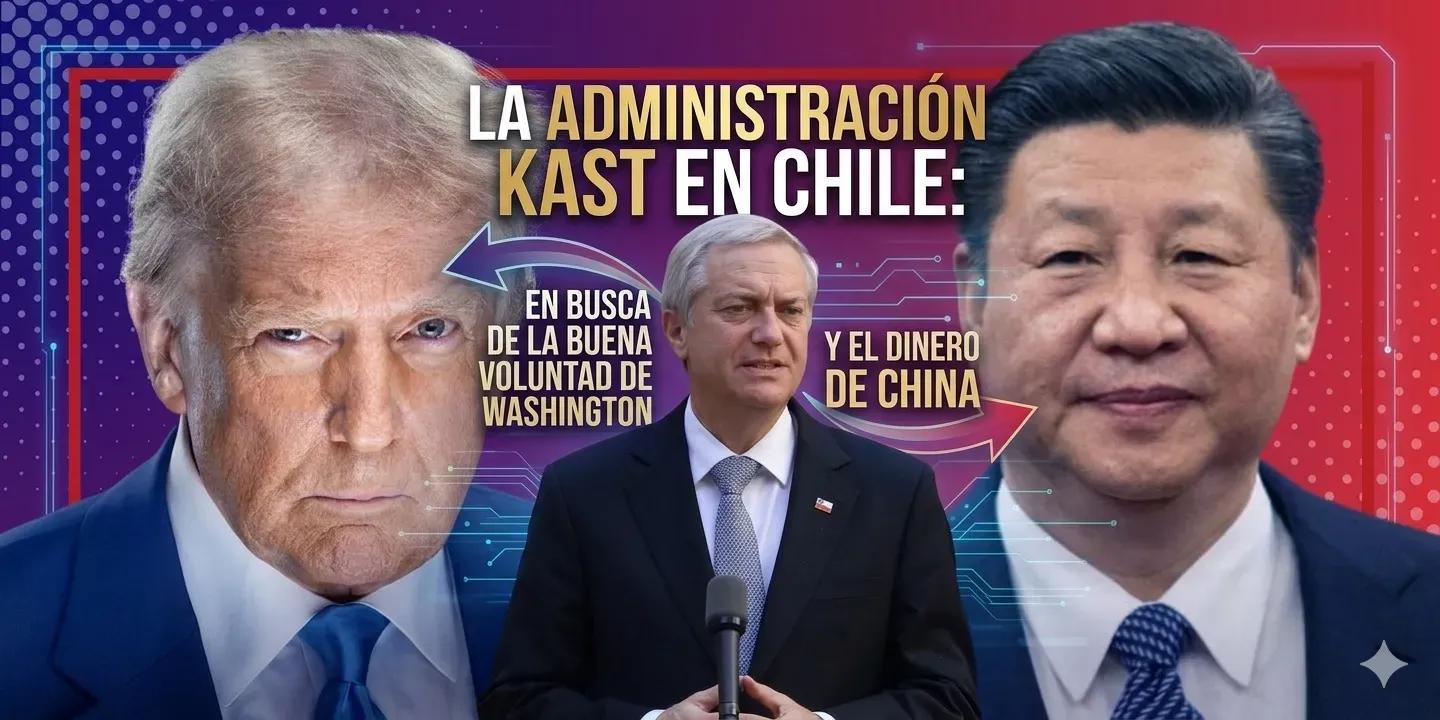
From March 22 to 28, 2026, I was in Santiago, Chile, giving presentations and discussing with experts about the activities of the People's Republic of China (PRC) in Chile. The new president of the country, José Antonio Kast, who took office on March 11, finds himself in a delicate situation, struggling between his priority to strengthen relations with Washington and the enormous influence that the PRC exerts over Chile as the main destination for the country's exports, with extensive and deep commercial and personal relationships throughout the territory. An example of this dilemma is Chile's Minister of Foreign Affairs, Francisco Pérez MacKenna, a graduate of Chicago, who comes from a business background with close ties to American companies and the American Chamber of Commerce. Previously, he held the second position in the Luksic Group, one of the most powerful business organizations in Chile, whose mining and other businesses are dominated by its ties to the PRC as a customer and partner. In his public discourse, including an interview about the new administration’s stance on foreign relations with the prestigious newspaper El Mercurio, Pérez MacKenna has strived to avoid suggesting that President Kast's notable rapprochement with Washington on key foreign policy issues and other matters implies a Chilean willingness to cool its ties with Beijing. In fact, during my week in Chile, Pérez MacKenna's social media account posted a message that was widely commented upon among the people I interacted with, featuring comparative photographs of the minister shaking hands with U.S. Ambassador Brandon Judd and PRC Ambassador Niu Qingbao, identical even in posture, suit, and tie.
In the weeks leading up to President Kast's inauguration and his government, various symbolic events underscored the efforts of the United States to counteract the activities of the People's Republic of China in strategically sensitive areas of Chile, as well as the Chinese actions to reaffirm their presence and demonstrate that they would not be intimidated. The United States sanctioned three senior officials from the outgoing government of Gabriel Boric for their involvement in a Chinese fiber optic cable between Valparaíso and Hong Kong, which potentially would have given Chinese intelligence access to a significant amount of data transmitted between the two continents. Chinese Ambassador Niu responded emphatically, stating that China would not allow the United States to "undermine the sovereignty" of other countries. While the drama of the "Chile-China Express" data cable unfolded, a Chinese oceanographic vessel, the Tan Suo Yi Hao, accused by Australian security experts of engaging in espionage activities, carried out a mission presented as scientific exploration in Chilean waters. Almost simultaneously, the hospital ship Silk Road Ark of the People's Liberation Army docked at the Chilean ports of Antofagasta and Valparaíso, despite the apparent lack of need for such "assistance" in the Chilean healthcare system, which boasts high standards of quality. In fact, the Chilean government had not authorized them to carry out medical operations, according to the country’s strict medical quality control laws. Shortly before these incidents, the Chilean government had also halted the People's Republic of China's construction of the Ventarrones space base in the Atacama Desert, where experts had identified the risk of being used for military purposes against the United States in the event of war.
During my inaugural speech at the Chilean War Academy (ANEPE), a three-member delegation from the People's Liberation Army (PLA), including its military attaché, Major Colonel Wang Hui, and his deputy, Lieutenant Colonel Chen Chen, attended the session along with other military attaches from friendly countries of Chile, although some colleagues informed me that it is unusual for them to participate in such forums.
While the most public reaction from the United States to China's activities in Chile has focused on military, space, and strategic technology areas, the main tool of pressure from the People's Republic of China over Chile is undoubtedly its strong position as a trading partner, complemented by the extensive network of relationships it has built in the country. As a high-level Chilean businessman candidly expressed to me, given that 40% of Chile's exports are directed to China, double what Chile sells to the United States, it would be reckless for the country to risk provoking China. He cited how the People's Republic of China (PRC) had imposed harsh economic sanctions on Australia when the latter opposed China on security matters, illustrating that the PRC’s history of subtle but significant vengeance against those who challenge it is very much on the minds of Chileans.
Virtually all major sectors of the Chilean economy are affected in some way by the PRC. Seventy-five percent of Chilean copper, the country's main export, and a similar proportion of its lithium, are destined for the PRC. The Chinese company Tianqi is a significant investor in the Chilean lithium sector, in partnership with SQM, linked to Chilean tycoon Julio Ponce Lerou. China also buys 90% of Chilean cherries, a significant portion of its grapes and other fruits, as well as Chilean wine and even wood pulp.
In the electrical sector, PRC-based companies control nearly 60% of electrical distribution throughout the country and are major suppliers of solar panels, in addition to being significant builders of wind and solar facilities across the national territory. Forty percent of the cars in Chile are Chinese, and Chinese companies like BYD have a much larger share of the electric vehicle market, including electric buses. For example, all buses in Coipaipo are now electric, sold to the city by China, while Santiago has the largest fleet of Chinese electric buses outside the People's Republic of China.
In telecommunications and other digital industries, Chinese companies are dominant. Chinese cellphone brands like Huawei, ZTE, Xiaomi, Honor, and Oppo are omnipresent and are offered through almost all major operators in Chile: Movistar, Entel, Claro, and WOM. Huawei has at least three data centers in Chile and had announced plans to build more, along with Chinese company Tencent, if the Chile-China Express submarine cable project is realized.
In the strategic port sector, two Chinese companies, China Railway Construction Corporation (CRCC) and China Harbour Engineering Corporation (CHEC), are among the seven prequalified for the first phase of a significant, although long-delayed, project to expand the Port of San Antonio, Chile's most important deep-water port serving the metropolitan area of Santiago. Of lesser commercial value but of enormous potential strategic importance, during my trip, my colleagues also informed me about the initial commitments signed for a new port project by Shanghai Ports Investment Corporation in Tierra del Fuego, where a Chinese facility could provide the People's Republic of China with opportunities to monitor and even jeopardize the transit of U.S. warships through the Strait of Magellan and the Drake Passage in times of war.
CRCC has also played a key role in major infrastructure projects, including improvements to Highway 5, the main north-south artery of the country, and Line 7 of the Santiago Metro. However, CRCC had performance issues in both projects, leading the Chilean government to exclude it from the metro project, in addition to a lawsuit for $140 million for its work on Highway 5.
In the retail sector, it is estimated that there are 1,000 Chinese shopping centers across the country, practically in every Chilean city. These have become the focus of attention of authorities due to irregular practices, ranging from smuggling of goods to failure to issue receipts, allowing them to evade taxes.
Ironically, in sectors such as electricity, mining, and transportation infrastructure, the market-friendly policies and regulatory streamlining supported by President Kast could indeed accelerate the advancement of Chinese companies in the country, especially those whose projects were hampered by environmental and other regulations during the previous Boric administration.
Beyond business, the Chinese networks that have emerged in Chile through commercial and other links are also noteworthy. These include formal organizations like the China-Chile Business Council (CHICIT). The Chilean Congress has an unusually large friendship group with the People's Republic of China, with over 40 members in the previous session, including its president, Karol Cariola, a member of the Communist Party of Chile, who was involved in an influence-peddling scandal involving Chinese businessman Emilio Yang and the irregular certification of one of his shopping centers in China. These networks also include trips by local officials, sometimes leveraging the sister-city relationships that the People's Republic of China has established in the country, such as the one between Hefei and Santiago.
In the academic field, important Chilean universities such as the University of Chile, the Catholic University of Chile, the University of Santo Tomás, and the University Andrés Bello have Chinese studies programs that maintain networks of scholars with academic ties to the People's Republic of China. Initiatives that connect Chilean scholars specializing in China from various universities, such as the Millennium Nucleus ICLAC program, further facilitate these ties. Beyond these academic networks, the People's Republic of China has 17 Confucius Institutes in Chile, including one at the Catholic University, one at the University of La Frontera in Temuco, a new one opened in December 2025 at the University of Magallanes, and a total of 14 associated with campuses of the University of Santo Tomás across the country. Chile also hosts CRICAL, the headquarters of all Chinese Confucius Institutes, at the University of Santo Tomás. These institutions also serve as a crucial gateway to attract Chileans interested in the Chinese language and culture, channeling the most qualified towards deeper engagement with the People's Republic of China through scholarships funded by the Chinese government and other grants.
In the media sphere, the two main Chilean newspapers, El Mercurio and La Tercera, receive advertising revenues from the People's Republic of China (PRC). El Mercurio regularly publishes verbatim editorials from PRC Ambassador Niu Qingbao. Radio Cooperativo, left-leaning, and the Chinese organization Radio China International co-produce a relatively well-known program in favor of China, "The China Effect."
The PRC's networks in Chile extend to criminal activity, and it is believed that the strongest presence involves a mafia group based in Fujian. They are reported to be involved in human trafficking, marijuana cultivation, and synthetic drugs, among other activities. There are indications that Chinese intelligence services may collaborate with these groups. For example, a supposed "police station" of the PRC in Viña del Mar was located in the restaurant Fooly, owned by Chinese businessman Wang Ing La, with alleged ties to the mafia. With so many ties to China among Chilean business groups and so many networks of interpersonal Chinese relations, it is hard to imagine that Kast's government will significantly reduce the commercial presence of the People's Republic of China or diminish its political pressure on it. It is equally likely that U.S. Ambassador to Chile, Judd, known for his candor, will continue to denounce risky or inappropriate relations with China. Meanwhile, President Kast will continue to act cautiously regarding how far to limit the power of his own government, possibly risking economic and other retaliations from China, in order to further strengthen the relationship with Washington.
R. Evan Ellis is a research professor on Latin America at the U.S. Army War College and a member of the China and Latin America: Multidisciplinary Approaches Network (REDCAEM). The views expressed in this document are his own.

Comments