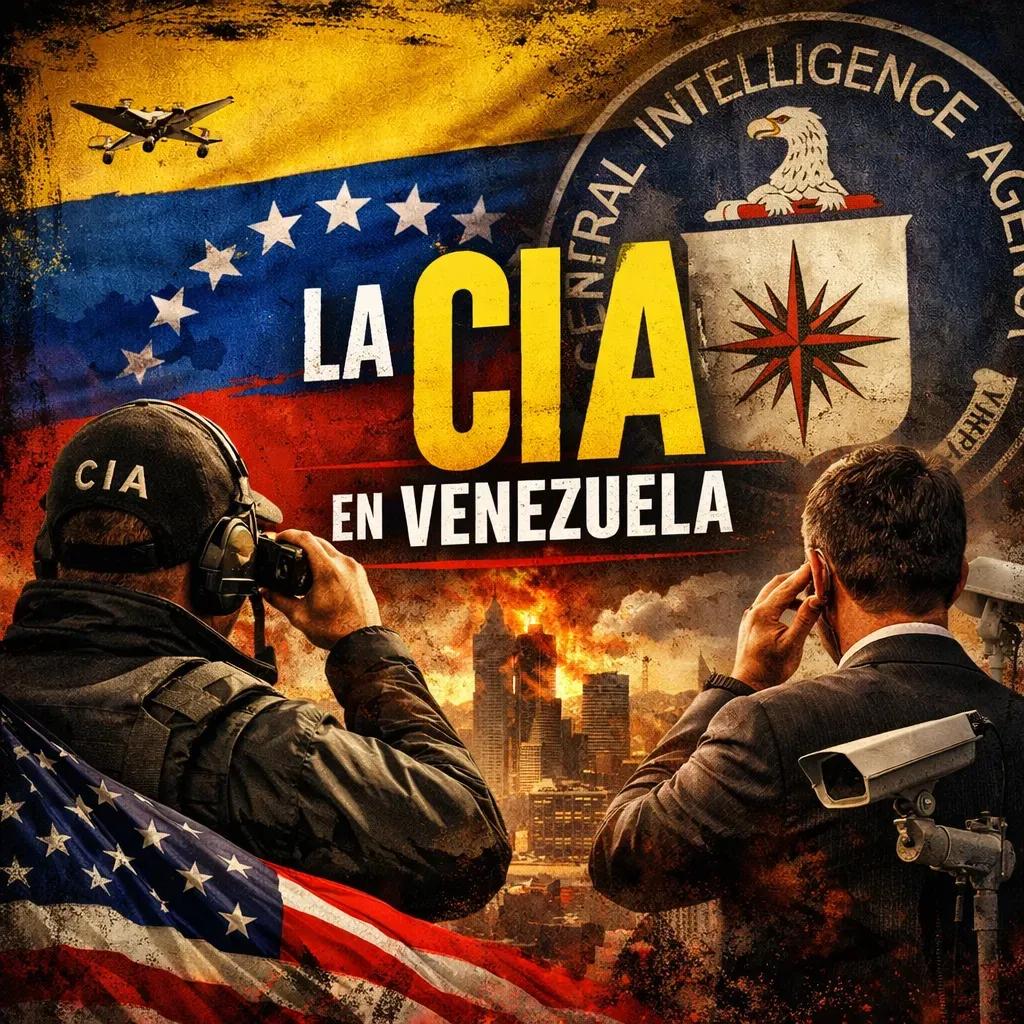
The visit of the director of the Central Intelligence Agency of the United States to Venezuela was neither a protocol gesture nor a belated diplomatic courtesy. It was an act of deliberate strategic signaling, whose real impact is not measured in official statements but in the internal reactions —silent but profound— of the power structures that still try to recover after the collapse of the core of the regime. In contemporary intelligence practice, high-level open gestures are part of the same strategic continuum as covert operations, with carefully calculated psychological and political effects (CIA/CSI, 2022; ODNI, 2024).
The mere fact that John Ratcliffe was received by the Venezuelan military high command, shaking hands and being treated as a legitimate interlocutor, communicates an unequivocal reality: the center of gravity of power in Venezuela has shifted. In strategic intelligence, these shifts matter more than any public declaration because they reorder perceptions, incentives, and loyalties within highly personalized authoritarian systems (ODNI, 2024).
The context that explains it all
This visit occurs after an event that marked a point of no return: the systemic and concurrent failure of Venezuelan and Cuban intelligence agencies. The outcome was evident.
The United States captured Nicolás Maduro and Cilia Flores during the Absolute Resolve operation, executed with precision, timing control, and absolute dominance of the adversary's decision-making environment. It was neither improvisation nor an excessive use of force; it was the culmination of sustained informational superiority, identified by contemporary literature as the decisive factor in high-value operations (RAND, 2024).
This event not only exposed operational vulnerabilities. It exposed a more uncomfortable truth: the system that was supposed to protect power ceased to understand the environment in which it operated. When intelligence becomes politicized and is primarily oriented toward monitoring internal loyalties —instead of anticipating real threats— the blindness is not accidental; it is structural (International Crisis Group, 2025; International Crisis Group, 2026).
Punishing without correcting: the Venezuelan response (and the Cuban contrast)
On the Venezuelan side, the reaction was quick, visible, and predictable, but not structural. Instead of a deep review of the intelligence and power protection model, selective removals and command restructurings were chosen, a typical response of regimes where error is personalized to avoid recognizing systemic failures (International Crisis Group, 2025).
Among the most significant changes reported in the immediate presidential security environment was the removal of Brigadier General Javier José Marcano Tábata, then Commander of the Presidential Honor Guard, the unit directly responsible for the physical security of the head of the Executive and their closest circle. His departure was interpreted by regional analysts as a loss of political trust rather than the result of a doctrinal assessment of the protection system.
In parallel, the repositioning of General Gustavo Enrique González López took place, a figure historically associated with the regime's internal security and counterintelligence apparatus, who assumed an enhanced role within the control scheme, including responsibilities linked to the General Directorate of Military Counterintelligence (DGCIM). The objective was clear: to close ranks and reaffirm loyalties, not to redesign processes or correct vulnerabilities.
Beyond these names, multiple analyses of open intelligence agree that a relevant number of general officers and colonels linked to security, intelligence, and strategic areas stopped appearing in public events and visible chains of command in the weeks that followed. In authoritarian systems, this “administrative disappearance” often indicates internal investigations, political isolations, or punitive reassignment, classic control mechanisms after a crisis (International Crisis Group, 2026).
What is truly revealing is not just who was removed, but what did not happen. There was no announcement of a reorganization of the intelligence system, no public review of early warning mechanisms, no correction of the fragmentation between political and military intelligence, nor was the reliance on external advice as a substitute for internal capability addressed.
In professional terms, there was a purge, not a reform.
This pattern gains more weight when observing the contrast with Cuba. Despite the collapse of the protective device involving Cuban advice and presence, no visible changes were reported in the direction or at the top of the Cuban intelligence apparatus. There were no public removals or announced doctrinal adjustments from Havana. This lack of changes responds to a well-documented doctrinal logic: Cuba processes strategic failures internally, compartmentalized, and silently, avoiding exposing fractures or conceding signs of weakness (CSIS, 2024; Atlantic Council, 2026).
When the "enemy" walks through the door
It is in this context that the visit of the CIA director acquires its true value. For hardline chavismo —figures like Diosdado Cabello and Vladimir Padrino López— the image of the head of U.S. intelligence being received by the military high command is profoundly disturbing because it breaks the internal narrative that for years held the system's discipline: absolute confrontation with the external enemy.
Contemporary literature on authoritarian regimes shows that the loss of the invulnerability myth erodes internal cohesion and accelerates elite fragmentation, even before any formal transition of power (International Crisis Group, 2026).
The "Judas kiss" in strategic terms
From this perspective, the gesture can be interpreted as a "Judas kiss" in strategic terms: not moral, but functional. An act that, without firing a single shot, publicly signals who has become misaligned from the new axis of power. In intelligence, images weigh as much as operations; and this type of open signaling is part of the modern architecture of power (CIA/CSI, 2022).
For Cuba, the impact is even deeper. Venezuela had been a strategic asset for years.
Seeing the main adversary openly interact with the Venezuelan high command, following the collapse of the security ring, exposes the limits of the exported model and forces a silent recalibration (CSIS, 2024; Atlantic Council, 2026).
Conclusion: the rupture of the intelligence apparatus
This is the true strategic meaning of what occurred. It is not a tactical episode nor an isolated result, but rather the irreversible exposure of an intelligence apparatus that has lost its ability to provide effective protection to the core of power.
From this point onward, both in Venezuela and within the Cuban tutelage structure, the problem ceases to be operational and becomes structural. The systems continue to function, but they do so with visible fractures in internal trust, inter-agency coordination, and adversary assessment.
In intelligence, this state is particularly dangerous: it does not produce an immediate collapse but opens a prolonged window of exploitation, in which external actors with informational superiority can deepen existing vulnerabilities without the need for direct confrontation.
This is the scenario that unfolds now. Not one of renewed stability but one in which time, for the first time in years, works against the Cuban and Venezuelan intelligence apparatus.
Jesús Daniel Romero is a Retired Naval Intelligence Commander, former Deputy Director of Intelligence of the Naval Forces of the U.S. Southern Command. Author of the Amazon best seller “The Final Flight: The Queen of the Air” and a prominent specialist constantly consulted by major U.S. media on issues of his expertise.
References
Atlantic Council. (2026, January 8). Delcy Rodríguez’s untenable balancing act.
https://www.atlanticcouncil.org/dispatches/delcy-rodriguezs-untenable-balancing-act/
Central Intelligence Agency, Center for the Study of Intelligence. (2022). Studies in Intelligence,
Volume 66, No. 1 (March 2022).
https://www.cia.gov/resources/csi/studies-in-intelligence/volume-66-no-1-march-2022/
Center for Strategic and International Studies. (2024, December 6). China’s intelligence footprint
in Cuba: New evidence and implications for U.S. security.
https://www.csis.org/analysis/chinas-intelligence-footprint-cuba-new-evidence-and-implications-
us-security
International Crisis Group. (2025, October 23). Beware the slide toward regime change in
Venezuela.
https://www.crisisgroup.org/latin-america-caribbean/venezuela/beware-slide-toward-regime-
change-venezuela
International Crisis Group. (2026, January 9). Venezuela after Maduro: Transaction or
transition?
https://www.crisisgroup.org/latin-america-caribbean/venezuela-united-states/venezuela-after-
maduro-transaction-or-transition
Office of the Director of National Intelligence. (2024). Annual Threat Assessment of the U.S.
Intelligence Community (Unclassified).
https://www.dni.gov/files/ODNI/documents/assessments/ATA-2024-Unclassified-Report.pdf
Office of the Director of National Intelligence. (2025). Annual Threat Assessment of the U.S.
Intelligence Community (Unclassified).
https://www.dni.gov/files/ODNI/documents/assessments/ATA-2025-Unclassified-Report.pdf
RAND Corporation. (2024). Has trust in the U.S. Intelligence Community eroded?
https://www.rand.org/content/dam/rand/pubs/research_reports/RRA800/RRA864-
1/RAND_RRA864-1.pdf
Comments