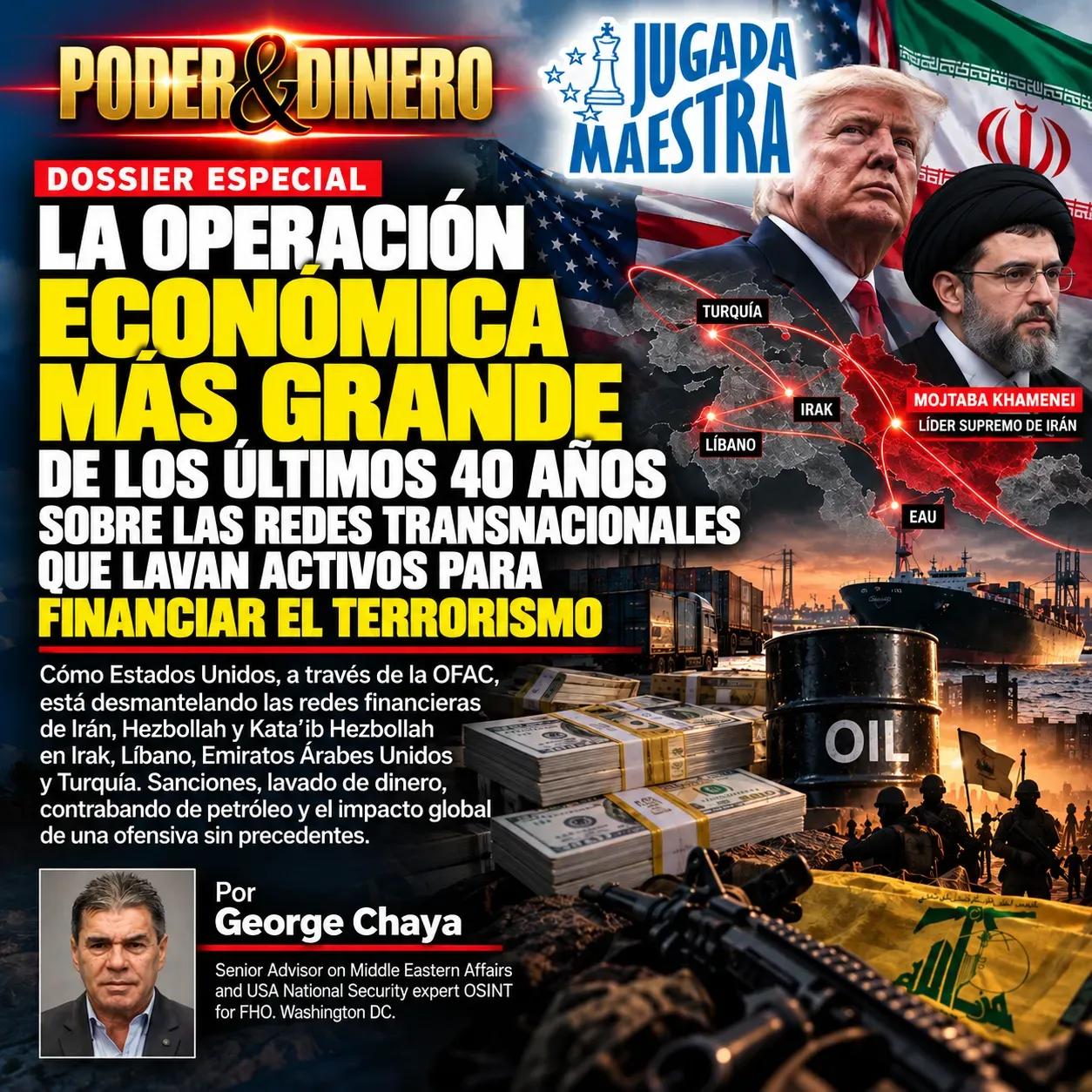
Beyond the words of President Donald Trump at the annual United Nations meeting regarding Iran, which sounded like a conclusive warning when the president said (referring to the regime): “Agree with me and become a great nation in the region and the world again, or you will be obliterated,” there is also a war that goes beyond the discursive and is hitting the regime as hard as bombs and missiles.
As part of the “Economic Neutralization Operation” (also called Economic Marginalization), the Office of Foreign Assets Control (OFAC) of the U.S. Treasury Department took action against the networks that allow Iran to continue sowing chaos in the Middle East through its satellite terrorist groups.
Following the barrage of severe sanctions announced on August 28 and reconfirmed on September 4, all directed against entities and individuals who comprise and support Iraqi Kata'ib Hezbollah (KH) and Lebanese Hezbollah, the OFAC updated its Licensing Policy Statement for Iran.
The operation targets those who support the Iranian regime (according to statements from Treasury Secretary Scott Bessent), whether they finance terrorism, launder money, or help Iran evade sanctions, “we will find them, disconnect them from the U.S. financial system, and dismantle the networks that keep the regime afloat,” Bessent said.
For the Treasury Secretary, Iraqi KH and Lebanese Hezbollah fuel Iran's destabilization in the Middle East, endangering U.S. forces and their allies, and facilitating schemes to evade sanctions.
The Treasury report underscores the global reach of the Iranian regime's illicit networks and the grave threat posed by the terrorist organizations that operate in its name, distributed across Iraq, Lebanon, the United Arab Emirates, and Turkey.
The latest designations target the most dangerous groups in Iran, which not only terrorize their civilian population but all of the Middle East, serving as instruments of Tehran to project violence, terror, and global destabilization. Hence, the recent measure is taken under Executive Order (EO) 13224 - amended - which targets terrorists and their supporters. The State Department designated KH as a Specially Designated Global Terrorist (SDGT) under EO 13224 and as a Foreign Terrorist Organization (FTO) under Section 219 of the Immigration and Nationality Act on June 24, 2009, for being responsible for multiple terrorist attacks against Iraqi and U.S. targets in Iraq.
Meanwhile, Lebanese Hezbollah was designated as a foreign terrorist organization under EO 13224 on October 31, 2001, under Section 219 of the Immigration and Nationality Act on October 8, 1997. The recent measure was taken under EO 13902, which targets persons operating in the oil, financial, and petrochemical sectors. The current measure, also known as “Economic D-Day”, is cutting off the last financing channels sustaining the Iranian regime. The Treasury Department has identified the networks, intermediaries, and financial channels Iran uses for oil smuggling, sanction evasion, and terrorism financing. Thus, in collaboration with its European partners and Arab Sunni Gulf countries, the Treasury Department is advancing against any illicit income sources of the regime, as well as its networks to evade sanctions and transfer funds.
The Economic Neutralization Operation significantly increases the risk of sanctions for those who continue doing business with Iran. The Treasury Department warned that any entity that facilitates money laundering or sanctions evasion on behalf of Iran risks being excluded from the U.S. financial system and faces increased exposure to secondary sanctions for those who continue doing business with the Khomeini regime.
KH is considered by Washington a prominent Iraqi terrorist faction within the so-called “Axis of Resistance” of Iran that receives training, weapons, funding, intelligence, and logistics from the Iranian Islamic Revolutionary Guard Corps/Quds Force (IRGC/QF), which is why it is categorized as a terrorist organization.
KH is also the most influential faction within the Iraqi Popular Mobilization Forces. KH members hold key leadership positions within the governing body of the PMF, including roles in the intelligence, anti-tank missile, and special forces directorates of the PMF. Thanks to this influence, KH is one of the main beneficiaries of over 2.6 billion dollars annually in funding from the Iraqi government allocated to the PMF, which instead diverts the wealth from the Iraqi people to support the Iranian regime, enhance the luxurious lifestyle of its leaders, and finance its own terrorist activities.
Iraqi Kata’ib Hezbollah threatens the American people both at home and abroad, as evidenced by the recent detention on May 16, 2026, of Mohammad Baqer Saad Dawood Al-Saadi, a senior KH commander (for attempting to organize the bombing attack against a synagogue in New York and other Jewish institutions in Los Angeles, Scottsdale, and half a dozen opportunistic targets that were successfully aborted by federal agencies on U.S. soil).
On the other hand, since February 2026, KH and other Iranian-aligned terrorist groups in Iraq have carried out several attacks against U.S. forces in Iraq and the region. These attacks include the use of explosive drones and indiscriminate rocket fire, endangering the lives and livelihoods of innocent Iraqi civilians and directly threatening the U.S. Embassy and diplomatic facilities. These attacks are conducted to promote Iran's desire to dominate Iraq and do not benefit the security or economic interests of the Iraqi people. Hence, the OFAC took action against four commanders and members of KH: Ali Hasan Farhan Al-Lami, a high-ranking KH commander, and Hussein Ahmed Hussein Al-Dhuhaibawi, Mohamed Ameen Fadhil Ali Al-Shaikhli, and Karrar Mohammed Qasim Al-Hraishawi, who are active members of KH.
Al-Lami, Al-Dhuhaibawi, Al-Shaikhli, and Al-Hraishawi are being designated pursuant to Executive Order 13224, as amended, for having acted or purported to act for or on behalf of, directly or indirectly, Kata'ib Hezbollah.
Also, Abbas Jawad Kadhim Al-Tameemi is a senior official of the Technical Equipment Directorate of the Popular Militias, headed by Salah Mahdi Hantush al-Maksusi, who is a U.S.-designated terrorist and former KH official. OFAC designated al-Maksusi in 2012 for his involvement in KH attacks against U.S. and coalition forces in Iraq.
Meanwhile, Al-Tameemi provides strategic guidance and technical advice on foreign military procurements and is considered an expert in defense equipment within the Iranian-aligned terrorist groups. Due to his position, his service, and support, the U.S. identifies Al-Tameemi as one who facilitates the provision of crucial financial and military support to the Quds Force of the Islamic Revolutionary Guard Corps (IRGC-QF).
Abdullah Nadhim Luaibi Al-Ameri is considered a weapon trafficker in the UAE, founder and CEO of Al-Brouj For General Contracting Company Ltd., based in Iraq. Through his control over Al-Brouj, Al-Ameri provides various goods and services to the pro-Iran Popular Militia’s private military company, including the illegal procurement of equipment with military applications. Al-Ameri provides support, such as maintenance of Russian-made helicopters to Iraqi military organizations operating under the direction of the Quds Force of the Islamic Revolutionary Guard Corps (IRGC-QF).
Khaldoon Naser Maryoosh Al-Abada is a representative of Ain Al-Iraq For Protecting Technology and Audio, Visual, and Communications Solutions Company Ltd. The company is engaged in dual-use technological procurements (military and technical) and is affiliated with the Iraqi National Private Companies (CMP). Ain Al-Iraq coordinates the acquisition of foreign defense equipment and components and has provided support to networks and individuals affiliated with the Quds Force of the Islamic Revolutionary Guard Corps (IRGC) in Iraq, and has conducted business transactions between Iraq, Russia, Iran, and China in order to acquire defense components, which has formed part of public corruption and sanction evasion schemes in Iraq. Ain Al-Iraq has also been used in attempts to procure U.S. defense material through its sanction evasion networks.
Al-Tameemi, Al-Ameri, and Ain Al-Iraq are being designated pursuant to Executive Order 13224, as amended, for having materially assisted, sponsored, and/or provided financial, material, or technological support, or goods or services to Saleh Mahdi Hantush al-Maksusi or in support thereof.
Al-Brouj is being designated pursuant to Executive Order 13224, as amended, for being owned, controlled, or directed by, or having acted or purported to act for or on behalf of, directly or indirectly, Al-Ameri.
Al Abada is being designated pursuant to Executive Order 13224, as amended, for having acted or purported to act for or on behalf of, directly or indirectly, Ain Al-Iraq.
Majid Ali Akbar Namdar Al-Mandalawi uses various Iraqi private banks to transfer funds through his money exchange company, Shams & Bahr Trading Company LLC.
This exchange platform based in Dubai has been used to send millions of dollars from Iraq to Iran through the UAE. Shams & Bahr Trading Company is also owned by Abdulhasan Ali A. Namdar Al-Mandalawi.
Shams & Bahr Trading Company, LLC is being designated for operating in the financial sector of the Iranian economy. Majid Ali Akbar Namdar Al-Mandalawi and Abdulhasan Ali A. Namdar Al-Mandalawi are being designated pursuant to Executive Order 13902 for having acted or purported to act on behalf of, or representing, directly or indirectly, Shams & Bahr Trading Company LLC.
The United States suspects that Hezbollah collaborates with the IRGC and its Quds Force sector using front companies to transfer cash funds from the sale of Iranian oil by smuggling the money from the profits to exchange houses in the region.
Federal agencies evaluate information that members of the IRGC's Quds Force in Lebanon collaborate with financial operators of Hezbollah to receive funds in Beirut through various Lebanese money changers, including Hussein Ibrahim and Abdallah Hamieh. See the February 2016 designation of Mohamad Noureddine, designated by the United States for having participated in the transfer of funds for over ten years. Other Lebanese businessmen and money exchangers constitute an important channel for transferring money from the Quds Force to Hezbollah.
Between May and September 2025, Hussein Ibrahim and Abdallah Hamieh transferred hundreds of millions of dollars from the Quds Force to Hezbollah. Once the money reaches Lebanon, Ossama Jaber, a member of Hezbollah designated by the United States in 2025, collaborates with Ghaith Hussein Wehbe (Wehbe), a Hezbollah courier, to personally collect the money from these currency exchangers on behalf of Hezbollah financial operators. The Lebanese organization uses these funds to purchase weapons, manufacture equipment, and pay the salaries of its members.
The financial operative of Hezbollah Hamdi Zaher El Dine, also designated by the United States, directs and operates several gold trading and cash exchange houses in Lebanon through family members and close associates to evade sanctions. While Hamdi Zaher El Dine does not appear in the legal structure of these Lebanese money exchange houses, he directs relatives who work there or are part of their legal financial structure. Hamdi’s sister, Mervat Jamil Zahreldine, works in two of these exchange houses on behalf of Hamdi, holding a position at Yousef Ibrahim Mansour Inc. and Partner for Exchange and a notarial power at Gold Pro SARL. Although Gold Pro SARL does not have a license from the Central Bank of Lebanon p"To import gold, Hamdi uses the Hawala system to buy gold in Dubai (United Arab Emirates) and then employs couriers and messengers to transport it to Lebanon.
Similarly, under Hamdi's direction, Amir Al-Makansi, based in Syria and Turkey, runs a gold exchange company based in Syria with additional offices in Istanbul, Turkey. While this exchange primarily operates with gold, it also uses Lebanese exchanges to convert currencies for Hamdi in high denomination bills, known in the Lebanese exchange sector for frequently coming from Hezbollah.
Both Hussein Ibrahim, Abdallah Hamieh, and Wehbe have been designated under Executive Order 13224, as amended, for providing material assistance, sponsoring, or providing financial, material, or technological support, or goods or services to Hezbollah or in support thereof.
Mervat and Amir Al-Makansi were designated under Executive Order 13224, as amended, for providing material assistance, sponsoring, or providing financial, material, or technological support, or goods or services to Hamdi or in support thereof.
YIM Exchange and Gold Pro SARL were designated under Executive Order 13224, as amended, for being owned by Hamdi, controlled by him, or directed by him, or for having acted or attempted to act on his behalf or representation, directly or indirectly.
Imposition of Sanctions on Iran: Transactions with sanctioned parties, as well as with jurisdictions such as Iran, are generally prohibited, and coercive actions related to Iran remain a priority for OFAC. Today, OFAC announced that an individual agreed to pay $1,427,230 to resolve his potential civil liability for providing consulting services and management advice to one of Iran’s leading software solutions companies. This individual also received Iranian-sourced dividends in his U.S. bank accounts and acquired real estate in Iran. The settlement amount reflects OFAC’s determination that the alleged violations were serious and not voluntarily disclosed. OFAC’s investigation and resolution of this matter were conducted in cooperation with the FBI’s Los Angeles Field Office and the Orange County Resident Agency. OFAC’s campaign to hold U.S. and foreign individuals accountable for violating sanctions against Iran will continue as part of the Economic Marginalization Operation.
A few days ago, OFAC published a new Licensing Policy Statement for Iran , informing the public about the presumption of denial unless required by law or under certain circumstances, such as risk to life, physical integrity, or environmental security. Additionally, OFAC’s Licensing Division immediately began denying the vast majority of pending specific license applications related to Iran. OFAC will maintain this licensing policy until Iran modifies its behavior, including obstructing the Strait of Hormuz, attacks against U.S. personnel and partners in the Gulf, and the development of nuclear and conventional weapons. Applicants are advised to subscribe to OFAC's Recent Actions to receive updates.
As a result of the action taken, all property and interests in property of the individuals designated or blocked described above that are located in the U.S. or in the possession or control of U.S. persons are blocked and must be reported to OFAC. Additionally, any entity that is owned, directly or indirectly, individually or collectively, 50% or more by one or more blocked persons is also blocked. Absent a specific license from OFAC or in the event of an exemption, OFAC regulations generally prohibit all transactions conducted by U.S. persons or within (or transiting) the United States involving the property or interests in property of blocked persons.
Violations of U.S. sanctions may result in civil or criminal penalties against U.S. and foreign nationals. OFAC may impose civil penalties for violations of sanctions under the principle of strict liability. OFAC Guidelines for Economic Sanctions provide more information about the enforcement of such sanctions by OFAC. Additionally, financial institutions and other persons may be exposed to sanctions for engaging in certain transactions or activities involving designated or blocked persons. Prohibitions include making any contributions or providing funds, goods, or services by, to, or for the benefit of any designated or blocked person, or receiving any contribution or providing funds, goods, or services from such person. Also, non-U.S. persons are prohibited from causing or conspiring to cause U.S. persons to violate, knowingly or unknowingly, U.S. sanctions, as well as engaging in conduct that evades such sanctions. Individuals residing in the U.S. or abroad who provide information about sanction violations to the whistleblower incentive program of FinCEN may be eligible for rewards if the information provided leads to successful enforcement action resulting in monetary sanctions exceeding $1,000,000.
Furthermore, conducting certain transactions with the individuals designated today may carry the risk of secondary sanctions being imposed on participating financial institutions. OFAC may prohibit or impose strict conditions for the opening or maintenance in the United States of a correspondent account or payment account through a foreign financial institution that knowingly conducts or facilitates any significant transaction on behalf of a designated person under the relevant authority.
The effectiveness and integrity of OFAC's sanctions rely not only on its ability to designate and include individuals on the SDN List but also on its willingness to remove them from that list in accordance with the law. The ultimate goal of sanctions is not to punish peoples, but to neutralize the actions of networks and individuals engaging in illicit activities related to criminal convergence to induce positive change in criminal behaviors.
*Prof. George Chaya, is a Senior Advisor on Middle Eastern Affairs and USA National Security expert OSINT for FHO based in Washington DC.
"
Comments