Every time I hear that Rayados and Tigres are getting ready to play another Classic in Monterrey, something happens inside me.
For a moment, I am no longer a retired DEA agent, thousands of miles and fifteen years away from that chapter of my life.
I am back in Monterrey.
It’s Friday, July 22, 2011.
And my friends are still alive.
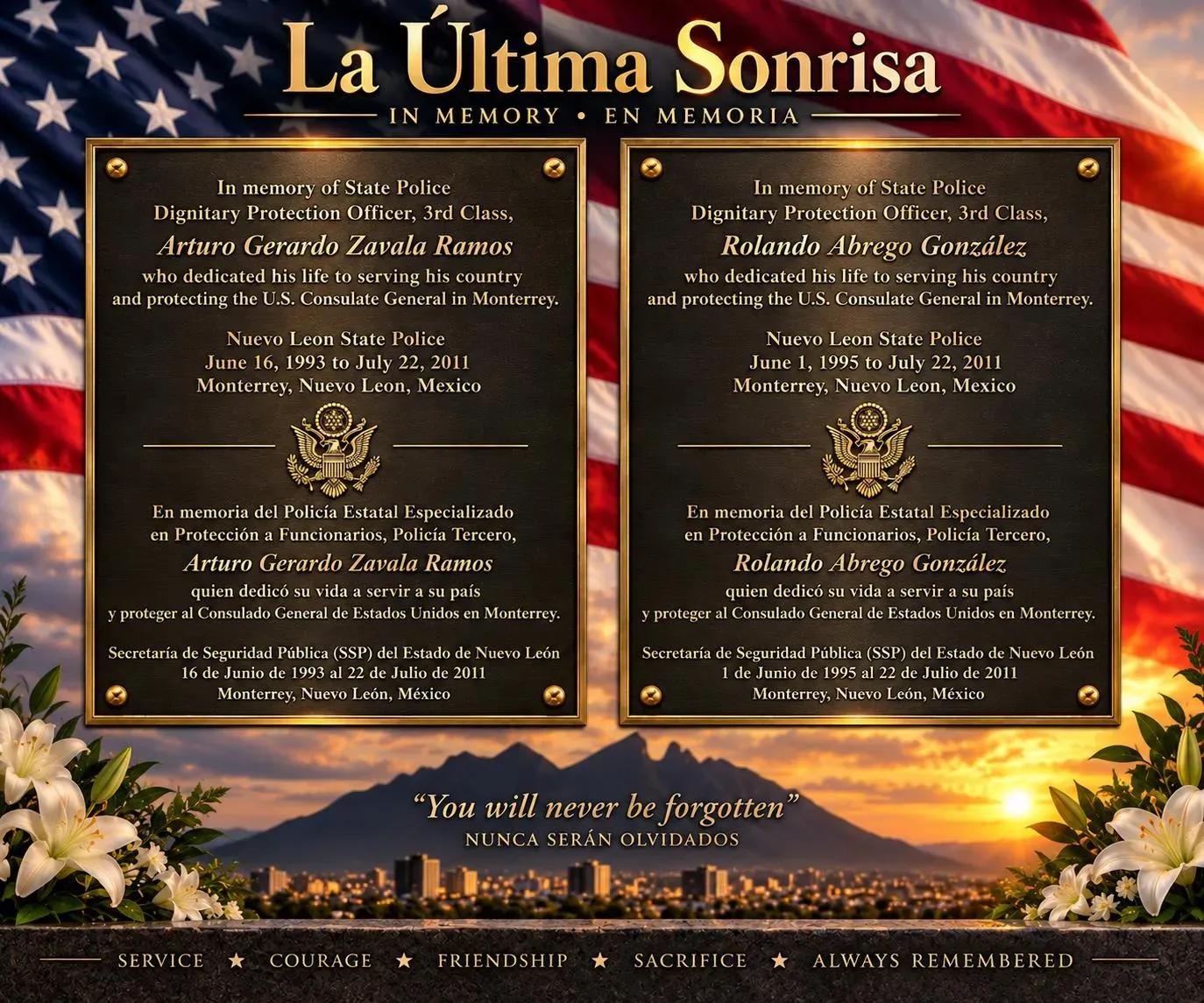
Their names were Rolando Abrego González and Arturo Zavala Ramos.
They were members of the State Police of Nuevo León assigned to the protection team of the United States Consul General. But that description has always seemed insufficient to me. Abrego and Zavala were much more than two police officers I met through my work at the U.S. Consulate.
They were my friends.
Before our families were ordered to leave Monterrey in 2010 due to the worsening security situation, Abrego and Zavala would attend dinners at my house. They would sit at my table and eat with us. Across the street was a park where my children and the children of the Consul General played, and these two men watched over them while we enjoyed our evenings.
I entrusted my children to Abrego and Zavala.
There are few expressions of trust greater than what one person can deposit in another.
When our families finally left Monterrey, those of us who remained grew even closer. During some of the darkest days the city had lived through, the people around us became our substitute family.
Abrego and Zavala were part of mine.
However, that July Friday morning, none of us were thinking about a tragedy.
We were thinking about soccer.
Monterrey was gearing up for the Classic between Rayados and Tigres. It seemed to be the only thing everyone wanted to talk about, and we were no different.
When I arrived at the Consulate that morning, I found members of the Consul General’s protection team next to their armored Suburban, impeccably dressed, as always, in their black suits and polished shoes.
We started talking about the game.
I jokingly told them that Rayados was going to beat Tigres and that I didn’t want to see them crying over the defeat when I saw them again on Monday.
They laughed.
I laughed.
Abrego smiled.
I can still see that smile.
There was nothing extraordinary in that moment when it happened. We were simply friends joking with each other about a soccer game.
I didn’t know I was saying goodbye.
None of us knew.
Hours later, Consul General Nace Crawford left for the airport. His protection team returned to the Consulate, and Abrego and Zavala changed from their suits into civilian clothes.
Zavala had recently bought a Suzuki motorcycle and was proud of it. He was eager to get home, prepare a barbecue, and enjoy the Classic.
The two friends got on the motorcycle and left together.
About ten minutes later, they were attacked in Guadalupe.
Abrego died on the spot.
Zavala died shortly after.
The men I had laughed with that morning were no longer there.
The next day I attended both funerals.
Two funerals in a single day.
Abrego’s coffin remained closed.
As his family prayed the final Hail Marys, Consul General Crawford, another colleague, and I were granted the privilege of approaching his silver coffin, covered in white flowers, to bid farewell.
I placed my hand on the coffin.
Nace also placed his hand on it.
Then our gazes met.
I have never forgotten that look.
Neither of us said a word. There was nothing to say. At that moment, he was not the United States Consul General and I was not the Resident Agent in Charge of the DEA.
We were simply two men with broken hearts who had lost their brothers.
Tears ran down our faces while Abrego’s family continued praying.
I thought of the man who was inside that coffin.
I thought of him sitting at my table.
I thought of him watching over my children.
And I remembered his smile.
As Abrego’s coffin remained closed, death could never replace the last image I hold of my friend.
The last time I saw Abrego, he was smiling.
Perhaps that was a final kindness.
But he is never alone in that memory.
Zavala is always there too.
I remember his excitement about his motorcycle. I remember him sitting at my table. I remember both men watching over our children in the park. I remember two friends with families, plans, and a future ahead.
Their loss changed something inside me and, somehow, I have carried it ever since.
Their deaths also forced me to confront something I had always understood intellectually, but had never felt so deeply: the fragility of life. Just hours earlier we had been laughing together, talking about soccer and making plans for the weekend. Then, without warning, they were gone.
That reality struck me deeply.
Life doesn’t always give us time to prepare for a loss. There isn’t always the chance for a final conversation, a last hug, or even an appropriate goodbye.
Sometimes, an ordinary moment becomes precious only after it has been lost.
Perhaps that is why I have held on so tightly to that Friday morning.
Fifteen years have passed.
The investigations ended. Over time I retired. My children grew up. I put the badge away. Life went on, as it always does.
But I still mourn the loss of my friends.
And every time another Classic approaches in Monterrey, time folds back on itself.
For a moment, I am back.
Friday morning.
The black suits.
The polished shoes.
The jokes about Rayados and Tigres.
Zavala.
Abrego.
And the three of us laughing together.
If I had known that those would be our last moments together, maybe I would have said something profound. I would have thanked them for their friendship. I would have thanked them for sitting at my table and for watching over my children. I would have told them that during some of the darkest years of our lives, they had become family.
But life rarely warns us when a goodbye will be the last.
Sometimes there is no goodbye.
Sometimes there is just a handshake.
A joke about a soccer game.
Friends laughing on a Friday morning.
And a smile.
I cannot change what happened on July 22, 2011.
But I can choose how to remember my friends.
I choose not to remember Abrego and Zavala by the way they died.
I remember how they lived.
I remember them sitting at my table.
I remember them watching over our children.
I remember Zavala, proud of his motorcycle and looking forward to the weekend.
I remember Abrego smiling.
And I remember myself smiling with them.
As long as those of us who love Rolando Abrego González and Arturo Zavala Ramos continue to say their names and tell their stories, a part of them will remain with us.
Fifteen years have passed.
My friends have never been forgotten.
And as long as I am here to remember them, they never will be.
The last smile.
Abrego and Zavala.
My friends. My brothers.
They will never be forgotten.
Before there were headlines, there was Leo Silva, working in the shadows of Mexico and facing some of the most dangerous drug trafficking organizations in the Western Hemisphere.
Retired Special Agent of the United States Drug Enforcement Administration (DEA), Silva spent 28 years on the front lines of the American struggle against transnational organized crime, including a decade stationed in Mexico. His career took him from undercover investigations along the southwestern U.S. border to postings in Guadalajara and Monterrey, where he ultimately served as Resident Agent in Charge of the DEA Office in Monterrey, during one of the most violent periods in recent Mexican history.
Today, Silva brings all those experiences to the pages of his writings.

Comments