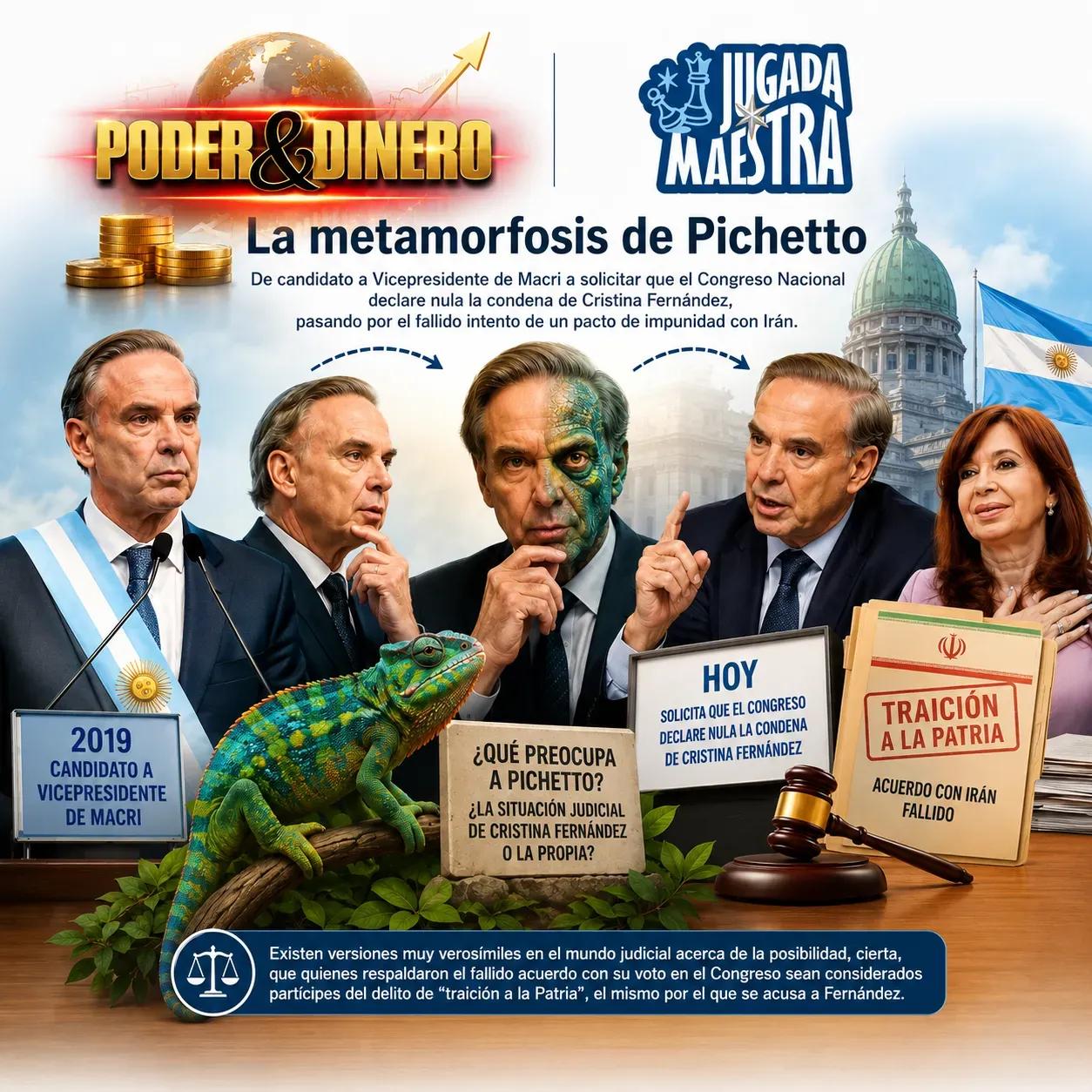
In Argentine politics, transformations are often frequent. However, few are as striking as that of Miguel Ángel Pichetto. Who, for years, presented himself as a staunch defender of republican institutionality, running mate of Mauricio Macri in 2019 and a severe critic of Kirchnerism, now surprises by promoting initiatives aimed at questioning the judicial conviction against Cristina Fernández de Kirchner.
The political evolution of the experienced leader from Río Negro seems worthy of an entomological study. From the discourse of the threatened Republic, he has moved to holding positions that, for many of his former allies, imply an indirect defense of who was for years his main political adversary.
The question inevitably arises: what really worries Miguel Ángel Pichetto? The judicial situation of Cristina Fernández or his own?
The doubt does not appear by chance. It is worth remembering that Pichetto was one of the main parliamentary promoters of the so-called Memorandum of Understanding with Iran, the controversial agreement signed during Cristina Fernández's government that proposed the creation of a "Truth Commission" and effectively suspended the normal progression of the judicial investigation into the attack against the AMIA.
That agreement was presented by its defenders as an innovative diplomatic tool. Its detractors, on the other hand, described it as an attempt to guarantee impunity for Iranian officials accused by the Argentine Justice of participating in the worst terrorist attack in the country's history.
Pichetto not only publicly defended the Memorandum. He also voted in favor of turning it into law. He did so with enthusiasm, conviction, and a political discipline that today seems to have been carefully filed away along with other uncomfortable memories from his extensive career.
In federal courts, persistent versions have circulated for years regarding the potential criminal responsibility of those who institutionally supported that initiative. Various specialists argue that, if certain legal interpretations prevail, the legislators who accompanied the agreement could eventually be caught up in investigations related to the crime of treason to the Fatherland, the same penal figure that was invoked at different times by those who denounced the Memorandum.
Of course, none of this implies a condemnation or formal accusation against Pichetto. But it does help to understand why some observers look with curiosity at his sudden interest in others' judicial situations.
Perhaps the explanation is much simpler. It may simply be a new station in the endless ideological journey of Argentine politics, where some leaders change positions with the same ease with which others change homes.
Or perhaps not.
What is certain is that the metamorphosis is visible. From being Mauricio Macri's running mate to a circumstantial defender of Cristina Fernández. From the discourse of the Republic to concern about the consequences of judicial decisions. From rejection of Kirchnerism to seeking mechanisms to question its convictions.
Franz Kafka would probably have enjoyed observing such a transformation.
José Daniel Salinardi is a Public Accountant graduated from the Faculty of Economic Sciences of the University of Buenos Aires. Producer of Poder & Dinero and Jugada Maestra (FinguTv)
Comments