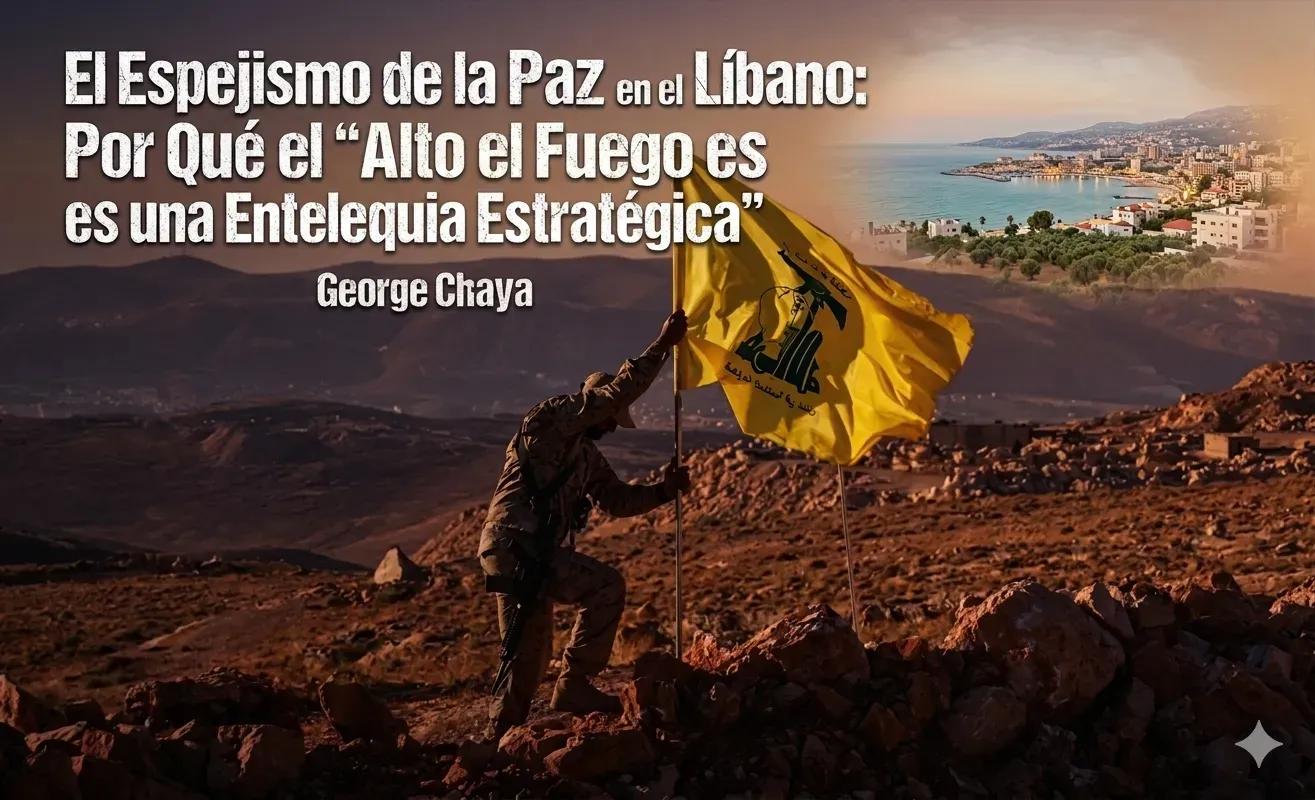
In the specific case of the border between Israel and Lebanon, the idea of a definitive cessation of violence is nothing more than an unattainable ideal, it is a perfect theoretical construct whose only problem is that it clashes head-on with the dynamics of survival, deterrence, and sovereignty of the conflicting actors.
To understand the nature of the current announced ceasefires -such as the 60-day mediated pact at the end of 2024 and the subsequent attempts to sustain it- it is imperative to shed the lenses of institutional idealism. We are not witnessing the birth of an era of reconciliation, but rather a sophisticated tactical reconfiguration of the balance of power. The war has not ended; it has simply changed its rhythm and is far from concluding.
The heritage of the failure of UN Resolution 1701, from its inception to the present, perfectly traces the genealogy of the current infeasibility of peace when it comes to the dogma of religious terrorism. In other words: "if with reivindicative and secular terrorism, the possibility of achieving success in a negotiation was scarce, the chances of reaching an agreement with religious terrorism “are zero-sum”. The analysis must necessarily go back to August 2006. After a devastating 34-day war, the United Nations Security Council unanimously approved Resolution 1701. The document, impeccable on paper, demanded the creation of a demilitarized zone between the “Blue Line” (the de facto border between Lebanon and Israel -set by the UN-) and the Litani River. In that strip of land, exactly 32 kilometers wide, no armed group other than the official Lebanese army or the “blue helmets” of UNIFIL could operate.
However, what was the pragmatic reality almost twenty years after what the sociologist Johan Galtung defined as “negative peace”: “which he referred to as the equivalent of the absence of large-scale armed conflict, but with a massive accumulation of structural tensions.” Hezbollah not only did not disarm, violating Res. 1701 and also 1559 (from 2005), but exponentially multiplied its arsenal and offensive military capabilities. The Shiite group built an extensive network of tunnels, stored hundreds of thousands of precision rockets and drones, and perfected its guerrilla combat capabilities. For its part, Israel continued to operate and respond from Lebanese air and land space under the premise of preventive surveillance and the security of its citizens residing in its northern towns and cities (the most affected by Hezbollah since 1982). International institutions, represented on the ground by UNIFIL, demonstrated their intrinsic inability to impose the disarmament of a non-state actor that possesses, in practice, military and political capabilities superior to those of the state that hosts it.
The outbreak on October 8, 2023, was nothing more than the logical consequence of this unresolved security dilemma. By opening fire in northern Israel in “solidarity” with the terrorists of Hamas in the Gaza Strip, Hezbollah blew up the last appearances of Resolution 1701.
The realistic logic behind the agreements attempted between the Israel Defense Forces (IDF) and Hezbollah negotiated in a ceasefire, such as the one orchestrated in November 2024, under the auspices of the United States and France, has shown naive analysts -or those with a vested interest- that they are not seeking the “goodwill” of the signatories, but their strategic results.
For Israel, a temporary ceasefire addresses three critical operational needs: a) Resource management and combat fatigue, maintaining multiple active fronts simultaneously drains economic and military resources and the morale of reserve troops, b) Internal pressure: The forced displacement of over 50,000 civilians from the north of the country generates a complex political crisis for any administration in Jerusalem. Freezing hostilities allows for a projected return of the population, c) Freedom of covert action: Since this is not a binding peace treaty, Israeli strategists reserve the right to carry out “surgical” attacks or bombings if they detect that the adversary violates the red lines of rearmament or mobilization south of the Litani.
On the other hand, for Hezbollah, the truce represents an indispensable breath of fresh air. After suffering devastating blows to its leadership structure and military infrastructure during the Israeli land and air incursions at the end of 2024 and the current ones, the group needs time. “The ceasefire grants it the logistical window necessary to reorganize its command structures, replenish its arsenals through the porous borders with Syria, and consolidate its narrative of resistance before its Shiite social base in Lebanon.”
Under this reality, “the ceasefire” does not seek to extinguish the fire; it seeks to prevent the combatants from burning out completely before being ready for the next battle. However, the insurmountable obstacles of geopolitics confront the aforementioned postulates, and there are structural factors that render permanent peace in southern Lebanon a factual impossibility in the medium term. The political analysis must contemplate three unmovable vectors: First, the asymmetry of commitments and organizational survival. Israel's main requirement for a lasting cessation of hostilities is the total withdrawal of Hezbollah to the north of the Litani River and its subsequent disarmament. For Hezbollah, voluntarily accepting this would mean signing its own political and military death sentence in the country. The Iranian organization derives its currently worn internal legitimacy among many Lebanese from its status as "resistance" against Israel. Disarming and abandoning its territorial strongholds in the south would mean transforming itself into a conventional political party, losing its main bargaining chip and the veto power it exerts over the Lebanese state by the force of its arms.
Secondly, there is the ineffectiveness and weakness of the Lebanese State. Recent agreements usually delegate the monitoring of southern Lebanon to the Lebanese Armed Forces (LAF). However, pragmatic analysis shows that Lebanon's official armed forces lack the budget, equipment, and, above all, the cohesion and political will necessary to confront Hezbollah and force its withdrawal. Thus, the country navigates in a chronic institutional collapse; to expect that its armed forces will subdue the most powerful militia in the region is to commit a grave analytical naivety.
Finally, the conflict is not purely a proxy clash embedded in the larger security architecture of the Middle East. Hezbollah has historically functioned as the most valuable piece of the “Axis of Resistance” commanded by the regime of the Islamic Republic of Iran. The strategic decisions of the group on when to attack and when to halt are not made by its political-military leadership in the suburbs of Beirut, but directly respond to the deterrence needs and geopolitical projection of Tehran against Israel and Western powers. As long as the cold war (and sometimes hot, as in the current case) persists between Iran and Israel, the Lebanese border will remain a powder keg ready to explode.
In conclusion, the war by other means, according to the term coined by Carl von Clausewitz, configures the famous maxim that war is the continuation of politics by other means. In the intricate labyrinth of the conflict between Israel and Hezbollah, one could invert the postulate: the ceasefire is the continuation of war by other means. But one should not confuse the temporary absence of massive bombings with the resolution of the conflict. The underlying factors that drive both actors to violent clashes, the significance of the security that Israel grants to its borders, and the political-military agenda of Hezbollah supported by Iran remain absolutely intact.
Anyone intending to write or legislate about Lebanon, assuming that a mediated agreement by the United States, Saudi Arabia, or other actors in the international community to end decades of bloodshed, will fall into the delusion of erroneous thinking. In the realm of Realpolitik, ceasefires are tools of military engineering. The ceasefire is not the prelude to peace, but the silent timer that marks the countdown to the next inevitable outbreak of violence.

By George Chaya (Washington DC) *
*Professor George Chaya is a Senior Advisor on Middle Eastern affairs in National Security and an expert in OSINT (Open Source Intelligence) based in Washington DC, USA.

Comments