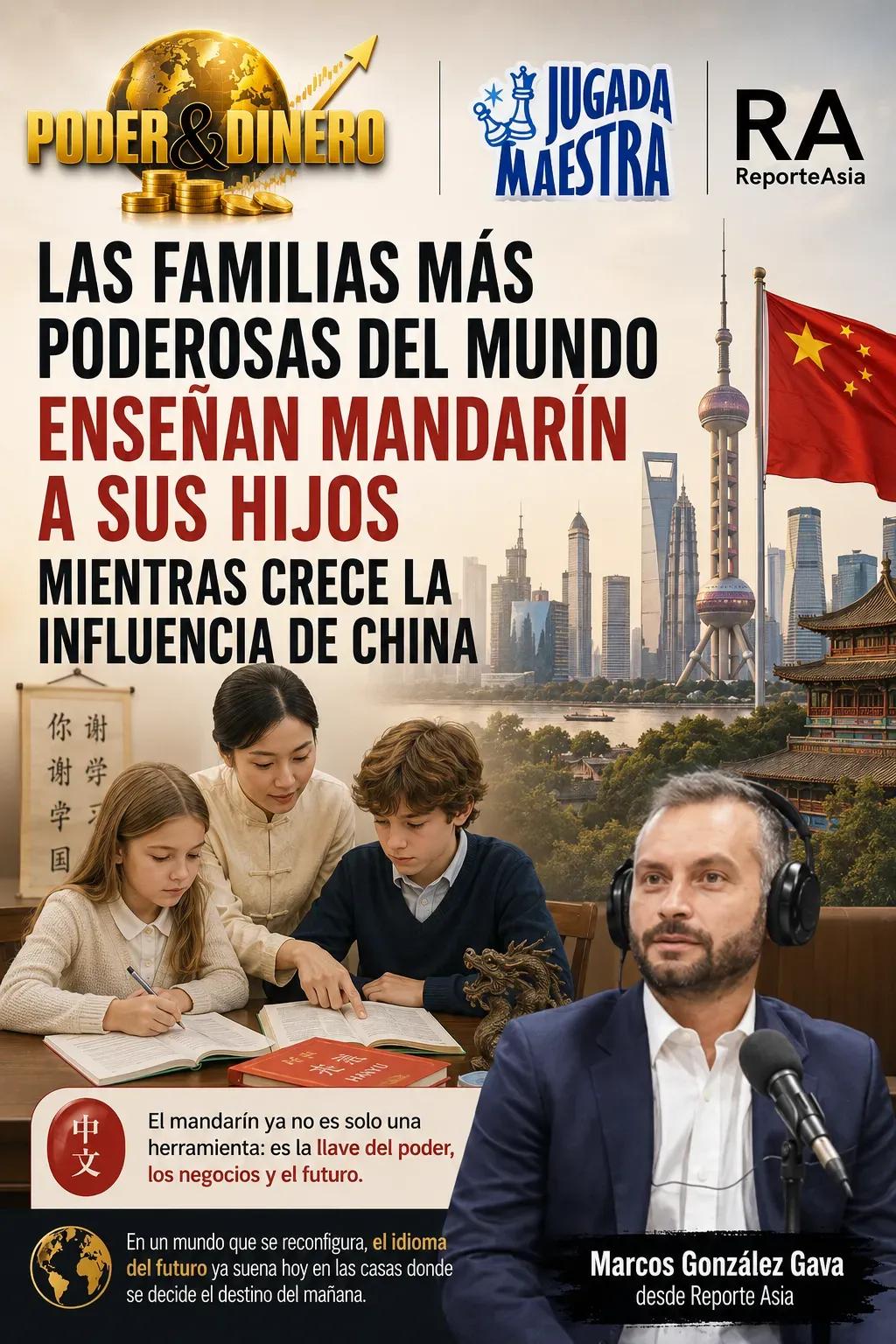
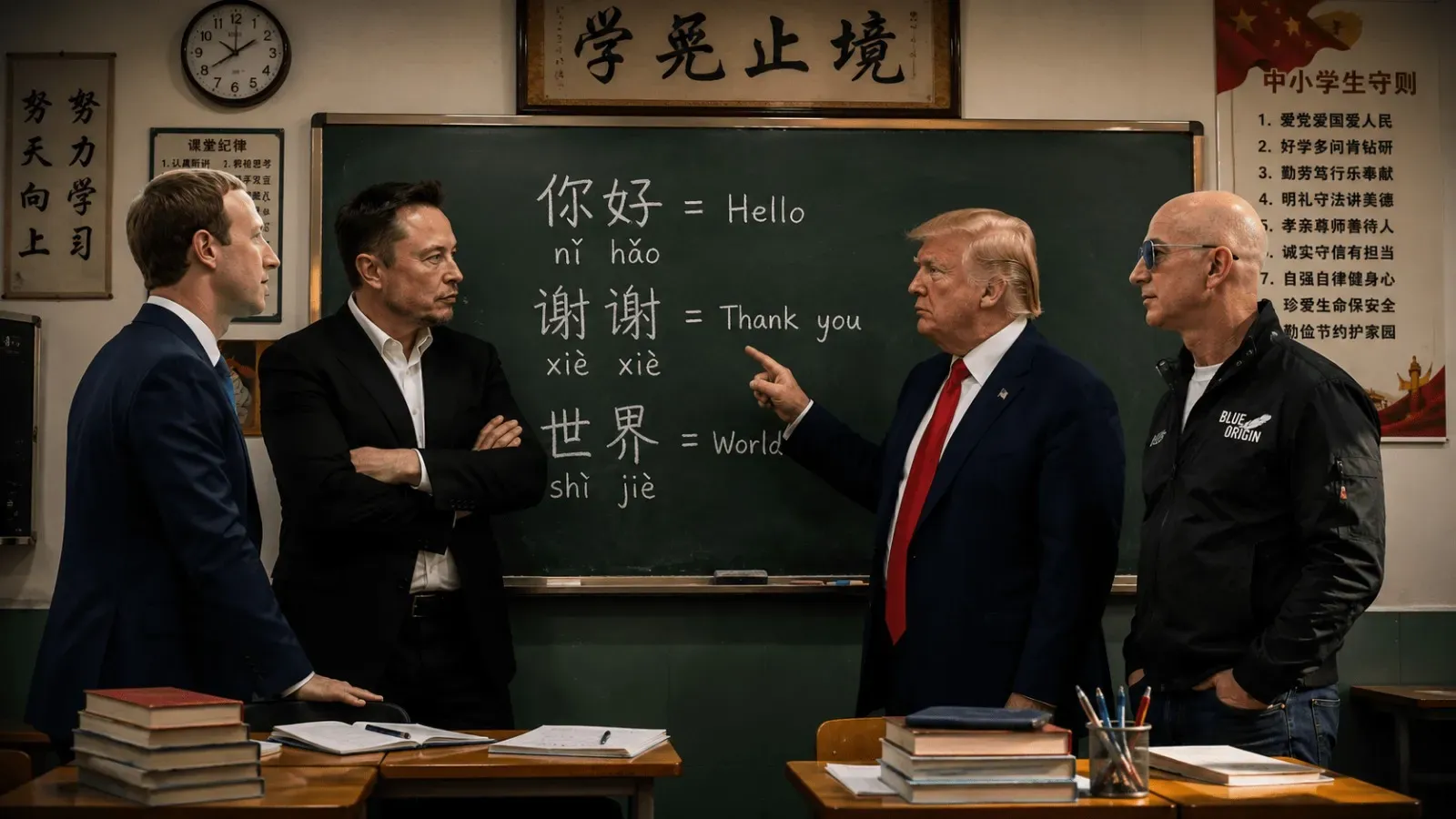
Elon Musk published it in Mandarin: "我的儿子正在学习普通话". My son is learning Mandarin. The post did not go unnoticed, but Musk is not the only one. Donald Trump's grandchildren, Jeff Bezos' children, and Mark Zuckerberg's children (who also speaks it) are also studying the official language of China. Prince George, heir to the British crown, is said to have learned some Mandarin in primary school.
The phenomenon is neither coincidence nor fashion: it is calculation.
Self-interest, not idealism
Kerry Brown, a professor of Chinese studies and director of the Lau China Institute at King's College London, states it bluntly: with China as the second largest economy in the world, the powerful have obvious practical reasons to learn the language.
"It's simply self-interest and the recognition that China will be a hugely significant technological and economic partner in the future," he noted. "If you are interested in the business world, even if you are skeptical or not particularly friendly with China, it makes sense to learn Chinese."
Brown also highlights the diplomatic dimension. When Trump's granddaughter, Arabella Kushner, sang in Mandarin in front of Xi Jinping during the Chinese president's state visit to the United States in 2017—and became a sensation on Weibo—the academic called it good diplomacy. The language as a gesture of soft power.
The phenomenon is not limited to the West. Vladimir Putin declared during his recent visit to Beijing that over 100,000 Russians study Chinese, and 20,000 do so directly in China. The Kremlin's press secretary, Dmitry Peskov, acknowledged that his daughter speaks Chinese before Russian, thanks to her nanny.
The gap in the Western academic world
Despite the interest of the elites, the situation in Western universities is going in the opposite direction. In Australia, research by the Australian Academy of Humanities revealed that only seven of the fourteen universities with Chinese studies programs offer undergraduate degrees in Chinese studies with a linguistic component.
Between 2017 and 2021, the average number of annual graduates in that specialty did not exceed five. The chairman of the parliamentary education committee, Labor's Tim Watts, warned last year that enrollments in Southeast Asian languages at Australian universities had dropped by 75% between 2004 and 2022.
The Australian government announced last month an investment of $2.5 million to promote the learning of Asian languages in nine organizations in Victoria, the Australian Capital Territory, and New South Wales, as part of a $25 million program aimed at secondary school students.
Mandarin in Latin America: growing presence, shallow depth
In Latin America, interest in Mandarin has grown alongside China's economic expansion in the region, but it remains marginal in terms of critical mass. The Confucius Institutes—present in Argentina, Brazil, Mexico, Chile, Colombia, Peru, Ecuador, Venezuela, and Cuba, among others—constitute the main channel for accessing the language, with a network of over 40 locations that combine Mandarin teaching with cultural promotion. Universities such as UBA, UNAM, USP, or the University of Chile offer courses or degrees with a Chinese component, but postgraduate programs with advanced linguistic levels are scarce, and graduates with functional Mandarin for business or diplomacy remain a rarity.
The profile of the Latin American Chinese student is primarily instrumental: commerce, logistics, tourism, or bilateral relations with Beijing, driven by China's weight as the first or second trading partner for most countries in the region.
However, unlike the Australian or European cases, Latin America lacks systematic public policies for funding the study of Asian languages, which leaves the development of this capability almost exclusively in the hands of private initiative and direct cooperation with Chinese institutions—raising questions about academic autonomy and agenda in the content.
Globally, more than 30 million people study Chinese Mandarin. This figure includes students of all ages spread across more than 180 countries. The growth of the language has been driven by digital platforms and its economic importance.
What AI cannot replace
Returning to Australia, Ning Zhang, a Chinese studies lecturer at the University of Adelaide, warns in an article for ABC News that the growing reliance on artificial intelligence for translation is no substitute for genuine language learning. "Chinese culture is fundamentally based on relationships and connections. AI is a cold machine. Sometimes it's not about a verbal expression, but a transfer of verbal message. That’s why learning the language is so important face-to-face, from human to human, and also through immersion in China or in Chinese-speaking communities such as Hong Kong, Taiwan, and Singapore."
Elijah Barrott-Walsh, a biomedical engineering and Chinese studies student at the University of Adelaide, agrees: "The language is inseparable from culture, history, and tradition. It is such an idiomatic language. So much meaning is lost when moving from Chinese to English."
For Kirsty Duff, who grew up speaking Chinese at home and is studying international relations in Adelaide, she points out a gap that she considers strategic: "In China, all the children of people in high positions study English. It is a critical subject. But here we do not have that requirement with languages." On LinkedIn, she specified, she has already received professional contacts specifically due to her command of Mandarin.
A language as a bet of the time
Mandarin is quietly becoming the "new English" for global elites. Not in terms of universality, but as a signal: those who learn it are betting on a world where China is not a peripheral variable but a central axis of the economy, technology, and diplomacy.
That this bet is led by the children of Musk, Bezos, and Zuckerberg—the architects of Western digital capitalism—says more about the reordering of global power than any macroeconomic index.
Marcos González Gava is Co-Founder of Reporte Asia, a specialist in economic financial business and cultural affairs with the People's Republic of China.

Comments