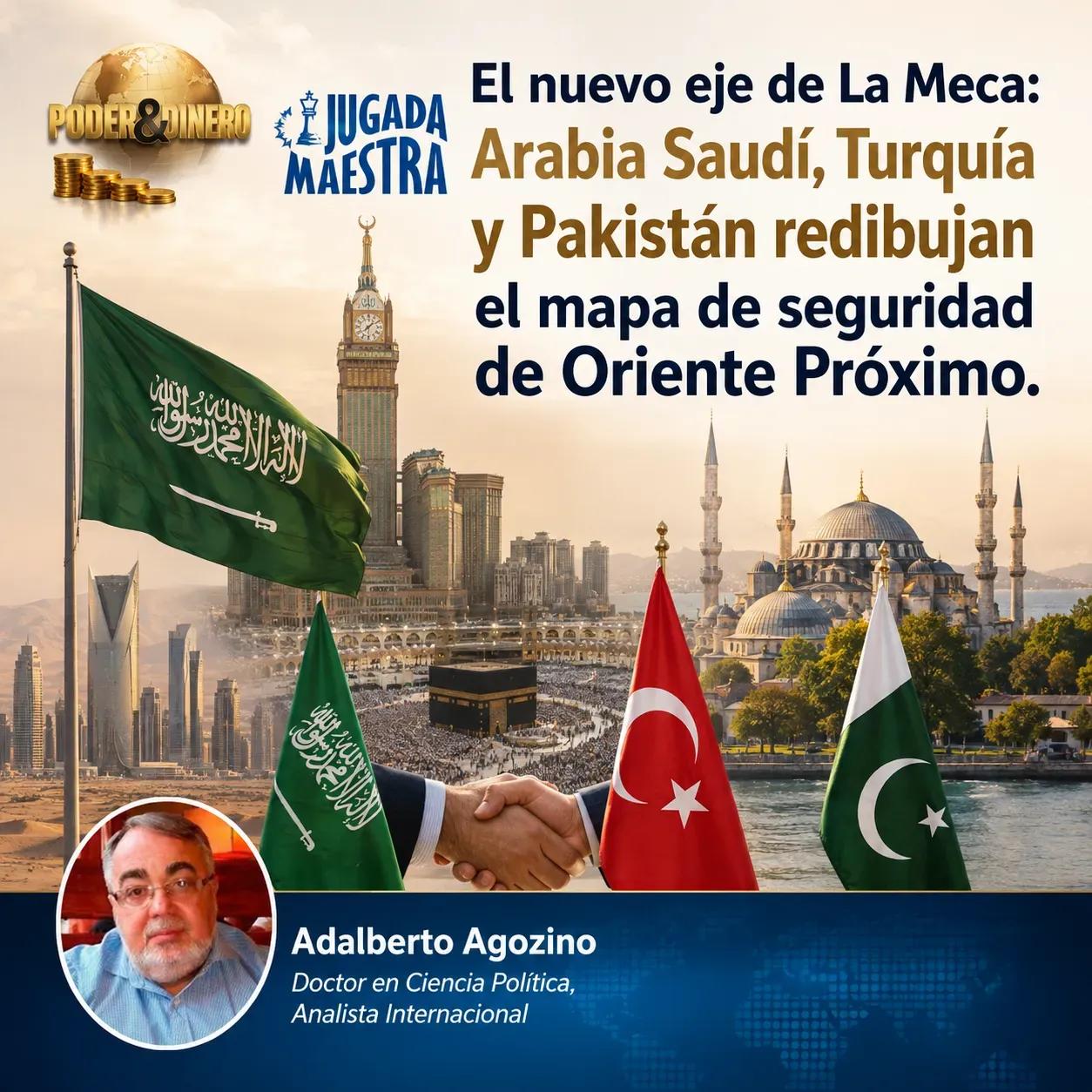
The photograph of Mohammed bin Salman, Recep Tayyip Erdogan, and Shehbaz Sharif gathered in Mecca carries a powerful symbolic weight. Three leaders from three of the main Sunni Muslim powers have decided to place the security of their countries under a single political and military umbrella. The so-called Joint Defense Agreement of Mecca, signed on August 7, establishes that an armed attack against any of the three states will be considered an attack against all. The document also provides for an expansion of defensive cooperation, including joint exercises, training, intelligence sharing, and technology.
The importance of the pact, however, does not reside solely in its clauses. It resides in what its three signatories represent. Saudi Arabia brings financial resources, energy, and a central position in the Arab and Islamic world. Turkey has the second largest army in NATO and a defense industry that has become one of Ankara's instruments for projecting power abroad. Pakistan is the only Muslim-majority state that possesses a nuclear arsenal.
This combination is extraordinarily significant. Not because a new military alliance comparable to NATO has been born—the treaty still lacks public activation mechanisms and does not specify what concrete response applies to each member—but because three regional powers have begun to build a partial alternative to a security architecture that has been dominated by the United States for decades. Reuters precisely underscores the absence of specific military commitments despite the political formula for collective defense.
Security is no longer dependent on a single guarantor
For Saudi Arabia, the agreement primarily represents a diversification policy. For decades, the kingdom's security fundamentally relied on its strategic relationship with Washington. But the attacks on Saudi oil facilities, the war in Yemen, the uncertainties generated by U.S. policy, and the inability of external guarantees to prevent the Gulf allies' territory from being exposed have altered Riyadh's calculations.
The bilateral pact signed with Pakistan in September 2025 had already anticipated this move. The new agreement now incorporates Turkey and transforms a bilateral relationship into a broader security network. The International Institute for Strategic Studies believes that the Saudi-Pakistani agreement was already altering the strategic ties between the Middle East and South Asia.
Riyadh is not abandoning the United States. It is doing something more sophisticated: reducing its dependence on a single guarantor. The strategy consists of simultaneously having Washington, Islamabad, Ankara, and, in the economic and technological realm, Beijing. Diversification allows for an increase in maneuvering room and prevents a potential decision by Washington from leaving the kingdom strategically exposed.
This behavior reflects a broader trend. A recent analysis from the Carnegie Endowment points out that countries in the Middle East are practicing a hedging policy, that is, of strategic coverage between the United States and China, but also through relationships with intermediary powers like Pakistan, South Korea, or Turkey. The goal is not necessarily to choose between Washington and Beijing but to avoid being exclusively dependent on either.
The most precise expression to define the new Saudi strategy is, therefore, "break with the United States", but Islamic strategic reassessment. Riyadh seeks to ensure that its survival does not rely on a single security relationship.
A message for Washington and Beijing
The new alliance also introduces a variable in the rivalry between the United States and China. Beijing does not need to become the military guarantor of Saudi Arabia to benefit from this transformation. China can take advantage of the growing desire for strategic autonomy among the Gulf monarchies while maintaining its position as the main trading and energy partner of many countries in the region.
Washington still retains military advantages that China is far from matching. The United States has an extensive network of bases and security agreements in the Middle East, while China lacks a comparable military architecture. Beijing has so far opted for a more cautious presence, combining investments, trade, technology, diplomacy, and arms sales.
The Mecca pact could accelerate this indirect competition. The greater the military autonomy of regional powers, the less capability the U.S. will have to use its position as an indispensable security provider. But it may also benefit Washington: greater regional capacity to contain threats could reduce the cost of U.S. military presence.
The outcome will depend on whether the alliance evolves toward a permanent military structure or remains a flexible coordination mechanism. For now, Saudi and Turkish authorities insist that the agreement is not aimed at any specific state and does not intend to replace existing alliances.
The Israeli factor
The most delicate dimension of the new axis is Israel. Turkey maintains an increasingly conflictive relationship with Benjamin Netanyahu's government, especially due to the Gaza war. Saudi Arabia, while it has not turned Israel into a strategic enemy, has hardened its political conditions for eventual normalization. Pakistan, for its part, does not diplomatically recognize Israel.
The existence of a military structure linking the three countries increases the potential cost of a regional escalation. But it would be exaggerated to automatically interpret the pact as an anti-Israeli alliance. The text itself avoids identifying adversaries, and Riyadh has expressly rejected it being a sectarian or military block directed against a specific state.
The most likely consequence is another: Israel will have to incorporate a new variable into its strategic calculations. Until now, it could consider separately Turkey's military capabilities, Saudi wealth, and Pakistani deterrence. The pact creates, at least potentially, a space for coordination among these capabilities.
This is particularly important for Turkey. Ankara is a NATO member, but its foreign policy has been seeking greater autonomy from Washington for years. Close military cooperation with Pakistan and Saudi Arabia increases Turkey's options and could strengthen its position against Israel without necessarily forcing it into direct confrontation.
What will happen with the Abraham Accords?
The effect on the Abraham Accords could be considerable, though not necessarily definitive. Saudi Arabia never formally joined them and continues to condition normalization with Israel on substantial advances in the Palestinian issue. In July, Donald Trump publicly linked U.S. civilian nuclear cooperation with Riyadh to Saudi accession to the Abraham Accords, precisely when Saudi Arabia was still resisting taking that step without a credible prospect of a Palestinian state.
The Mecca pact strengthens Saudi Arabia's negotiating position. Riyadh can now argue to Washington that it has security alternatives and that normalization with Israel is not an existential necessity for its defense. At the same time, Saudi Arabia can simultaneously use its relationship with the United States, Turkey, and Pakistan to secure better conditions.
This does not mean that the Abraham Accords are dead. It means that Saudi adherence, which Washington considers one of the main strategic objectives of its regional policy, becomes more complex and diplomatically costly.
The nuclear shadow
The presence of Pakistan inevitably introduces the nuclear question. But it is important to separate three different phenomena: the existence of Pakistani nuclear weapons, a potential extension of its deterrence to Saudi Arabia, and the possibility of Turkey or Saudi Arabia developing their own weapons.
The Mecca agreement does not publicly contain a clause on nuclear transfer. In fact, Saudi authorities have explicitly denied that the pact is related to nuclear ambitions or an arms race.
However, the issue cannot be easily dismissed. The 2025 bilateral Saudi-Pakistani agreement already generated speculation about a possible Pakistani nuclear guarantee. The Arms Control Association then reported on statements by Pakistani Defense Minister Khawaja Asif, stating that Pakistan’s nuclear capabilities would be available to Saudi Arabia under that agreement, although the published text did not explicitly specify a nuclear guarantee.
The difference is fundamental. A deterrent guarantee does not equate to delivering nuclear weapons. Much less does it mean that Turkey or Saudi Arabia have received access to a Pakistani arsenal. The transfer of nuclear weapons would represent an extraordinary qualitative leap and would clash with the international non-proliferation regime.
But there is a more troubling phenomenon: the emergence of overlapping deterrents. Saudi Arabia could count on U.S. conventional protection, Turkish military support, and a potential Pakistani strategic guarantee while developing its own civilian nuclear program. The United States and international oversight bodies are closely monitoring that possibility. The announced U.S.-Saudi civilian nuclear agreement in 2026 has raised precisely this concern as it could open the door to enrichment capabilities that, though civilian, have potential relevance for proliferation.
A new nuclear race?
The question of whether other states are reconsidering the nuclear option has a troubling answer: there is indeed an international trend toward a greater valuation of nuclear weapons as a security instrument.
The experience that may influence the calculations of other countries is the perception that states without strategic deterrent capability may be exposed to pressures, sanctions, or military intervention while nuclear-armed countries, such as North Korea, enjoy a different level of caution from their adversaries.
SIPRI warns in its 2026 report of an expansion and modernization of nuclear arsenals and the deterioration of the international arms control regime. India and Pakistan continue to develop new launch systems, and both engaged in a military confrontation in 2025 that once again tested the logic of nuclear deterrence.
The message that other countries receive is dangerous: in a world of less predictable alliances, nuclear capability can appear as a form of insurance against coercion by a great power.
Pakistan looks towards India
For Islamabad, the agreement has an even more concrete dimension. India continues to be the main reference for its security strategy. The 2025 confrontation demonstrated that the Indo-Pakistani rivalry could again acquire a high-intensity military dimension. SIPRI points out that Pakistan continues to develop launch systems and accumulate fissile material, while India modernizes its arsenal both against Pakistan and China.
The alliance offers Islamabad strategic depth and access to Saudi resources. Turkey can provide technology, drones, naval systems, and industrial cooperation; Saudi Arabia can provide capital and investments; Pakistan can contribute military experience and nuclear deterrence. This is a particularly attractive division of capabilities for a state under strong economic constraints.
However, it would be erroneous to imagine that Islamabad can automatically transfer its deterrence against India to the Middle Eastern scenario. Pakistani nuclear logic remains fundamentally tied to India. The nuclear dimension is unlikely to become a formal component of the new trilateral alliance.
An agreement that is still not an Islamic NATO
The name that will likely accompany the new agreement for months will be "Islamic NATO". But the comparison may be misleading. NATO has permanent institutions, integrated command structures, consultation procedures, joint military planning, and decades of interoperability. The Mecca Agreement still has nothing like that.
What does exist is something potentially more important: a political will to build a regional architecture that reduces dependence on external guarantees.
The true significance of the pact will be measured in the coming years. If it produces permanent exercises, joint arms production, systematic intelligence sharing, integration of air defense systems, and naval cooperation, a new security structure will have been born. If it remains a political statement of solidarity, its effect will primarily be diplomatic.
But even in the latter case, the message has already been sent. The Middle East is beginning to behave like a system in which states seek multiple insurance simultaneously. Saudi Arabia is not breaking with the United States; Turkey is not abandoning NATO; Pakistan is not renouncing its relationship with China. The three are doing something more characteristic of the new international order: accumulating options.
The photograph from Mecca does not yet announce a new NATO. It announces something perhaps deeper: the beginning of the end of the idea that the security of the Middle East can be organized from a single foreign capital.
Adalberto Agozino holds a PhD in Political Science, is an International Analyst, and a Professor at the University of Buenos Aires.

Comments