Those who argue that the new global geopolitical order following the fall of the former Soviet Union has come to an end after more than three decades, the international system is conceptualized -even in circles with limited access in Washington- by critics with peculiar views of geopolitics as a bad sign and defined as a “flawed American Pax,” however, they do not provide new solutions to old problems.
Although it is true that such “status quo” was maintained by economic globalization, the primacy of the dollar, and the military deterrent capacity of the North Atlantic Treaty Organization (NATO) and its key allies, such as Israel in the Middle East. However, the accumulation of structural tensions, anti-American petty jealousy, political pettiness, and historical resentment, as well as changes in the balance of economic power have catalyzed the formation of a coalition that today directly challenges Western democracy.
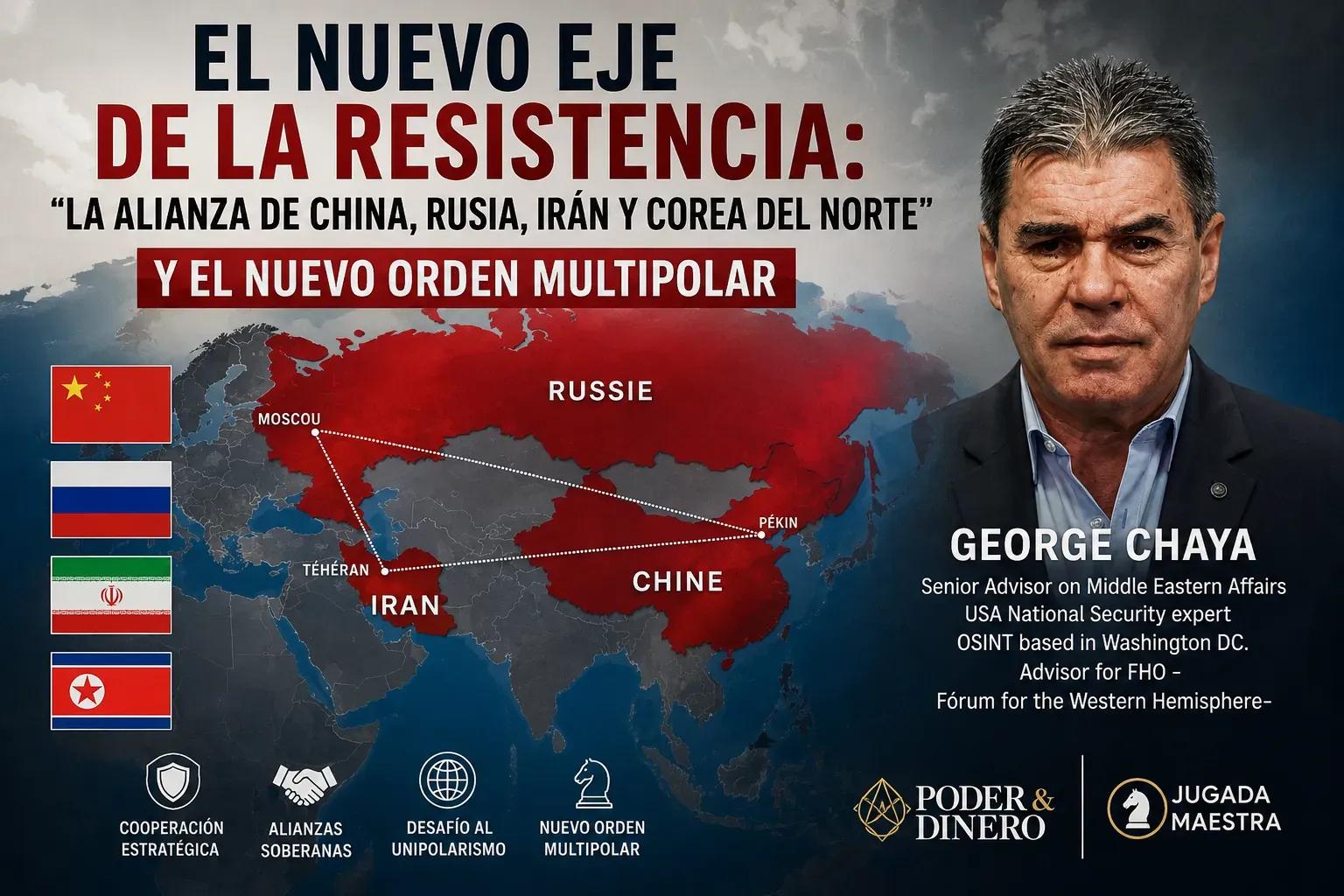
However, what the West is facing is not a formal alliance structured through a mutual defense treaty like NATO; rather, what we observe is more of a marriage of strategic convenience of certain effectiveness. Thus, Beijing, Moscow, Tehran, and Pyongyang have configured what colleagues and analysts call the “global resistance axis” (which we could call a Eurasian block of systemic revision). However, what unites these four capitals is not ideological affinity -as single-party communism coexists in China, orthodox and autocratic nationalism in Russia, Shiite theocracy in Iran, and dynastic totalitarianism of Juche in North Korea- but rather a shared existential objective: to undermine, weaken, fragment, and ultimately replace the international order led by Washington.
As such, as a Judeo-Christian civilization, but more than anything, as Westerners, secular or children of the Enlightenment, we cannot ignore the two most critical war fronts of our time: “the Russian invasion of Ukraine and the multi-front conflict in the Middle East facing the United States and Israel against Iran and its ideological state satellites in Lebanon, Yemen, Qatar, and Iraq”. It is in this global scenario where the multifaceted dangers that this coalition represents for global security, where economic stability and the survival of democratic values in the coming years must not be overlooked from academic naïveté, diplomacy, and much less from military perspectives.
The war of attrition in Ukraine has been for all these years the undeniable laboratory of Euro-Asian cooperation. The total invasion of Ukraine by Russia, initiated in February 2022, has ceased to be a purely regional or European conflict and has turned into the first global proxy war of the new Cold War. The Ukrainian resistance, financially and militarily sustained by the Western coalition, also forced Moscow to seek logistical, technological, and armament alternatives outside its borders when it found itself isolated by the Western sanctions regime. It is here where the alliance showed its real operational capacity.
On this geopolitical board, China’s role assumed the part of the dual-use economic and technological engine. Beijing adopted a posture of formal neutrality in the conflict, constantly presenting itself as a “peace mediator.” However, the strategic reality contradicts China’s diplomatic rhetoric. Following the declaration of a limitless friendship between Xi Jinping and Vladimir Putin just days before the invasion, today it is evident that China has transformed into a crucial economic lifeline for Russia by massively absorbing Russian oil and gas exports that were previously directed to Europe. Thus, China has guaranteed the flow of currency that feeds the Kremlin’s war machine. However, beyond energy, the critical danger lies in the provision of “dual-use” goods. Chinese state-owned and private companies supply Russia with microchips, semiconductors, advanced electronic components, commercial drones, and precision machinery indispensable for missile and tank manufacturing in Russian factories. Without Beijing’s industrial and logistical support, Russia’s capacity to sustain a prolonged war of attrition would have been severely diminished.
At the same time, the game of Iran and North Korea dangerously supplies the arsenals of both autocracies (regardless of one being atheist and the other ultra-religious and applying the Law of Velayat e-Faqih).
In this context, no one in the Pentagon is ignorant that, while China acts as the industrial engine, Iran and North Korea have assumed the role of direct providers of military lethality; recently, under the condition of anonymity, a senior military official from the Pentagon who serves as a liaison with the Oval Office confirmed this to me over lunch with good friends. And there is more on this, Iran introduced Shahid series drones (Martyr in Arabic) into the European theater of operations. These low-cost, but highly tactically effective weapons have been systematically used by Russian forces to saturate Ukrainian air defense and ruthlessly destroy the country’s civilian energy infrastructure. CIA satellites hold -in reserve and in classified form- proof of the last 26 months, and HUMINT reports on the ground are conclusive evidence of these activities. In Langley, they know that Tehran transferred technology for Russia to build large quantities of these drones on its own territory, thus consolidating a very low-cost air warfare doctrine that is extremely destructive for the Kremlin’s enemies.
At the same time, North Korea, under the iron fist of Kim Jong-un, has taken an even bolder and more dangerous step. Pyongyang has sent millions of 152mm artillery shells and Hwasong series ballistic missiles to the Russian front, thereby resolving the critical ammunition shortage suffered by Putin’s army. The danger escalated to unprecedented levels with the direct deployment of North Korean army troops in border regions like Kursk, marking the first direct military intervention of a foreign power on European soil in the 21st century.
On the other hand, regarding the always contentious Middle Eastern front, the war between the United States and Israel against Iran, in parallel with the European front, sharpens the known volatility of that region and has dramatically intensified following the attacks on October 7, 2023, and the subsequent military campaign by Israel in Gaza and southern Lebanon. This scenario is not a static and isolated photograph; it is intrinsically interconnected with the Euro-Asian block. However, Western public opinion often expresses misconceptions of the conflict, and the reality is that to understand the current dynamics, it is necessary to analyze Iran's security doctrine in light of a reality that has historically placed Tehran surrounded by adversaries from the Gulf Cooperation Council, overwhelmingly superior in conventional weaponry given their partnership with Washington. Thus, Tehran developed the “Resistance Axis” strategy (a network of non-state actors and Shiite militias spread throughout the Levant and the Arabian Peninsula). This includes Hamas in Gaza, Hezbollah in Lebanon, Shiite militias in Iraq and Syria, and Houthi rebels in Yemen.
Thus, when Israel and the United States confront these forces, they are not fighting isolated insurgencies, but rather the operational extension of a regional power supported in turn by global giants. The ballistic missile and direct drone attacks between Iran and Israel have demonstrated that the period of “shadow warfare” has ended, giving way to a conventional inter-state conflict of unpredictable consequences.
In this increasingly clear scenario, where actors no longer bother to disguise or conceal their actions, Russia and China play a role of “cover and diplomatic legitimization” that weakens the coercive power of Washington and Jerusalem. Russia has strengthened ties with Iran to an unprecedented historical level. In exchange for the drones and missiles received for the war in Ukraine, Moscow provides Tehran with advanced air defense systems (such as the S-400), Su-35 fighter jets, and electronic warfare technologies. This exchange somewhat undermines Israel's historical air superiority and substantially raises the military cost of any preventive attack on Iranian nuclear facilities. Additionally, Moscow maintains operational relations with Hamas and Hezbollah, using them as tools to divert Western military resources away from Ukraine.
In the case of China, Beijing uses its diplomatic weight in the UN Security Council to veto or soften resolutions seeking to sanction Iran or condemn the actions of its satellites. Moreover, Beijing is the leading buyer of sanctioned Iranian oil, evading the Western financial system through the use of the Yuan and fleets of “ghost” ships. This constant economic injection stabilizes the regime of the ayatollahs in the face of crises of internal discontent and international sanctions.
In this dangerous dynamic of reciprocity over cross-technological transfer, the most severe and systemic danger of this alliance lies in the transactional and symbiotic nature of its interactions. The individual weaknesses of each member are compensated by the strengths of the others, generating a military proliferation ecosystem that is difficult to control.
The global geopolitical order that emerged after the fall of the former Soviet Union has come to an end. For a little over three decades, the international system was governed by that flawed American Pax. However, the accumulation of structural tensions, historical resentment, and changes in the balance of economic power have catalyzed the formation of a coalition that today directly challenges freedom and Western democracies, and it is not just about those four countries; there are several Western accomplices who, if they could, “would be the tree that provides the wood for the axe handle that brings it down.” Fortunately, that will not happen. Although this analysis addresses the convergence of these powers and materializes in the two most critical war fronts of our era: the Russian invasion of Ukraine and the Middle Eastern conflict facing the United States and Israel against Iran and its satellites.
In my view, breaking down the multifaceted dangers that this coalition poses is vital for global security, economic stability, and the survival of democratic values in the coming years, and it deserves to be shared with the reading public free from ideologies and/or religious beliefs.
First of all, it is essential to address “the War of Attrition in Ukraine,” which has been and is the laboratory of Euro-Asian cooperation. The Ukrainian resistance, supported by the Western coalition, forced Moscow to seek new logistical, technological, and armament alternatives when isolated by the Western sanctions regime. It is here where the alliance showed its real operational capacity, and where China’s role emerges as the dual-use economic and technological engine of the mentioned alliance. Therefore, it is crucial to insist that when Israel and the United States confront these forces, they are not fighting against isolated insurgencies but rather against the operational block of a regional power backed in turn by global giants. These conflicting dynamics of reciprocity in cross-technological transfer represent the most severe and systemic danger of this alliance, and lie in the transactional and symbiotic nature of their interactions. The individual weaknesses of each member are compensated by the strengths of the others, thus generating an ecosystem of military proliferation that is difficult and dangerously uncontrollable.
In conclusion, it is pertinent to note the need for an integrated containment strategy. The alliance between China, Russia, Iran, and North Korea does not represent a temporary crisis or a series of disconnected conflicts. It is a systemic and coordinated challenge that seeks to reconfigure the map of global power for the 21st century.
The artificial separation of the military operation theaters of Ukraine and the Middle East is a grave strategic diagnostic error that the West cannot continue to incur. To confront this danger, the United States, Israel, and their democratic allies in Europe and Asia must design an integrated containment strategy that operates at multiple levels.
Militarily, the policy of trickle support must be abandoned, and a compelling technological superiority must be guaranteed on the current battle fronts. The defeat of Russian objectives in Ukraine and the dismantling of the attack capabilities of Iranian satellites in the Middle East are essential requirements to restore global deterrence. Economically, a selective decoupling of critical supply chains from China must be urgently accelerated, especially in high-tech sectors, rare minerals, and pharmaceutical active ingredients, reducing vulnerability to future economic blackmail.
Politically, the West must rebuild its bridges with the so-called “Global South” (Latin America, Africa, and Southeast Asia), offering legitimate investment, trade, and security alternatives that equally compete with China's predatory capital and Moscow's autocratic security offers.
History shows that coalitions based solely on common antagonism tend to fracture under sustained and cohesive external pressure. The great current danger is not the intrinsic strength of the Euro-Asian block but the indecision, internal polarization, and erosion of political will within democratic societies.
The response to this axis must be given. Prof. George Chaya, is a Senior Advisor on Middle Eastern Affairs USA National Security expert OSINT based in Washington DC. Advisor for FHO -Fórum for the Western Hemisphere-

Comments