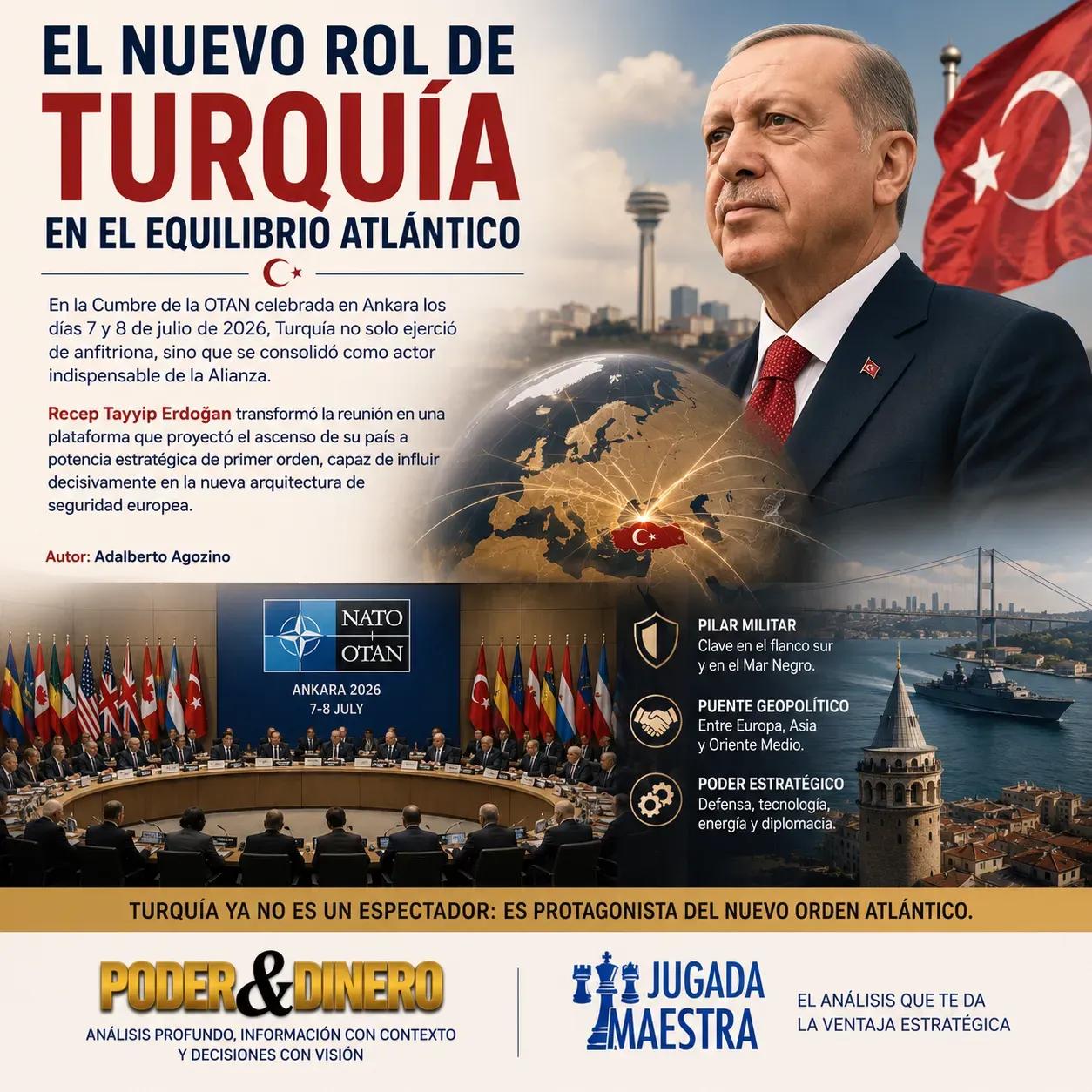
The geostrategic position of Turkey, its thriving defense industry, and the shrewd diplomacy of its president have made Ankara an unavoidable partner for the West. Far from being a problematic peripheral flank, Turkey emerges as the axis of a new Atlantic balance in which Europe must assume greater responsibilities while Washington reorients its global priorities.
For decades, the Western perception of Turkey oscillated between distrust and tactical utility. Tensions with Greece and Cyprus, internal democratic deterioration, occasional closeness to Russia, and the acquisition of Russian S-400 systems had generated notable apprehensions within NATO. However, the Ankara summit marked a turning point. The war in Ukraine, instability in the Middle East, the Iranian crisis, and competition for energy and Arctic routes have elevated the strategic value of a country that controls the Bosporus and Dardanelles straits, has borders with multiple conflict scenarios, and exerts influence in the Caucasus, the Balkans, and the eastern Mediterranean.
This relevance is not limited to geography. In the last two decades, driven by Erdoğan, Turkey has developed one of the most dynamic defense industries in the world. Transitioning from a dependent importer, it has begun producing armored vehicles, precision missiles, frigates, helicopters, and especially unmanned aerial vehicles that have proven their effectiveness in Libya, Syria, the Caucasus, and Ukraine. These affordable and operationally impactful drones have become an export product to numerous countries in Europe, Asia, and Africa, positioning Turkey as a relevant supplier of intermediate and high military technology.
The summit allowed for the visibility of this transformation. While many European allies debated how to accelerate their productive capacity in light of increased defense spending, Turkey already had a mature industrial infrastructure, capable of responding swiftly to growing demand. This productive capacity alters the internal power relations of the Alliance: political weight is no longer measured solely by the ability to consume U.S. security, but also by the ability to produce it and sustain prolonged logistical chains.
The personal understanding between Erdoğan and Donald Trump was key. Both leaders share a pragmatic leadership style, based on direct relationships and quick decisions. That affinity translated into concrete advancements, such as the U.S. willingness to facilitate Turkey's return to the F-35 fighter jet program, suspended after the purchase of the S-400. Although pending congressional approval, the gesture symbolizes a strategic rehabilitation of Ankara and a normalization of its ties with Washington. The eventual reintegration would strengthen the Turkish aerospace industry and alter the military balances in the eastern Mediterranean and the Black Sea.
In the broader context of the summit, Turkey capitalized on NATO's evolution towards a model that some call "NATO 3.0." The United States maintains the nuclear umbrella, high-level intelligence, and global political leadership but demands that Europe take on a greater conventional burden. In this redistribution, Turkey occupies a privileged position: it acts as a bridge between Europe and the Middle East, contributes proven operational capabilities, and offers industrial alternatives to a Europe seeking to reduce its excessive technological dependence on U.S. suppliers.
This centrality does not imply unconditional alignment. Erdoğan has demonstrated skill in maintaining dialogue channels with diverse actors without renouncing Turkish national interests. The war in Ukraine, for instance, allowed Ankara to balance its role as a NATO member with a mediating posture that brought it diplomatic and economic benefits. Similarly, its influence in Syria, the Caucasus, and the eastern Mediterranean makes it a decisive actor for managing instabilities that directly affect European security.
The strengthening of Turkey compels a rethinking of the continent's security architecture. Europe, pressured by Trump to drastically increase its military spending, finds in Turkey a potential supplier of accessible and proven systems, while it must manage a complex relationship with a partner that does not always share its priorities or institutional values. This tension between strategic utility and political differences defines the new Atlantic pragmatism.
For the United States, Turkey represents an ally capable of projecting power in regions where Washington seeks to lighten its direct commitment without losing influence. The competition with China and Russia in Eurasia and the Arctic makes Turkey's ability to control critical routes and counter adverse expansions even more valuable.
From a historical perspective, Turkey's rise illustrates the mutation of the Atlantic Alliance. Born during the Cold War as a tool of Soviet containment, NATO is now adapting to a multipolar environment of hybrid threats, where flexibility and selective distribution of responsibilities are essential. Ankara embodies this adaptation: it is no longer merely an eastern bastion, but an intermediate power contributing to stabilizing its periphery and maintaining collective deterrent credibility.
Naturally, challenges persist. Relations with Greece and Cyprus, the internal Turkish situation, and occasional divergences with other allies continue to generate friction. However, international circumstances—more than unilateral concessions—have elevated the value of Turkey, turning those tensions into manageable elements within a framework of superior shared interests.
The Ankara Summit certified this new reality. Erdoğan succeeded in projecting his country as a geopolitical arbiter between Europe, the Middle East, and the United States. His success was not casual, but the result of meticulous preparation and the convergence of structural factors that favor Turkey's role. For Europe, this rise implies both an opportunity—increased autonomy through more diversified defense—and a challenge: learning to coexist with a powerful ally whose regional ambitions will not always align with European preferences.
Ultimately, Turkey illustrates the transition towards an Alliance that is more European in its conventional responsibilities, more selective in U.S. commitment, and more conditioned by the logic of competition among great powers. In this fluid scenario, Ankara not only participates: it defines the new balance. Its consolidation as an emerging power marks the beginning of an era in which the security of the continent will increasingly depend on actors like Turkey, who combine strategic location, industrial capacity, and diplomatic pragmatism.
Recent history demonstrates that multilateral organizations survive by adapting. NATO is doing so in Ankara, and Turkey stands as one of its main architects. The Atlantic future can no longer be conceived without considering the decisive weight of this power that, from the shores of the Bosporus, projects influence far beyond its traditional borders.
Adalberto Agozino holds a PhD in Political Science, is an International Analyst, and a Lecturer at the University of Buenos Aires.

Comments