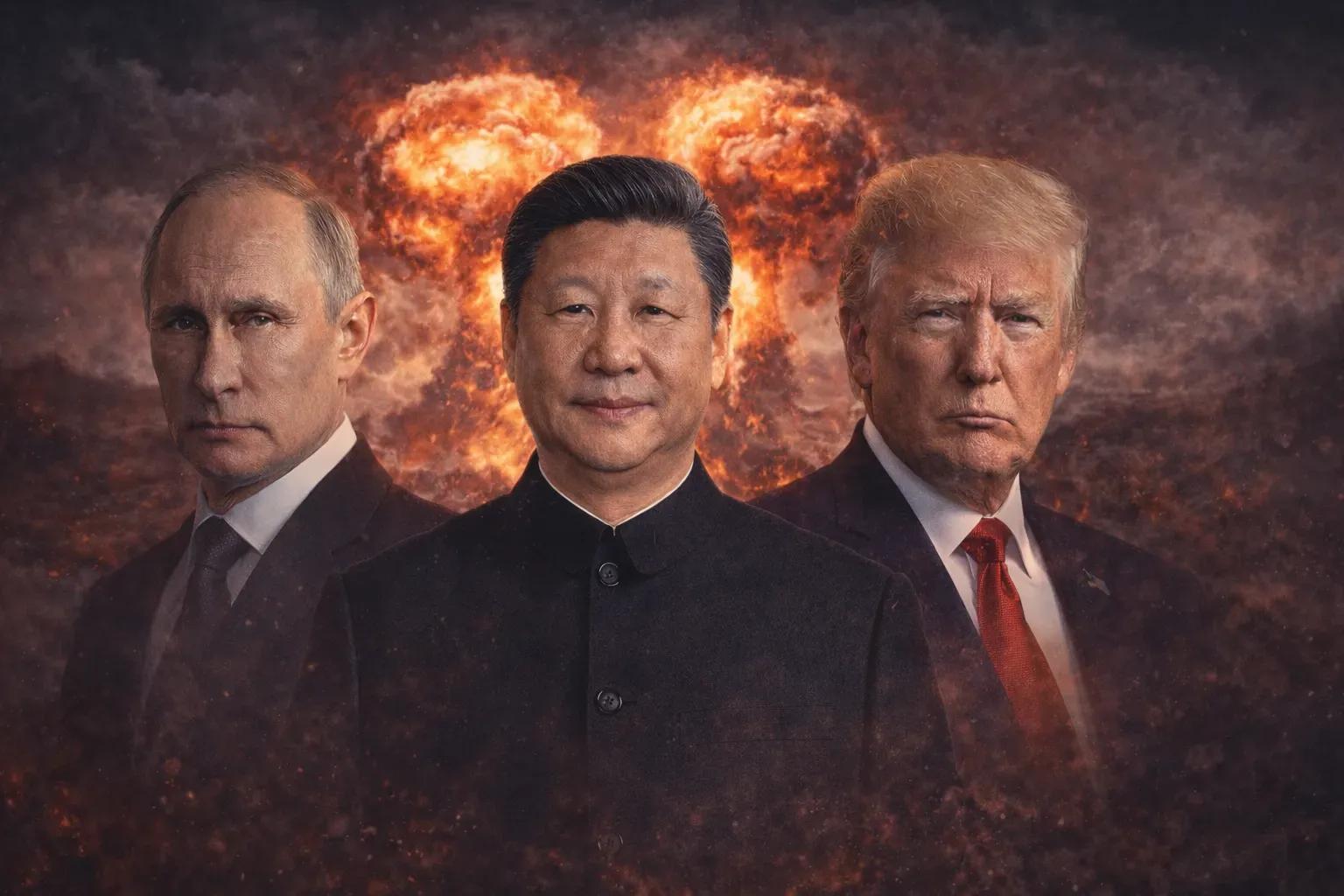
"Welcome again to the nuclear age." The phrase no longer sounds provocative or exaggerated. It sounds descriptive. With the expiration of the New START treaty, the last major strategic arms control agreement between the United States and Russia, the international system enters a zone of uncertainty not seen since the end of the Cold War.
The New START was signed in 2010 by then-U.S. President Barack Obama and his Russian counterpart, Dmitry Medvedev. Its goal was clear: to put a stop to the nuclear arms race inherited from the 20th century and to prevent strategic competition between the two powers from escalating uncontrollably. The agreement set a precise limit: 1,550 deployed strategic nuclear weapons per country, in addition to caps on intercontinental missiles, nuclear submarines, and strategic bombers.
But the real heart of the treaty was not just the number. It was the verification mechanisms. On-site inspections, data exchanges, and periodic notifications allowed each party to know what the other was doing. In a scenario of structural rivalry, the New START functioned as a minimum trust network. It did not eliminate nuclear risk but managed it.
The bureaucratic limit: it is over.
After the only possible five-year extension agreed upon in 2021, the treaty reached its expiration date without a renewal being achieved. Since September, Russian President Vladimir Putin has been publicly calling for the extension of the agreement, arguing that its disappearance weakens global strategic stability. Washington, on the other hand, has taken a more ambiguous position: it maintains that any new nuclear control framework should include China.
That point is key. The New START was conceived as a strictly bilateral agreement between the two largest nuclear powers on the planet. Including China would require completely redesigning the framework, as Beijing possesses a significantly smaller arsenal and resists being bound to limits designed for Moscow and Washington. So far, China’s response has been silence or diplomatic caution, accompanied by a troubling fact: its nuclear arsenal continues to grow.
The numbers help to size up the scenario. Russia currently possesses around 5,400 nuclear weapons in total, both deployed and stored. The United States has about 5,200. China, quite a bit behind, has close to 600, but with an expansion rate that worries analysts and military strategists. The imbalance remains large, but the trend is clear: the world is moving toward a more multipolar nuclear system.
The expiration of the New START implies something concrete and dangerous: for the first time in over half a century, there is no legally binding treaty limiting the strategic arsenals of the United States and Russia. There are no caps, no inspections, and no transparency obligations. Each power again depends solely on its intelligence capabilities and its reading of the other’s intentions.
In political terms, the setback is evident. Arms control agreements were one of the few consensuses that survived even the most tense moments of the Cold War. Today, however, the dominant logic is once again that of pure deterrence, power calculation, and implicit threat.
This is not a technical debate reserved for defense specialists or diplomats. It is a central discussion about the international order that is taking shape. A world marked by regional wars, growing geopolitical rivalries, and a sustained erosion of multilateral control mechanisms.
The disappearance of the New START does not guarantee a nuclear war, but it does eliminate one of the last brakes that existed to prevent it. In international politics, when rules disappear, what advances is not stability, but uncertainty.
This is not a diplomatic technicality nor a bureaucratic procedure that expired without further ado. It is, in historical terms, the return of a logic that the world believed had been overcome: that of nuclear power without clear limits or effective controls.

Comments