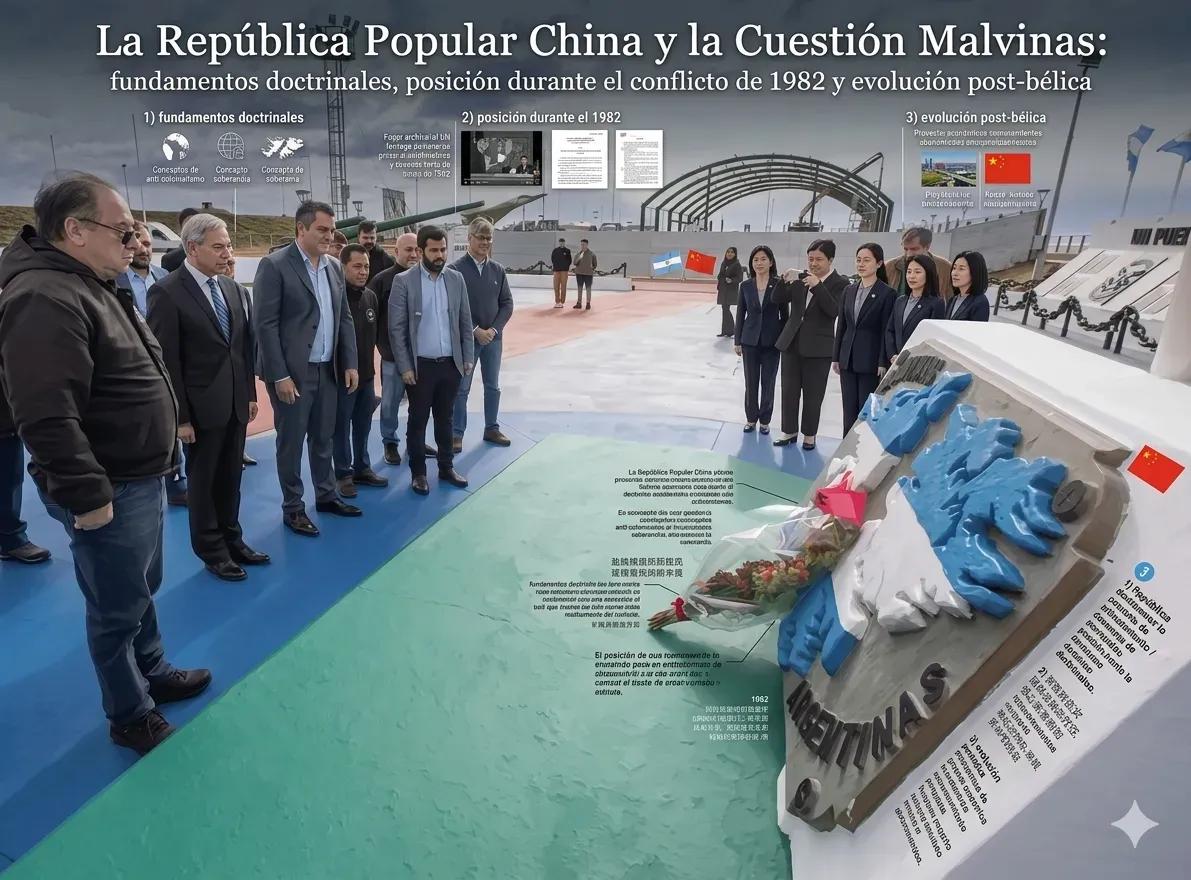
The position of the People's Republic of China (PRC) regarding the sovereignty dispute over the Falkland Islands can be analyzed as a result of the convergence between doctrinal principles of its foreign policy and its historical linkage with the agendas of the Global South. In this context, Chinese support for the Argentine position on the southwest Atlantic archipelago is articulated with recurring axes of Beijing's diplomacy, including territorial integrity and the principle of non-interference, which have been consistently present in its international projection since 1949.
Doctrinal foundations of the PRC
The foreign policy of the People's Republic of China has historically been structured around the Five Principles of Peaceful Coexistence enunciated in 1954, among which the territorial integrity of states occupies a central place. In this framework, the Falklands issue is addressed by Chinese diplomacy as a sovereignty dispute linked to decolonization processes, in line with the general principles of international law. In this sense, the British occupation of 1833 is referred to as a precedent of a situation still unresolved in terms of sovereignty.
This doctrinal framework also creates a notable functional symmetry with Beijing's own sensitivity regarding Taiwan: just as China rejects any invocation of the principle of self-determination that could support the formal independence of the island, it also tends to question the applicability of that principle —invoked by the United Kingdom regarding the island population— in those cases where sovereignty claims are based on arguments of territorial and historical continuity.

Bilaterals and regulatory framework prior to 1982
The establishment of diplomatic relations between Argentina and the People's Republic of China in February 1972 marked the beginning of a relationship that, from its outset, incorporated the Falklands issue as a point of convergence. In the context of the Cold War, the bilateral approach responded to partially differentiated logics: while Argentina sought to diversify its external relations, China sought to expand its presence in Latin America following its recognition as the legitimate representative in the United Nations through General Assembly Resolution 2758 (1971), which included its incorporation into the Security Council.
In this framework, both parties found common ground around principles related to sovereignty, territorial integrity, and decolonization processes. The PRC's participation in the G77 helped reinforce these commonalities in the multilateral arena.
The Chinese position during the armed conflict of 1982
The outbreak of the armed conflict on April 2, 1982, placed the People's Republic of China before the coexistence of lines of its foreign policy related to the rejection of the use of force and its positioning regarding a sovereignty dispute framed in discussions about decolonization. This situation was reflected in its abstention during the vote on April 3, 1982, regarding Security Council Resolution 502.
This abstention is framed within the general pattern of its international conduct, characterized by non-interference in internal affairs and reference to normative principles of the international system. In this context, the People's Republic of China did not exercise its veto power nor supported the resolution. Subsequently, on October 4, 1982, it expressed its support for an initiative presented to the United Nations General Assembly aimed at resuming negotiations on the issue of sovereignty.
Consolidation of post-war support: from rhetoric to strategic dimension
The post-war period marked the transition from declarative support to a systematic backing framework, with concrete expressions in both the multilateral and bilateral spheres.
In the multilateral arena, the PRC has consistently voted alongside the G77 on all resolutions of the Special Committee on Decolonization urging the United Kingdom to resume sovereignty negotiations, reaffirming that this support constitutes —as stated by the Vice Chairman of the Standing Committee of the National People's Congress, Jiang Shusheng, in December 2011— a position characterized by a high degree of continuity in Chinese foreign policy.

On the bilateral front, the strategic dimension of the relationship acquired greater institutionalization following the establishment of the Comprehensive Strategic Partnership between both States in 2014. In February 2022, in the context of the Beijing Winter Olympics, a high-level joint declaration was signed in which the People's Republic of China reaffirmed its support for Argentina's claim over the Falkland Islands, while Argentina reiterated its adherence to the one China principle.
Normative convergences, strategic interests, and future conditions
The analysis of the People's Republic of China's position regarding the Falklands issue allows for identifying the sustained presence of structural principles of its foreign policy, among which territorial integrity, non-interference in internal affairs, and an interpretation of the self-determination principle in the context of sovereignty disputes stand out.
In this framework, the treatment of the issue fits within broader guidelines of China's international actions, characterized by reference to norms of international law and processes addressed in the United Nations context. This continuity allows situating the Chinese position within a broader scheme of state behavior, where definitions about territorial disputes are articulated with long-term doctrinal principles and its projection in the international system.

Sergio Skobalski
Doctor in International Relations. Director of the Center for Social and Human Studies for Defense. Director of the Bachelor's degree in International Relations (UNDEF - Argentina)

Comments