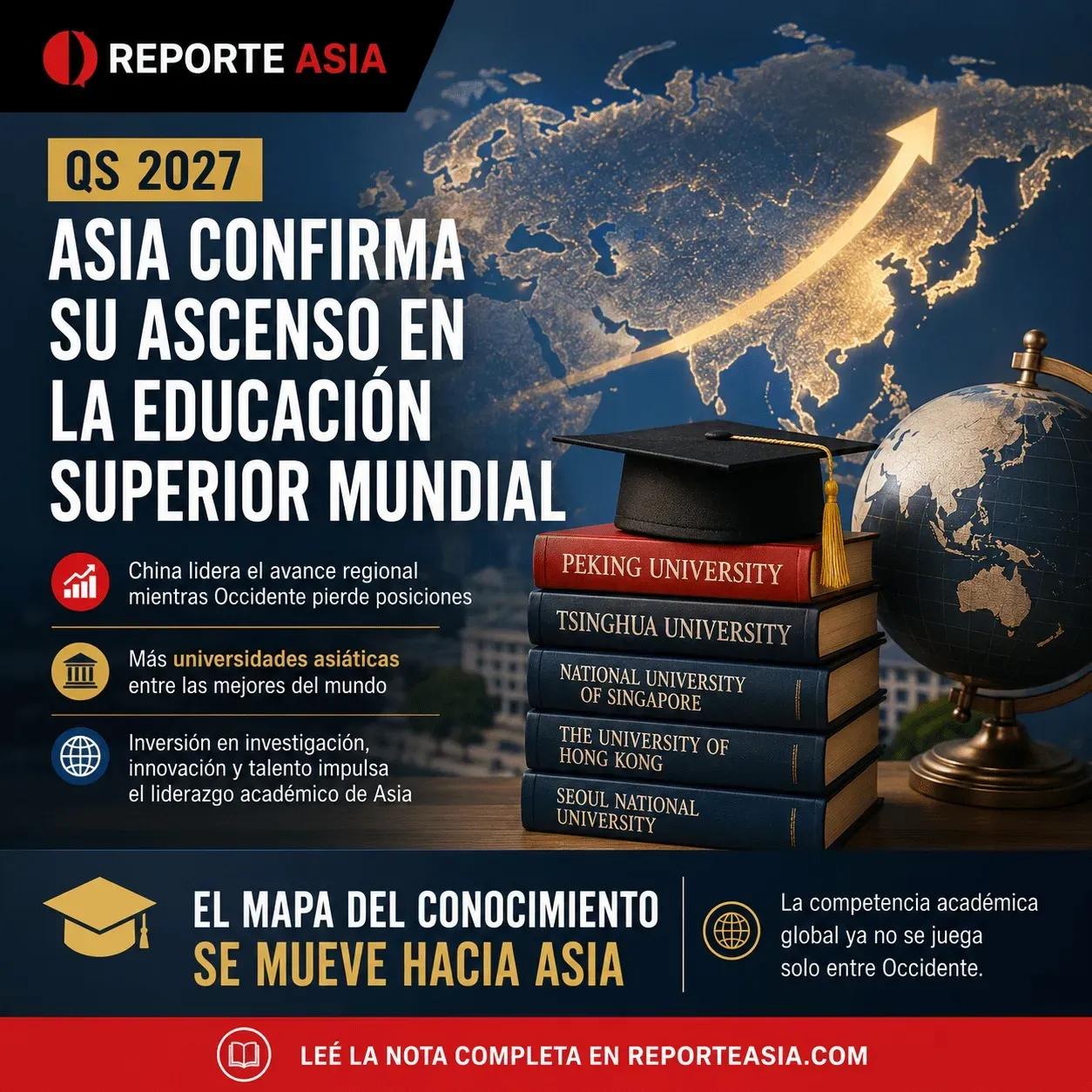
The QS World University Rankings 2027, published on June 18 by the British consultancy Quacquarelli Symonds, evaluated 8,467 institutions in 106 countries and included 1,504 universities in its final list. The Massachusetts Institute of Technology (MIT) leads the global ranking for the fifteenth consecutive year with a perfect score of 100, followed in a tie by Imperial College London and Stanford University. The University of Oxford ranks fourth and Harvard fifth, creating a top 5 that maintains its structure with minimal variations compared to the previous year.
However, the stability of the podium contrasts with a deep reconfiguration in the subsequent ranks. Yale University climbed five positions to enter the top 20, along with The Chinese University of Hong Kong, which advanced 14 places. This dynamism in the 10-200 segment is, according to the analysis from QS itself, the defining characteristic of this edition.
China, the engine of Asian ascent
One of the clearest narratives of the QS World University Rankings 2027 is the sustained rise of institutions from East Asia and the Middle East, particularly within the top 200. China records the highest number of new global entries—13 new entries—and contributes the largest number of rises across the table, with 29 institutions that moved up more than 20 positions.
Institutions in China, Hong Kong, and South Korea made the greatest strides in the top 100, with some achieving double-digit gains, driven by increased research impact backed by rising state spending on R&D, and by internationalization, with institutions placing greater emphasis on attracting international academic and student talent.

The contrast with English-speaking countries is stark. The UK and the US each saw 15 and 36 institutions respectively fall more than 20 positions in the ranking, compared to only seven in Canada and two in Australia. In contrast, China has 29 institutions that moved up more than 20 places.
QS attributes part of this trend to the restrictions imposed on international students by the so-called "Big Four" countries—USA, UK, Canada, and Australia—which degraded their student diversity indicator while Hong Kong, Singapore, Malaysia, and South Korea improved that same parameter.
The Asian map: Hong Kong, Singapore, and India
In the Asian regional ranking, the University of Hong Kong tops the list, followed by Peking University, while Nanyang Technological University (NTU) and the National University of Singapore (NUS) tie for third place. NUS ranks tenth globally, while NTU retains the twelfth position.
India solidifies its presence with 52 ranked institutions, its best historical record according to QS. South Asia is the most improved region proportionally, with the highest proportion of subjects rising in the rankings, followed by Southeast Asia with 38% of institutions on the rise. Vietnam, for its part, has Van Lang University as its highest progress institution in the Asian regional ranking, with a jump of 159 positions.
In the Middle East, the United Arab Emirates and Saudi Arabia record nine and twelve rising institutions respectively, combining gains in internationalization with targeted investment in research and infrastructure.

Latin America: UBA resists, but the system contracts
The Latin American landscape offers a more complex reading. The University of Buenos Aires (UBA) remains at 84th globally, establishing itself as the only Latin American university among the top 100 in the world, a position it has held in 11 of the last 12 years. However, this positive fact coexists with a concerning trend: 9 of the 16 ranked Argentine institutions fell in the classification, and universities such as the National University of San Luis, San Martín, and the University of the South of Bahía Blanca are no longer listed. QS highlighted UBA's "resilience" in a context of "checks and balances" in Argentina's university funding.
Among the main public institutions in the region, the Universidade de São Paulo (USP) ranks 133rd and the Universidad Nacional Autónoma de México (UNAM) 145th globally. The Tecnológico de Monterrey positions itself 188th in the world, sixth in Latin America, and second among private institutions in the region. The Pontificia Universidad Católica de Chile displaced USP as the second-best Latin American university in this edition. Colombia, for its part, saw ten of its twelve ranked universities decline.
The contrast with Asia is structural: while China adds 13 new universities to the global ranking in a single edition and propels dozens of rises, Latin America loses institutions from the list and those that remain mostly decline. The gap in investment in research and in internationalization strategies largely explains this divergence in trajectories.
Marcos González Gava is Co-Founder of Reporte Asia and a specialist in economic and financial business, and cultural affairs with the People's Republic of China.

Comments