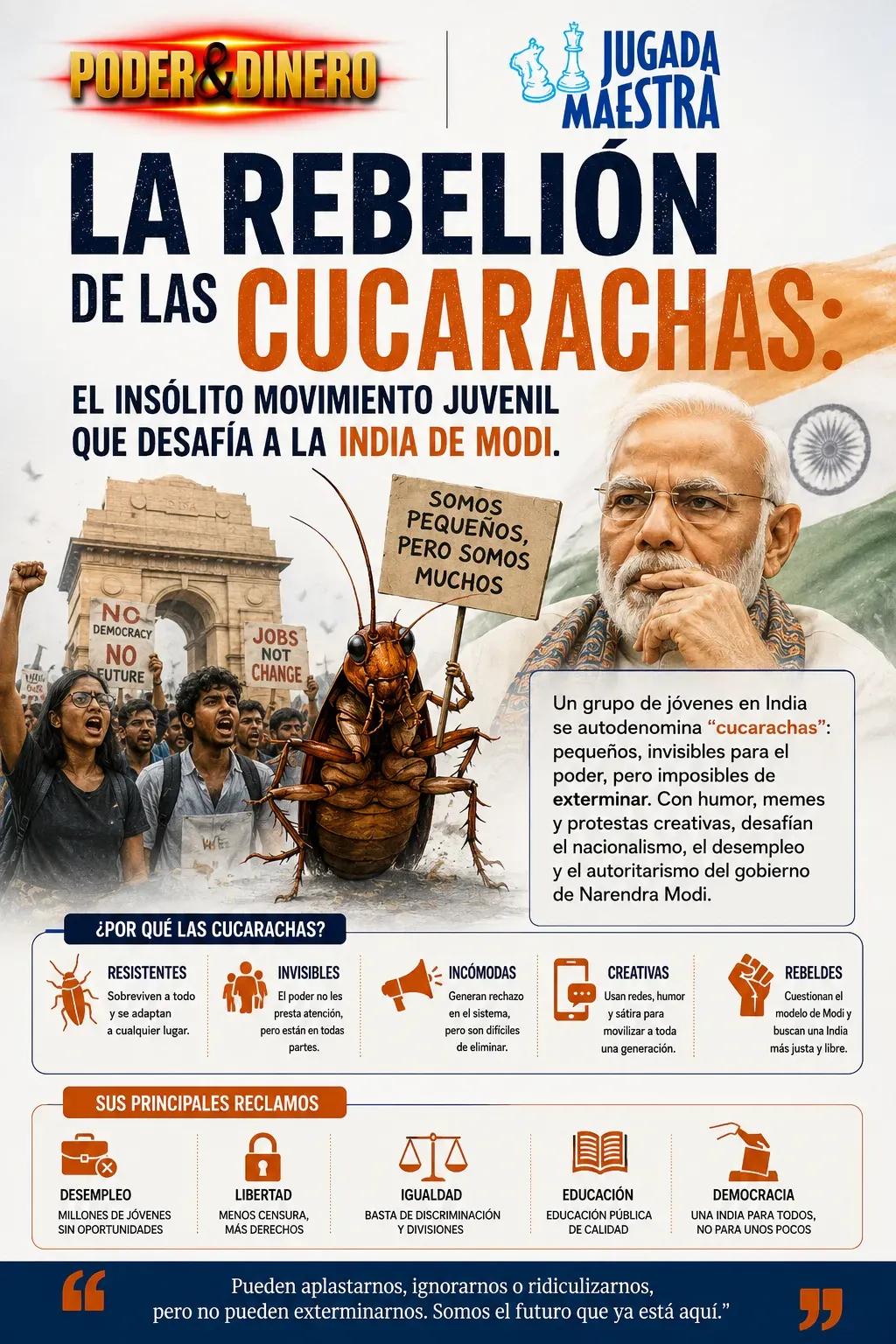
In the political history of India, movements of very diverse nature have emerged. Some were born from large popular mobilizations, others from regional or religious claims, and several found their origin in specific social struggles. However, few phenomena have appeared with the speed, irreverence, and symbolic impact of the so-called Cockroach Janata Party, known in Hindi as पार्टी पार्टी (CJP), an organization that in just a few weeks went from being a social media occurrence to becoming one of the most debated topics in the country.
Its emergence coincides with a particularly delicate moment for Indian society. Although the economy maintains high growth rates and the country aspires to establish itself as one of the great powers of the 21st century, large youth sectors perceive that prosperity does not translate into real opportunities. Millions of graduates compete for an insufficient number of stable jobs while criticism grows over labor precariousness, inflation, delays in public selection processes, and recurring scandals linked to leaks of official exams.
It was precisely in this context where a phrase uttered by the Chief Justice of India, Surya Kant, acted as a trigger. During a court hearing, Kant compared certain unemployed youths to “cockroaches” and “parasites”, suggesting that some of them ended up dedicating themselves to digital activism or institutional criticism. Although he later clarified that he was specifically referring to individuals linked with fraudulent professional credentials, the damage was done. The statements were interpreted by many youths as a display of disdain towards a generation that feels economically and politically marginalized.
The response was as unexpected as it was effective. Instead of rejecting the insult, thousands of young people decided to appropriate it. If the system considered them cockroaches, then they would be proud cockroaches. Thus was born the Cockroach Janata Party, driven by Abhijeet Dipke, a political communication strategist trained at Boston University and a former collaborator of the Aam Aadmi Party. The movement was officially launched on May 16, 2026, as a platform meant to represent those who felt excluded from conventional politics.
The choice of the cockroach as a symbol was not casual. In the collective imagination, this insect represents an extraordinary capacity for survival. It withstands extreme conditions, adapts to hostile environments, and persists even when other organisms disappear. For the founders of the movement, the metaphor was perfect to describe a generation that feels it has been ignored by political, economic, and judicial elites. The cockroach thus went from being an insult to becoming an emblem of resilience, resistance, and defiance.
The iconography of the movement is dominated by satirical images generated through artificial intelligence. Memes, cartoons, fictional campaign posters, and humorous videos flooded Instagram, X, and other digital platforms. Young activists even began participating in public demonstrations dressed as cockroaches, reinforcing the performative and provocative character of the movement.
The growth was spectacular. In less than a week, the movement's accounts accumulated tens of millions of followers. Instagram became its main platform for dissemination and surpassed the digital presence of many traditional parties by a wide margin. Hundreds of thousands of people filled out forms to symbolically affiliate with the movement. The phenomenon quickly spread through states as diverse as Bihar, West Bengal, Uttar Pradesh, Madhya Pradesh, and Jammu and Kashmir.
Despite its humorous appearance, the Cockroach Janata Party has a clearly identifiable ideological dimension. Its leaders ironically define themselves as “secular, socialist, democratic, and lazy”. The last characteristic is a deliberate provocation against the stereotype that unemployed young people are responsible for their own situation due to a lack of effort.
Beneath the satire lies a political program that combines demands for institutional transparency, democratic reforms, and criticism of the concentration of power. The manifesto questions the practice of appointing retired judges to political positions, demands greater electoral guarantees, proposes a much broader female representation in institutions, calls for an independent press against large business conglomerates, and suggests severe penalties for politicians who switch parties for convenience. It also demands access to public information and government accountability.
From an ideological perspective, the movement can be interpreted as a mix of urban progressivism, digital activism, anti-corruption populism, and defense of democratic rights. Although its leaders refuse to become a conventional party, many of their demands coincide with historical claims from liberal, moderate left, and citizen movements concerned about democratic quality in India.
The supporters of the movement mainly come from the so-called Generation Z. These are urban youths, university students, graduates without stable employment, precarious workers, and intensive users of social networks. The organization humorously states that to affiliate, one must be unemployed, lazy, connected to the internet for at least eleven hours a day, and possess the ability to complain professionally. Behind the joke lies an evident reality: the movement connects with a highly digitized youth that perceives a growing distance between its expectations and the real opportunities offered by the economic system.
The reception of the phenomenon has been extraordinarily diverse. Among those who have expressed sympathy are prominent political and social figures. Shashi Tharoor defined the movement as a revealing manifestation of youth frustration at unemployment and inflation. Akhilesh Yadav publicly celebrated the phenomenon on social media. Support also came from Congress leaders Trinamool Mahua Moitra and Mamata Banerjee, as well as activist and lawyer Prashant Bhushan, who considered the movement highlights structural problems affecting Indian youth.
Support also came from cultural spheres. Filmmaker Anurag Kashyap, comedian Kunal Kamra, and several Bollywood figures expressed sympathy for the initiative. For many artists and intellectuals, the phenomenon represents a healthy expression of political satire in a democracy that needs spaces for criticism and dissent.
Detractors, however, argue that the movement is nothing more than a carefully designed digital campaign. Some supporters of Prime Minister Narendra Modi claim that the success of the CJP is due to political marketing strategies and recall Dipke's past ties with the Aam Aadmi Party. Other analysts believe that the movement could suffer the same fate as many viral trends: rapid expansion followed by an equally swift disappearance.
The reaction of the authorities has also contributed to amplifying the notoriety of the phenomenon. Restrictions imposed on its social media accounts, the temporary blocking of platforms, and allegations of alleged cyberattacks fueled the narrative that the movement was being persecuted for questioning power. Various observers interpreted these measures as a sign of the government's growing sensitivity to digital expressions capable of mobilizing large sectors of youth.
The big unknown is whether the Cockroach Janata Party can become a real electoral force. In the short term, the odds seem limited. The movement is not officially registered as a political party, and its own leadership insists that it is a platform for protest rather than a traditional electoral organization. Furthermore, Indian politics continues to be dominated by large party machinery with immense territorial structures and considerable resources.
However, measuring its influence exclusively in electoral terms could be misleading. The true impact of the movement lies in its ability to alter public debate. It has forced media, political parties, and institutional leaders to pay attention to the concerns of a generation that felt for years that it lacked representation. Even if it never wins a parliamentary seat, it has already managed to put on the national conversation issues related to youth employment, institutional transparency, and freedom of expression.
The story of the Cockroach Janata Party ultimately reveals something deeper than the success of a viral campaign. It shows how a digitally connected generation can transform an insult into a collective identity and a joke into a political instrument. In an India that aspires to lead the 21st century, millions of young people seem to have found in the figure of the cockroach a singular way to express an elemental demand: to be heard. And although no one knows how long this insect rebellion will last, few doubt that it has left a visible mark on contemporary Indian politics.

Adalberto Agozino holds a PhD in Political Science. He is a professor at the National Gendarmerie University Institute and the National Defense Faculty of Argentina. He is the director of the Argentine Institute of Geostrategic Studies. He is the editor of Alternative Press Agency. Expert in Maghreb issues.

Comments