AUTHOR'S NOTE
There is a rhythm in the life of Mexico that I have never stopped hearing — a mix of laughter and nostalgia, of church bells and corridos, of the smoke from the carne asada rising with the prayers of the sunset. It lives in the streets of Monterrey, in the squares of small towns, in the tired eyes of the people who keep moving forward, however heavy the day may be.
These stories are born from that rhythm. They are not about heroes or villains, but about ordinary people — a guitarist, a mask maker, a flower seller — who find a way to cling to beauty and dignity in a world that often forgets both. Each one of them taught me something: that courage doesn’t always wear a uniform, that faith can survive in the least expected places, and that the smallest act of kindness can resonate louder than violence.
I write these stories as a kind of prayer — for the country I love, for the people who shaped me, and for the quiet grace I have been fortunate enough to witness. On Sundays, Mexico slows down. Families gather, music escapes through open windows, and memories rise like incense. These stories belong to those moments — when the world softens enough to allow us to see what truly matters.
— Leo Silva
THE FLOWER SELLER
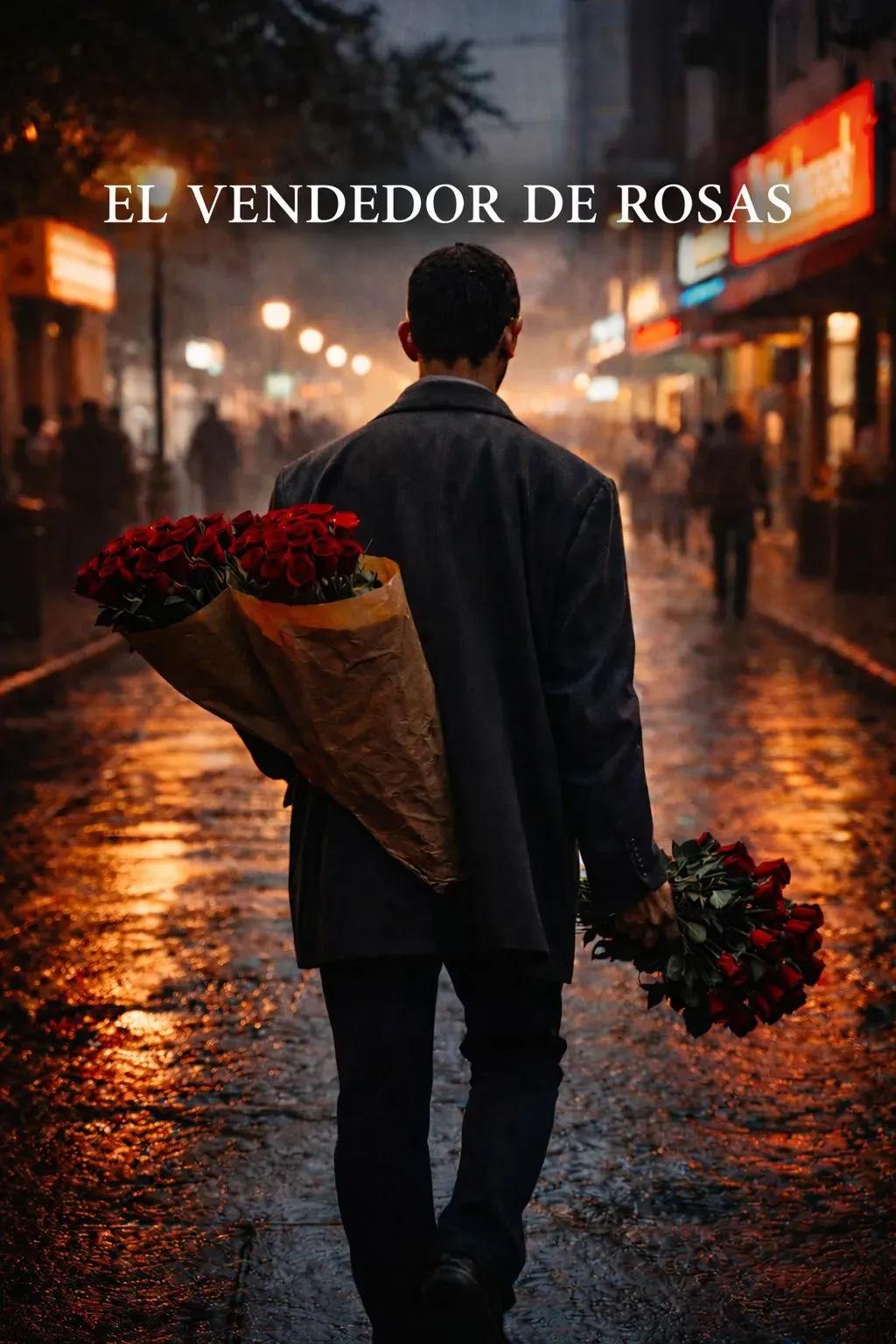
He could not have been more than twenty, and yet the weight of the world seemed to hang from his shoulders like the oversized jacket he wore. Every night, at the same hour, he appeared on the streets of Monterrey — when the lights on Calle Morelos began to shine and the musicians tuned their guitars. His roses were fresh, his shoes worn, and his tie always perfectly knotted, as if dignity itself could serve as armor against indifference.
I noticed him for the first time in a cantina near the Macroplaza. Amidst the laughter, tequila, and cigarette smoke haze, he moved silently — a seller of ephemeral beauty in a city that rarely paused to contemplate it. Most men barely registered his presence. Some women smiled politely and, at times, bought a single rose out of habit or kindness. But I did notice him. I noticed the way he paused at the entrance to adjust his tie, as if each arrival were a small act of hope.
One night, I called him over just to chat. Most people in that bar knew I worked at the U.S. Consulate. They didn’t really know what I did — just that I spoke English. When I called him over in Spanish, he tilted his head slightly, as if confirming something he already suspected — and then he answered me in clear, confident English. His voice was soft yet firm, thoughtful. It surprised me as much as his jacket and tie did.
He told me he was studying economics at university and that he sold flowers at night to get by. He had recently gotten married and was saving every peso to rent a small place for himself and his wife. There was a careful seriousness in the way he spoke of the future, as if he understood how fragile good plans can be.
Sometimes, when the bar quieted down and the music turned down, he spoke to me about his dreams. They weren’t grand ambitions — just a simple life near the sea. Maybe Mérida, he said once. Maybe Los Cabos. A place where the air smelled of salt instead of escape, where the mornings began with sunlight and not street noise.
He imagined a small shop, flowers at the entrance, his wife nearby, and a slower, kinder rhythm of life. He spoke of it like people do of hope when they aren’t quite sure the world will return it.
Over time, our brief exchanges turned into something resembling a friendship. I saw him almost every night — sometimes near El Ancla, other times further down the avenue when the mariachis stored their instruments and the sidewalks began to empty. What struck me most was his calmness. He entered places that most avoided after dark — rooms where conversations dropped in volume when unfamiliar faces entered, where everyone observed everyone else, where mistakes had consequences that weren’t always loudly announced. Yet Luis moved through those spaces with a silent grace, as if the mere presence of the flowers offered a thin but real shield.
Once, half jokingly and half concerned, I asked him if he ever felt afraid.
He smiled, adjusting his tie. “A little,” he admitted. “But I have to work.”
There was honesty in that response — no feigned bravery, no denial, just necessity.
Not long after, I found myself one slow afternoon sitting alone at the bar, taking small sips from a drink while “This Masquerade” by George Benson floated softly from the speakers above the bar. The melody lingered in the air like a question that refused to resolve, its silent melancholy accompanying the slow movement of light over the bottles — a reminder that not everything is as it seems. The city felt tired. Kidnappings and extortion had become part of everyday conversation. Businesses were closing earlier. Families learned which streets to avoid and which silences to respect. Fear had a way of seeping even into the smallest routines.
I remember staring at my glass, turning the problem over in my mind — how to reach one of the most dangerous men in Mexico, a man who seemed to move through the city untouched, invisible to the naked eye — a man no one could even put a face to. It was then that I heard in my mind the voice of my old partner Mario, something he used to say when cases seemed impossible: sometimes it’s the simplest details that men like him never notice. They observe power. They observe threats. They don’t observe the ordinary.
And it was then that I thought of Luis.
The flower seller moved everywhere unseen. He entered places that no one questioned. He got close enough to observe, to notice — not because he was bold, but because he was invisible in the way that only ordinary people can be.
The idea unsettled me immediately. The imbalance was impossible to ignore — a young man whose life revolved around roses, rent, and quiet dreams, placed in the orbit of someone who sowed fear across entire neighborhoods. It was like lighting a candle in the middle of a storm.
What we needed was simple in theory and nearly impossible in practice: a clear photograph of the current plaza boss of the Zetas. He operated deliberately without being seen — no social media, no public appearances, no reliable surveillance images. His name circulated constantly in intelligence reports, but his face remained a mystery. No one could describe him with certainty, much less identify him on the ground.
Without a photograph, without a face to anchor the name, he remained untouchable — a shadow protected by anonymity.
Still, the idea wouldn’t leave me alone.
When I finally posed the possibility to him, his expression changed. The easy warmth drained from his face, replaced by calculation and fear. He looked toward the street and then back at me.
“They don’t forgive mistakes,” he said quietly. “People don’t get second chances in those places.”
“I know,” I replied. “And I wouldn’t ask you if it weren’t important.”
He stood still for a long moment, his fingers brushing the stem of a rose as if he were weighing something invisible. Finally, he nodded. Not with enthusiasm. Not with apparent bravery.
Simply with determination.
“If it helps stop what’s happening in the city,” he said softly, “then it might be worth it.”
As he walked away that night, something heavy settled in my chest. I had asked a good man — barely more than a boy — to bear a risk that wasn’t his. He wasn’t trained for danger. He wasn’t protected by anything more than anonymity and trust. The burden of that decision remained with me, silent and persistent, a weight that isn’t announced but never truly goes away.
In the days that followed, whenever I spotted his familiar silhouette — the oversized jacket, the steady gait, the carefully adjusted tie — I felt both relief and unease.
Relief to see him still there. Unease for knowing what I had set in his path.
One night, he approached without ceremony and slid a small photograph into my hand. We exchanged no words. They weren’t necessary. The moment was discreet, almost ordinary — and yet it carried a gravity that I still feel when I remember it.
Not long after, our paths diverged. He told me he and his wife would be leaving the city to start anew in a quieter place. I didn’t ask where. There are journeys that deserve privacy.
I like to imagine him now at some point along the coast, as he used to describe it — perhaps enjoying the tropical breezes of Mérida, or watching a stunning sunset in Los Cabos — where the air smells of salt and not traffic, and mornings arrive gently.
In my mind, he has a small flower stand on a quiet street, his wife by his side arranging bouquets while a radio softly plays in the background, with romantic songs by José José like “Lo pasado, pasado.” The danger has faded, replaced by routine, light, and the simple peace he always dreamed of.
When I think of him — that young man in an oversized jacket bringing roses to uncertain places — I think of a different kind of courage. Not the kind that receives recognition or applause, not the kind measured in medals or uniforms, but the silent courage of an ordinary man doing his small part for something greater than himself. Sometimes a city, sometimes a family, sometimes a country.
He reminded me that courage is not always announced. Sometimes it moves silently among rooms full of people carrying flowers, believing — with tenacity and tenderness — that kindness still matters, even when the world offers no guarantees.
Leo Silva is a retired agent of the Drug Enforcement Administration (DEA) of the United States, having made Mexico his main assignment. He now lives in Texas and writes essays inspired by his experiences during his years of service.

Comments