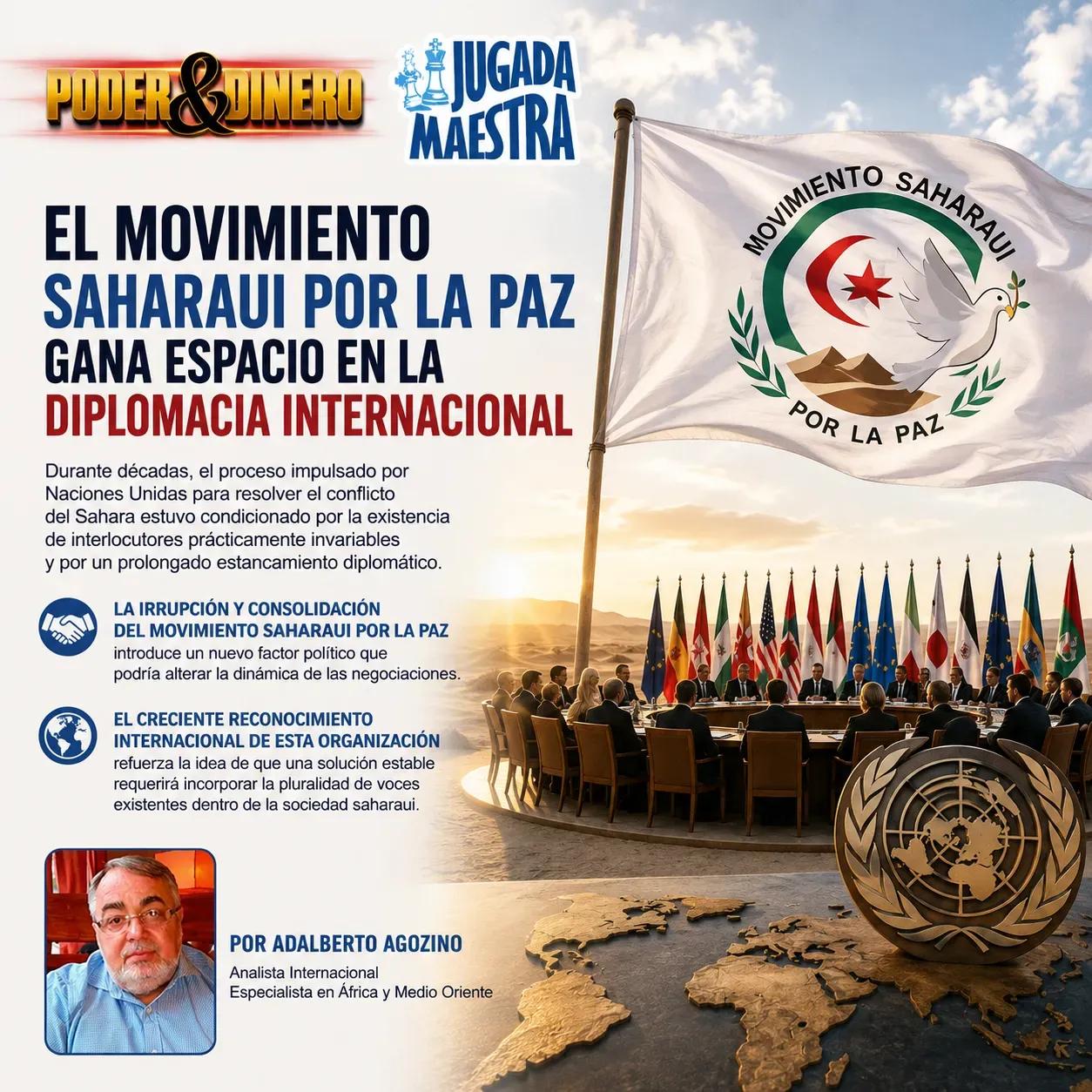
For nearly half a century, the Sahara conflict has remained trapped between diplomatic inertia, regional rivalries, and the difficulty of building a consensus capable of satisfying the stability and development aspirations of the Sahrawi population. The various initiatives sponsored by the United Nations have helped to avoid a permanent escalation of confrontation but have not managed to transform the prolonged ceasefire and successive rounds of negotiations into a definitive political agreement.
In this persistent immobility scenario, the emergence and subsequent consolidation of the Sahrawi Movement for Peace (MSP) constitutes one of the most relevant political developments in recent years. Rather than presenting itself as a mere testimonial actor, the organization has positioned itself as a political current that advocates for a negotiated solution based on dialogue, self-governance, and reconciliation among the Sahrawi people themselves, moving away from the confrontation dynamics that have dominated the conflict for decades.
Recent weeks seem to confirm this evolution. Various contacts maintained by MSP leaders with Western diplomatic representatives, both at the United Nations and in the city of El Aaiún, Morocco, show that the organization has stopped being seen as an emerging phenomenon to become an interlocutor whose opinion is beginning to be considered in major international forums. According to the documentation released by the movement itself, a delegation held meetings with the permanent missions of several members of the Security Council and received public acknowledgments from American representatives, who defined the MSP as one of the Sahrawi voices committed to seeking a lasting solution.
This recognition acquires a particularly significant political dimension because it breaks with a perception rooted for decades that the representation of the Sahrawi people rested exclusively on a single political actor: the Polisario Front. Without prejudging the positions of the different parties involved in the conflict, the evolution of the international scenario seems to reflect an increasingly evident realization: the Sahrawi society today is much more plural than it was during the Cold War years, and this diversity will hardly be able to be sidelined in any negotiation process aimed at consolidating lasting peace.
The MSP itself has built much of its political identity around this idea. The organization maintains that the era of monopolies of representation is over and that any sustainable solution must integrate all those sensitivities that advocate for a peaceful resolution to the conflict. Its discourse is not only oriented towards obtaining international recognition but also towards building consensus among the Sahrawis themselves, proposing dialogue with the Polisario Front, Algeria, and Morocco as an indispensable condition to reach a definitive agreement.
The growing attention that various international actors seem to grant to the movement also coincides with a renewed interest from Washington to reactivate a file that for years remained relegated to a secondary place on the diplomatic agenda. The series of meetings held between American representatives and MSP leaders reflects the desire to know firsthand the position of an organization that explicitly advocates for a political solution based on negotiation and self-governance formulas for the Sahara.
A meeting held in El Aaiún between movement leaders and the political advisor of the United States Embassy in Morocco is particularly relevant. During this meeting, requested by the American diplomatic representation, MSP officials presented their vision of the conflict, defended their formal inclusion in the process sponsored by the United Nations, and stated that a stable solution will only be possible if all representative forces of Sahrawi society participate. According to the information released after the meeting, the American diplomat positively evaluated the work developed by the organization and expressed Washington's interest in promoting an outcome that allows overcoming the prolonged political deadlock.
Beyond the specific content of these meetings, the politically relevant aspect lies in the normalization of international dialogue with the MSP. The organization has succeeded in establishing the idea that the future of the Sahara cannot be built by ignoring those who defend different positions within the Sahrawi political universe. In diplomatic terms, this signifies a substantial transformation regarding the dominant paradigm for decades.
This evolution is particularly significant because it coincides with a growing international acceptance that the Autonomy Plan constitutes one of the most realistic bases for reaching a mutually acceptable solution. Without delving into the specific positions of each state, numerous international actors have supported the need to explore pragmatic formulas that can reconcile the exercise of self-governance with regional stability and the economic development of the territory.
In this context, the Sahrawi Movement for Peace appears as a particularly well-placed actor to contribute to the construction of internal consensus. Its discourse avoids maximalist rhetoric and emphasizes political negotiation, reconciliation, and coexistence, elements that acquire increasing importance in any contemporary conflict resolution process.
No less relevant is the evolution of the diplomatic debate itself. While for years discussions revolved fundamentally around issues of historical legitimacy or exclusive representation, the international conversation is beginning to shift towards aspects related to future governance, institutional development, guarantees for the population, and the stability of the broader Maghreb region. This change favors those organizations capable of formulating viable political proposals aimed at building agreements rather than perpetuating confrontation.
From this perspective, the MSP seems to have understood that political legitimacy in the 21st century does not depend solely on historical claims but also on the ability to offer credible solutions to prolonged problems. Its insistence on the need to incorporate new voices into the negotiation process responds precisely to this logic of broadening representation spaces and reducing the polarization that has hindered any substantial progress for decades.
Of course, the consolidation of the movement as a central actor does not imply that negotiations will experience immediate resolution. The Sahara conflict continues to be conditioned by complex geopolitical interests and deeply rooted positions among the various protagonists. However, the inclusion of new interlocutors with international dialogue capacity can gradually help to modify the incentives of all parties and foster a more favorable climate for compromise.
Comparative experience shows that the most enduring peace processes tend to be those that incorporate the greatest possible diversity of political and social actors. In this sense, the emergence of the Sahrawi Movement for Peace introduces an element of plurality that could enrich the negotiations promoted by the United Nations and facilitate the search for a politically sustainable agreement.
After decades marked by immobilism, the Sahara conflict seems to be entering a different phase. Not because the obstacles to resolution have disappeared, but because the map of interlocutors is beginning to transform. In this new stage, the Sahrawi Movement for Peace emerges as an increasingly visible protagonist, with a growing ability to influence international diplomatic conversation and to advocate for an approach based on dialogue, autonomy, and reconciliation. If this trend consolidates, any future peace architecture will hardly be able to be built without an organization that has managed to position itself at the center of the debate on the political future of the Sahara.
Adalberto Agozino holds a PhD in Political Science, is an International Analyst, and is a Lecturer at the University of Buenos Aires.

Comments