On April 18, 2026, the interim president of Peru José María Balcázar suspended temporarily the signing of a $3.42 billion agreement for the purchase of 24 new fighter jets F-16 C and D block 70, along with associated equipment and support. The official purchase decision had been authorized by the Peruvian government in February 2026 after a formal two-year evaluation process, which reaffirmed the need for the capability and concluded that the offer from the United States better met Peru’s needs than other competitors, including the Swedish JAS-39 Gripen and the French Dassault Rafale F4. The agreement included an initial direct purchase of $1.5 billion for 12 new production aircraft purchased from Lockheed-Martin, to be delivered in 2029, in addition to the direct purchase of another 12 new production aircraft to be delivered later. It also included a $500 million Foreign Military Sales (FMS) package for arms, maintenance, and training, along with the possibility of providing Peru with a refueling aircraft KC-135 through the U.S. Excess Defense Articles (EDA) program, which would extend the range or endurance of the aircraft, a significant new strategic capability.
Although Peru is in the midst of a presidential election, with the second round scheduled for June 7, the rationale put forth by Balcázar—that the decision should be made by the “next president”—is less reasonable than it seems, given that the Peruvian government had already made the formal decision, following its established process, to opt for the U.S. offer. The underlying reason is that in the first round of the April 12, 2026, Peruvian election, the leftist Roberto Sánchez, aligned with Cuba, finished second (although the result has been contested and a recount is underway), potentially positioning him to defeat the right-wing candidate Keiko Fujimori in the second round on June 7 and become the next president of Peru. The leftist interim president, Balcázar, may have hoped that by delaying the signing of the contract and the initial payment of $462 million, he would leave open the option for Sánchez to secure a significant acquisition deal with China or Russia, rather than committing to the United States through the fighter jet agreement, and the long-term relationships surrounding training, munitions, maintenance, spare parts, and support systems that would accompany the purchase. In fact, similar maneuvers have occurred in the past, when elements aligned with the Russians within the Peruvian Armed Forces reportedly thwarted a 2016 Peruvian acquisition of U.S. Stryker armored vehicles for the modernization of wheeled combat vehicles in Peru.
In the current struggle, following harsh statements from the U.S. ambassador to Peru, Bernie Navarro, both the Peruvian Minister of Defense, Carlos Díaz, and the foreign minister Hugo de Zela, resigned in protest over President Balcázar’s improper action, and members of the Peruvian Congress sought to vote on a motion of censure against Balcázar. Ultimately, the Peruvian government signed the agreement and made the initial payment of $462 million.
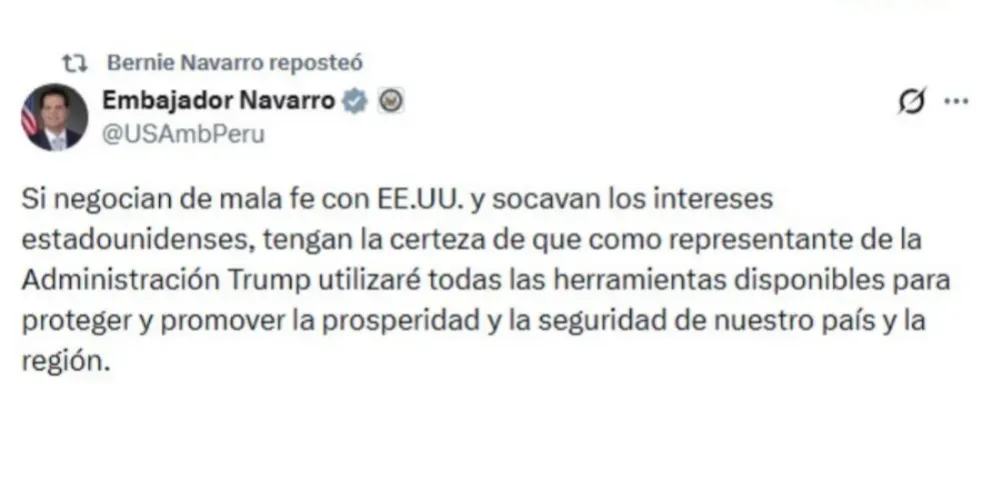
(The U.S. Ambassador to Peru, Bernie Navarro, posts a tweet warning that he will use all available tools to protect U.S. interests if Peru negotiates in bad faith. (@USAmbPeru))
For now, the outcome maintains Peru's positive trajectory as a solid U.S. defense partner, including its designation in January 2026 by the United States as a Major Non-NATO Ally.
In the context of the U.S. National Security Strategy's approach to resist the influence of extra-regional actors, recent events in Peru also highlight the role of political dynamics within U.S. partner countries to combat that influence and maintain U.S. military access and presence. Latin America faces a number of strategically relevant elections in the coming months, including May 2026 in the Bahamas, where the People's Republic of China (PRC) has a significant commercial presence and influence, the second round of the Peruvian presidential elections on June 7, 2026, the elections on May 31, 2026, in Colombia between left and right candidates with very different visions for the country's future, and the elections on October 4, 2026, in Brazil. The dynamics of each of these processes will be strongly influenced by economic pressures and discourse surrounding global events like the ongoing conflict in Iran, as well as by U.S. engagement and support for those governments. The administration, and particularly the Department of Defense, are currently at a critical moment where collective attention, constructive discourse, and support for key partners in Latin America can play a decisive role in the stance of important governments toward the U.S. and its extra-regional adversaries in the years to come, in the region that most directly affects U.S. security and prosperity.

R. Evan Ellis is a research professor on Latin America at the U.S. Army War College.
(This article is part of the new “Strategic Insights” series from the U.S. Army War College)

Comments