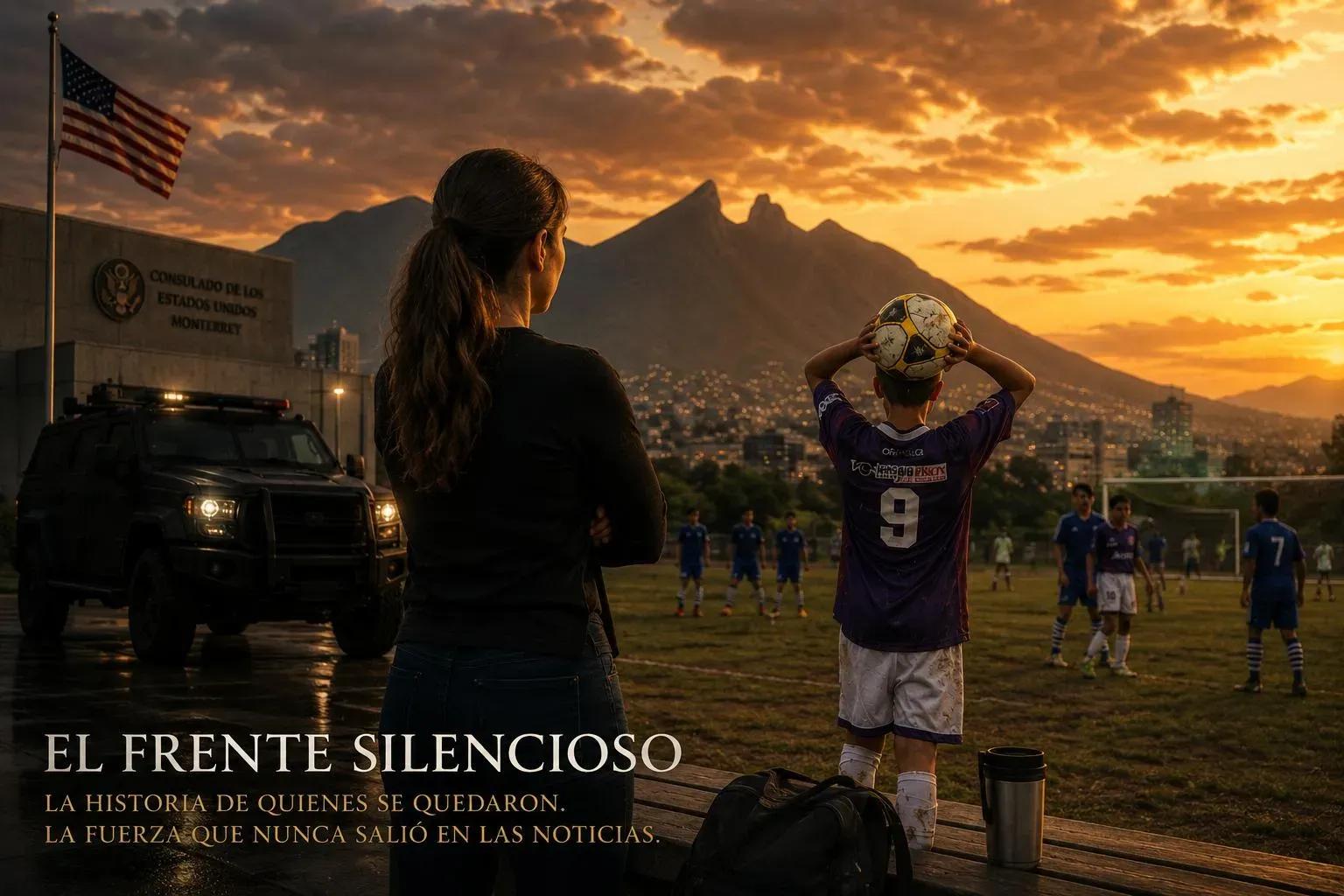
Monterrey, 2009 — for her, on her birthday
There is a version of the story that people know: the one of headlines, reports, documentaries, and books.
A story of operations, targets, strategy, and risk.
A world defined by movement: men crossing borders in the dark, decisions made in seconds, consequences measured in years.
In that version, there are heroes.
But there is another version of the story.
One that unfolds far from the noise.
It lives in quiet homes, in long nights, in the space between what is said and what is borne.
It is not written in reports nor does it appear in the news.
It is the story of those who remained.
My wife lived that story.
When we arrived in Monterrey, the illusion of distance quickly disappeared.
The U.S. Consulate was attacked, and with that came a certainty: this was not a distant struggle: it was here.
Fear settled in, not as panic, but as presence.
It moved among the consulate community, in conversations, in that silent understanding that we operated in a place where violence was not theoretical.
She knew it.
She knew what we were facing.
She knew we were on the trail of one of the most violent criminals of that time.
She understood the risk, not abstractly, but with that calm clarity that comes from living with it.
And beyond the walls of the consulate, the entire city bore that same weight.
Fear was not contained.
It permeated everything.
We had no security.
None of us had it.
And yet, life had to go on.
You didn't come from that world.
You didn't know how it operated… until you saw it face to face.
On the first day of our children's classes, the consulate sent an armored vehicle to transport them.
That’s when you understood everything.
I saw the fear in your eyes.
And yet… you did not back down.
In the midst of that uncertainty, my wife was doing something that, at first glance, seemed everyday.
She took our son to his soccer practice.
Not once, not when it was convenient, but constantly, silently, without hesitation.
Through a city that held its breath.
On days where staying home would have been understandable.
She never wavered.
I remember a particular day. I went to La Estanzuela to see where the field was.
I needed to know the route, the environment, to understand what I would be facing if something were to happen.
That was the world I lived in.
And there she was.
Standing by the sidelines of the field, as always, watching the children play,
as if the world around us was not marked by everything we both bore.
For a moment, I stood watching her. You.
You, who knew exactly what kind of world we lived in
and yet, you were there.
I saw the way you held yourself.
Serene. Present. Unbreakable.
And I understood something.
What I was seeing was not routine.
It was courage.
Not the kind that is announced,
but the kind that endures in silence, without recognition.
I approached and stood by your side.
You turned to look at me and, for a moment, I noticed:
a silent relief in your gaze.
No words were needed.
They never are in important moments.
There we were, together, watching our son play, surrounded by a world we could not control,
and yet, in that instant, everything was in its place.
We took each other’s hands,
not out of fear, but out of understanding.
Not as participants in a war,
but as partners in life.
That moment passed in silence, as the most important ones often do.
But I never forgot it.
Because in that instant I clearly understood what had always been there.
While I operated in a world defined by risk,
you operated in one that demanded something equally difficult:
steadfastness in the face of fear.
You created normality where there was none.
You built routines so that our children would never feel the weight that we carried.
Only responsibility and the strength to carry it without it being noticed.
If anyone deserves to be called brave, it is you.
Because bravery is not always found in the moments that make the news.
Sometimes, it lives in the quiet decision to protect what matters most,
not by facing chaos directly,
but by refusing to let it enter the home.
In that sense, you never failed.
And if there is honor in the story told of those years,
your place is not behind the scenes.
It is at the center.
I saw your strength then.
I still see it today.
And today I celebrate you.
Happy birthday, my love.
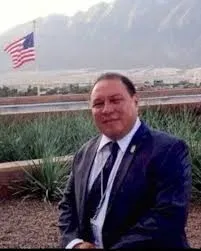
Leo Silva is a former special agent in charge of the DEA (Monterrey Office) and author of Reign of Terror and El Reinado de Terror. With decades of experience on the frontlines of the fight against transnational cartels, Silva offers readers an intimate look at some of the most dangerous operations directed against high-level leaders and organizations.
Since the publication of his memoirs, Silva has become a recognized voice in the media and the speaking circuit. His story and analyses have been featured in interviews with Pulitzer Prize-winning journalist Jorge Ramos on Univision (Así veo las cosas), three-time Emmy winner Paco Cobos (La Entrevista), and Ana Paulina (Voces con Ana Paulina), where his participation generated millions of views. He has also been a guest on prominent platforms such as the podcast Cops and Writers with Patrick J. O’Donnell, Game of Crimes with Steve Murphy, and Llamados a Servir with Roberto Hernández.
Through his books, speeches, and media appearances, Silva continues to illuminate the realities of organized crime, law enforcement's work, and the human cost of the war on drugs, while sharing lessons of resilience, leadership, and truthfulness.

Comments