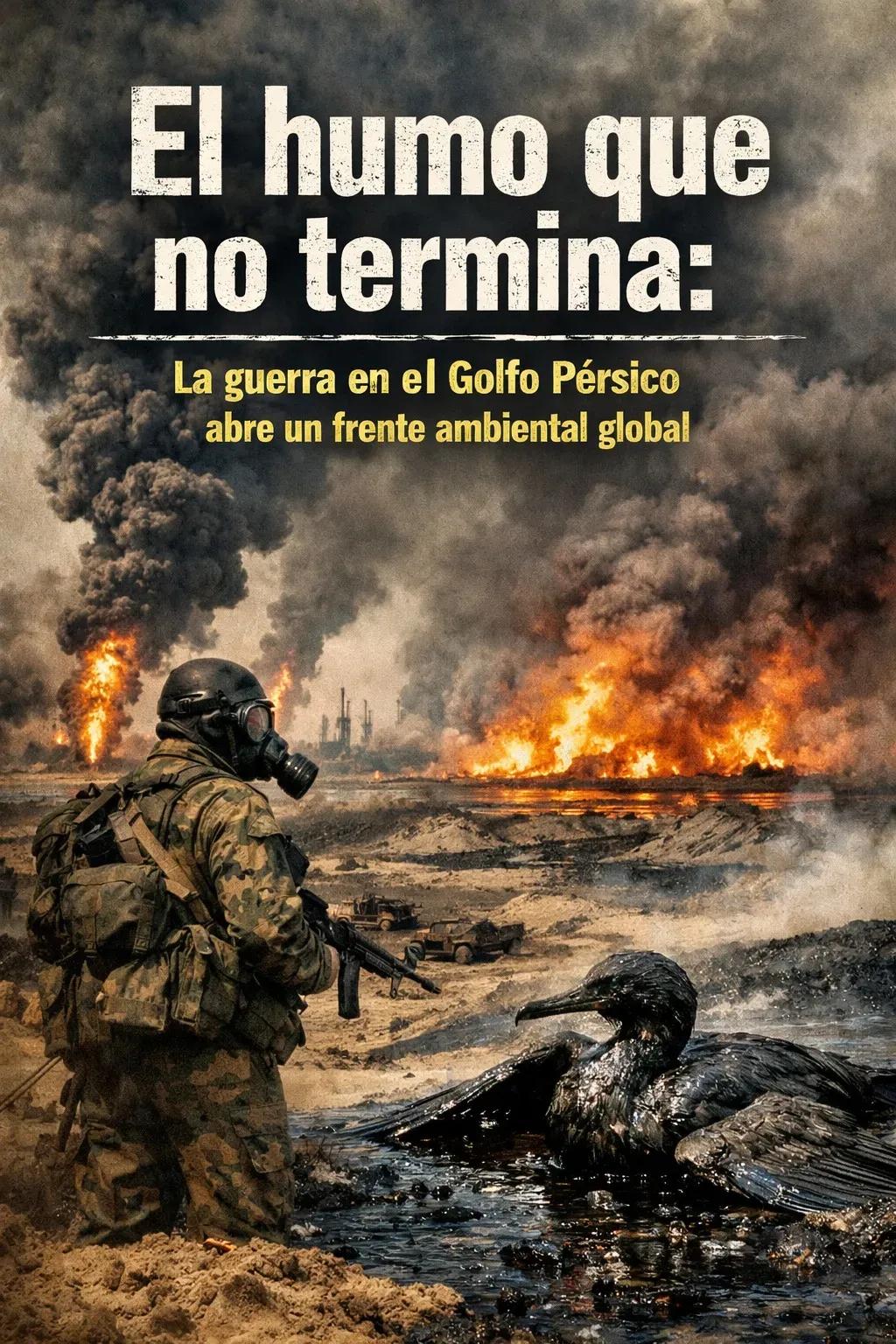
Modern warfare is no longer measured solely by destroyed cities or human displacement. In the Persian Gulf, since the onset of attacks on February 28, the conflict has unleashed a large-scale environmental degradation process whose magnitude is just beginning to be understood. Fires in refineries, explosions of fuel depots, and attacks on oil tankers have released a combination of toxic substances that disperse through the atmosphere, soils, and seas, affecting extremely sensitive ecosystems and densely concentrated urban populations.
In just the first few weeks of fighting, emissions from industrial fires and explosions have released around five million tons of carbon dioxide, a volume that exceeds the annual emissions of some small countries. This phenomenon is explained by the destruction of energy facilities—refineries, oil depots, and gas plants—which causes the massive combustion of hydrocarbons and the release of greenhouse gases that accelerate global warming. Added to this is the release of fine particles, black carbon, and toxic compounds that immediately affect air quality and public health.
The most visible scene of this impact has been experienced in Tehran. After the attacks on oil facilities in the outskirts of the Iranian capital, columns of smoke covered the city sky, where millions of people live. Scientists consulted by international media have noted that the mix of pollutants released in these fires—carbon monoxide, nitrogen oxides, sulfur dioxide, and volatile organic compounds—is typical of extreme industrial accidents, but is rarely observed at that scale in such a densely populated urban environment. Researcher Akshay Deoras from the University of Reading stated that the magnitude of the released pollutants could be “unprecedented”, while Professor Eloise Marais from University College London warned that the episode is equivalent, in chemical terms, to the simultaneous explosion of several industrial facilities.
One of the most alarming phenomena reported by the inhabitants of the Iranian capital has been the so-called “black rain”. This term describes precipitation laden with soot and chemical residues that darkens water upon falling. The process occurs when suspended particles in the air—resulting from oil fires or explosions—are captured by raindrops and dragged to the ground. Although rain can partially clean the atmosphere, it also deposits pollutants on streets, homes, crops, and water systems, facilitating their infiltration into aquifers and incorporation into the food chain.
Air pollution is just one front of this crisis. The war has also released toxic waste derived from ammunition, explosives, and industrial materials. When buildings, depots, and factories are destroyed, debris disperses hazardous substances such as lead, mercury, asbestos, or complex hydrocarbons that can remain in the environment for decades. These pollutants fixate in the soil, degrade its fertility, and affect its regeneration capacity, compromising agriculture and food security in broad regions.
The impact on human health is immediate and also prolonged. The Director-General of the World Health Organization, Tedros Adhanom Ghebreyesus, has warned that the destruction of energy infrastructures “risks contaminating food, water, and air”, generating serious consequences for the most vulnerable populations. Exposure to fine particles and toxic compounds not only causes acute respiratory conditions but also increases the risk of chronic diseases and cancer in the long term.
But the scope of the environmental disaster is not limited to Iran. The conflict has also moved to the sea, particularly the Persian Gulf and the Strait of Hormuz, one of the world's most important energy corridors. Attacks on tankers and military vessels have caused oil spills that form surface films over the water, reducing oxygenation and harming fish, seabirds, and coral reefs. These ecosystems, already weakened by global warming, could suffer irreversible damage if the spills continue.
Additionally, there is a risk to critical infrastructures like desalination plants, essential in a region where access to fresh water depends on the sea. Pollution of seawater can disable these systems or reduce their capacity, generating a water crisis amid war.
In this already critical context, the eventual opening of a land front by the United States in Iranian territory would represent a qualitative leap in environmental degradation. Unlike air and naval warfare, land operations involve a prolonged occupation of territory, the massive deployment of armored vehicles, heavy artillery, and troops, as well as the systematic destruction of infrastructures across wide areas. This type of warfare intensifies soil contamination through the direct dispersion of heavy metals, fuels, lubricants, and explosive residues.
Historical experience shows that land conflicts leave behind a persistent “weapons contamination”, characterized by the presence of mines, unexploded ordnance, and chemical remnants that can remain active for decades, affecting ecosystems and civilian populations. These elements represent not only a physical danger but also release toxic substances that contaminate water and soil, degrading biodiversity and hindering environmental recovery.
Moreover, ground operations often lead to the direct destruction of natural habitats, deforestation, and ecosystem fragmentation. The passage of heavy vehicles compacts the soil, alters its structure, and reduces its capacity to absorb water, favoring processes of erosion and desertification. In arid regions like much of Iran, these effects can be especially severe and long-lasting.
Another critical factor is the collapse of environmental management systems during prolonged wars. Supervision of spills, protection of water resources, and management of hazardous waste cease to function, which accelerates ecological degradation. The United Nations has warned that armed conflicts provoke an “accelerated environmental degradation” precisely due to the breakdown of these control mechanisms.
In a scenario of land occupation, there would also be an increase in the large-scale consumption of fossil fuels, due to the intensive use of military vehicles, logistics, and heavy machinery, which would increase global greenhouse gas emissions. This phenomenon, combined with the destruction of energy infrastructures, would reinforce the conflict's climate impact.
The consequences would not be limited to Iranian territory. Pollutant particles generated by explosions and earth movements can be transported by atmospheric currents thousands of kilometers away, while the contamination of rivers and aquifers can extend to neighboring regions. Ground war, in this sense, would amplify the global dimension of the already ongoing environmental crisis.
To this picture is added the risk associated with damaged nuclear and chemical facilities. Although no significant radioactive leaks have been confirmed so far, the deterioration of sensitive infrastructures in the context of land fighting would increase the likelihood of incidents with potentially catastrophic consequences.
The difficulty in assessing the real impact of the conflict further complicates the diagnosis. Independent organizations have identified hundreds of incidents with environmental consequences, although they warn that the actual number could be much higher due to lack of access and information restrictions.
The consequences of this contamination can extend far beyond the Middle East. Particles released by oil fires and explosions can travel thousands of kilometers and affect even remote regions, altering glaciers, soils, and ecosystems. The war, in this sense, becomes a global environmental phenomenon.
Meanwhile, on the ground, the most visible effects remain the unbreathable air and the devastated landscape. But experts agree that the true extent of the disaster will be measured in the years and decades to come, when the persistent pollutants continue to affect health, agriculture, and ecosystems.
The conflict in the Persian Gulf is proving that the environment is not collateral damage but one of the main victims of war. And if the conflict escalates into a land invasion, that invisible victim could transform into a historical ecological catastrophe.
Adalberto Agozino holds a PhD in Political Science, is an International Analyst, and a Professor at the University of Buenos Aires.

Comments