Is it better to be feared or loved?
I am a lifelong American Republican. Since the beginning of my career, focused on American security issues and its relationship with Latin America, I have been an advocate for American pragmatism with our partners and for the occasional and judicious use of American military power in service of the national interest. I have also long believed that the U.S. national interest requires a secure and prosperous hemisphere, dominated by friendly democratic allies, united by a shared framework of transparency that governs our commercial and other interactions.
Over the past two decades, while analyzing and writing about the challenge of China's advance in the Western Hemisphere, I have also increasingly focused on the strategic value of the American "brand" to respond to that challenge, including the differentiating power of what it represents and inspires throughout the region.
Today, the Trump Administration's "America First" approach unapologetically embraces the pursuit of U.S. national interest, sometimes including the use of economic coercion and open military force. The current policy does not abandon, but possibly minimizes American commitments to inherited international institutions and legal frameworks, as well as funding for initiatives in which the United States sought to improve health, education, development, institutions, democracy, and the protection of people when such programs do not immediately benefit American businesses or their strategic position.
The new U.S. foreign policy is possibly a significant shift from a more benevolent acceptance of international institutions, principles, and "doing good," which enjoyed a degree of bipartisan support since before World War II. Reviewing U.S. assistance programs from the perspective of national strategic objectives is useful. American taxpayers had come to fund too many inflated or ineffective programs in the undeniable name of "doing good." However, I am deeply concerned that the unapologetic pursuit of U.S. self-interest, backed by open economic and military coercion, will affect the calculations and behaviors of the region in the long term in ways that are significantly adverse to American interests.
Realism vs legitimacy
At the core of international relations theory is the debate between "realism," which primarily values the coercive power of states and the pursuit of their direct interest, and other perspectives that focus on the importance of institutions, moral and legal principles, and frameworks that bind states to broader, long-term concepts of interests. As the Italian political philosopher Niccolò Machiavelli famously posed, the central question of realism: "Is it better to be feared or loved?" Never has that philosophical question been more important than in the present moment.
Coercion and its long-term effects
The new U.S. posture toward Latin America includes significant tariffs, sanctions and threats against them, lethal interdictions against drug-trafficking boats, military action to capture the de facto leader criminally linked to Venezuela, and indirect threats of intervention in Panama, Greenland, Colombia, and Mexico, among others. Such military and economic coercion may work in the short term, as the United States holds disproportionate power and the coerced generally lack alternatives. However, this short-term thinking ignores that acts of coercion inevitably lead the victim to react to protect against future coercions, even as they drive others to adjust their own situations to reduce their perceived vulnerability.
Probably the greatest risk of an unembarrassed pursuit of self-interest that actively exploits coercion is that it undermines how the region views the United States, its trust and willingness to cooperate with it, and its willingness to turn to other partners, from the European Union to the People's Republic of China, as a "hedge" against the United States in the future.
In business, analogous concepts of "brand," reputation, and relationships often receive great value and are sometimes protected at a high cost, even though their effects on the "bottom line" are equally difficult to measure.
During the Cold War, American military power and resistance to attempts to subvert its partners played an important role in the final triumph of the West. However, in the end, it was the idea of democracy and individual rights that inspired the United States, and not American tanks and missiles, that led the people of the Warsaw Pact to break down the Berlin Wall and rise up to dismantle the communist system that controlled their countries.
Strategic competition with China
Today, even more than during the Cold War, the U.S. is competing globally against an adversary that matches it in economic size, key technology capabilities, and, in the near future, military strength. That adversary, the PRC, can mobilize its companies and banks to offer superficially beneficial projects to politicians who need to "deliver the goods" for their people. PRC-based companies can use stolen and subsidized technologies to secure contracts for technological architectures that they can later exploit for espionage. PRC agents can weave extensive networks of personal relationships, travel, and "perks" for businesspeople, politicians, journalists, government officials, and academics to promote their interests, distort public discourse, and create influence. A U.S. strategy that focuses on coercion and transactionalism competes with the PRC on the latter's greatest advantages.
Today, many American partners forego more cost-competitive Chinese options for their technological architectures, or avoid collaborating with the PRC on military, space, and other sensitive matters. Those who do likely make that sacrifice because they calculate that, in the long run, the best option for their countries' development, and for the security and well-being of their societies, is to align with democracy and the rule of law, rather than open the door to Chinese agents who could overwhelm and hijack their economy and political system through corruption, compromise, and dependence.
In the past, American programs to assist partners in areas such as health, education, anti-corruption, and strengthening institutions have contrasted with superficially attractive Chinese projects that are ultimately self-interested. Similarly, America's defense of democratic values, transparency, the rule of law, and the protection of the individual, even when uneven, misguided, or bothersome, has helped defend to populations why they need the United States as a partner, even when the PRC’s material "offer" is greater.
It is difficult to overstate how much the United States unnecessarily cedes its main strategic advantages in the competition with the PRC when it unembarrassed embraces transactionalism and coercion, eliminating relatively inexpensive programs that do good, leaving some of its most loyal defenders in the region unemployed as they depended on those contracts for their livelihoods. By following this path, the United States undermines decades of painstakingly created goodwill and repositions itself as an actor that operates with the same self-interest and coercion as the PRC, but without the latter's cynical "sweetener" in its respectful "win-win" rhetoric, while presenting an "offer" that appears more modest than China's.
For a time, the United States will likely be able to prevent some partners from accepting the PRC’s offer through a combination of coercion and its political alignment. However, over time, partner governments change. The coerced find ways to take Chinese money while pacifying Washington, and partners hedge and diversify to protect themselves. Some senior American officials may arrogantly assume that American neighbors will continue to yield to coercion because "they have always been with us" or because "they have no other option." I fear that by the time American decision-makers realize that our friends' alignment with the U.S. has been replaced by resentment, abandonment, and self-trapping in networks of influence woven by the PRC, it will be too late.
The value of the American "brand"
Protecting the American "brand," and the power derived from the faith of our neighbors in the Western Hemisphere in what the United States represents, does not require the U.S. to squander its wealth on foolish projects, tie its hands before its adversaries, or abandon the pursuit of American national interest. However, it urgently requires recognition of the strategic value of benevolent American democracy, and action from all branches of government to protect and foster it. This includes preserving a reasonable range of programs to "do good" in the world, without direct ties to commercial or political benefits. It includes limiting China's advance through modest but continuous investments in strengthening partner institutions and the rule of law. It includes a modest investment to make the American case to the region through media programs, academic studies, and other "people-to-people" encounters. It includes continuing to invest in the Organization of American States and other institutions of the Inter-American System to prevent the PRC, or other hostile actors to the U.S., from dominating those institutions.
A strategic warning
Finally, protecting the valuable American brand strategically also requires vigilance over what the U.S. says and does, including its implicit and explicit threats. It requires ensuring that U.S. actions are structured around shared principles, including advancing democracy, protecting the individual, and respecting the rule of law, around which those who share those values can unite. Never before has it been more important to recognize not only that "the region is watching," but also that American neighbors will decide and act based on the conclusions they reach that will profoundly impact American national security and interests.
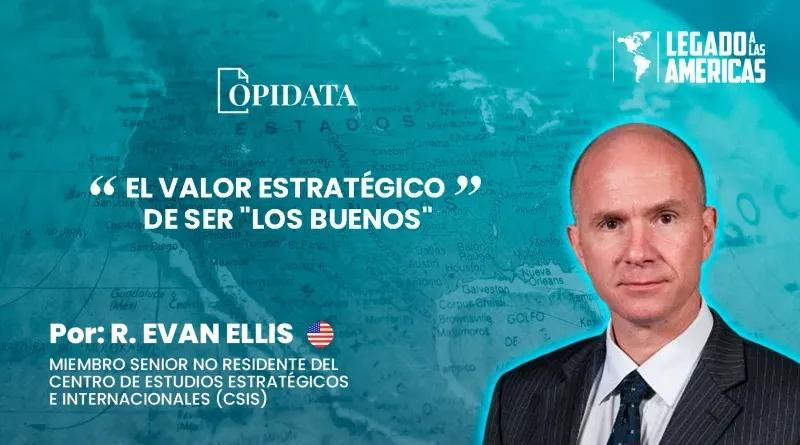
R. Evan Ellis is Non-resident Senior Fellow at the Center for Strategic and International Studies (CSIS) and an expert in security, organized crime, China, and geopolitics in the Western Hemisphere. Hemispheric security and U.S.-Latin America Relations Expert
Comments