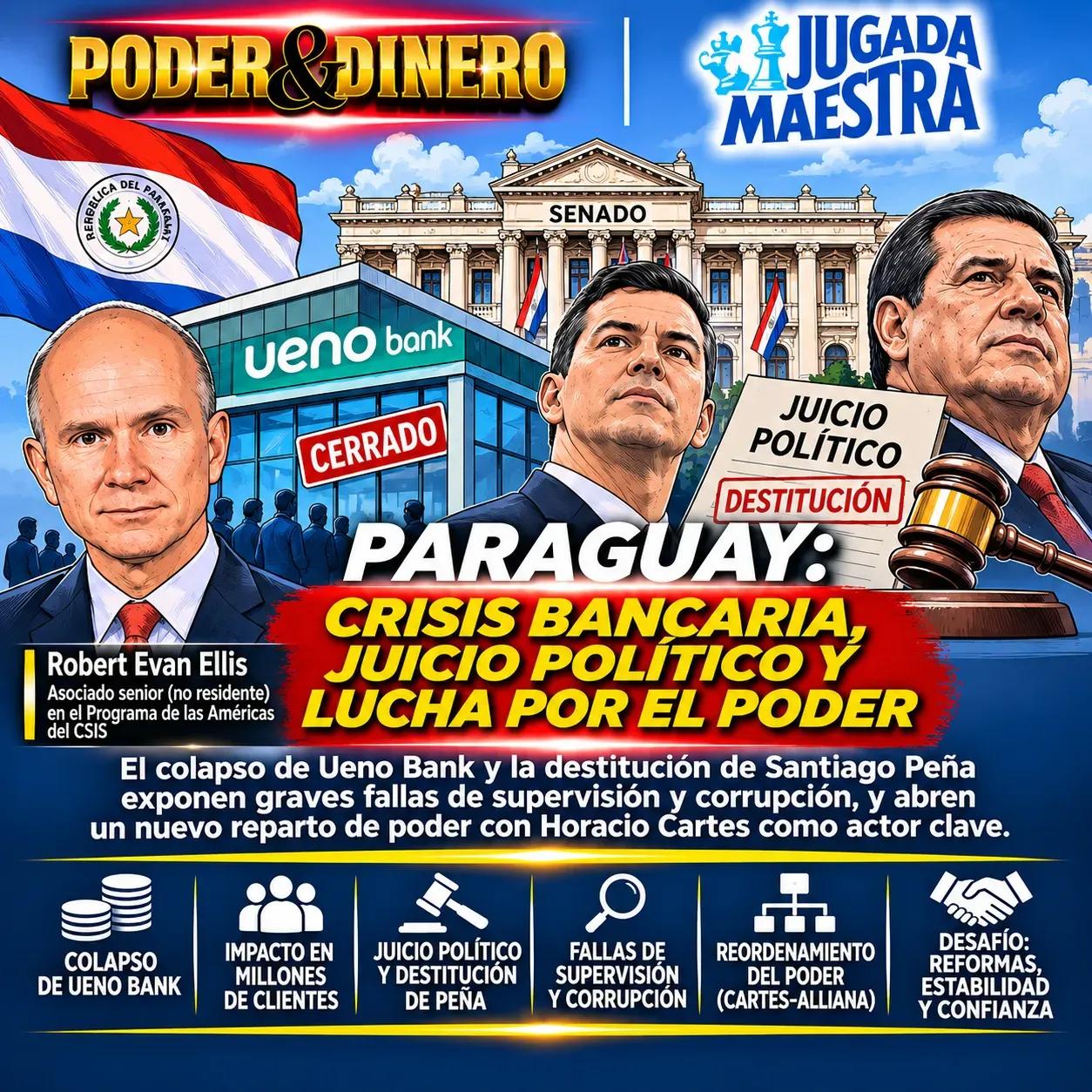
On November 3rd, the Central Bank of Paraguay announced the closure of Ueno Bank, the banking entity with the highest number of clients in the country, after its solvency index fell below half of the legal minimum. Three days later, the Senate voted 44 to zero to impeach President Santiago Peña, in the country's first presidential impeachment trial since 2012, and he has been detained since that night. The episode exposed serious governance and oversight failures, but it also shows how the fight against corruption can serve factional interests. It remains unresolved whether Paraguay will emerge from the crisis with stronger institutions or simply with a new distribution of power.
The collapse affected households all over Paraguay. Ueno declared 2.9 million clients, equivalent to nearly 60% of the country's adult population, many of whom were previously unbanked. The bank also held approximately 850 million dollars in public funds, including 355 million from the Social Security Institute, which paid pensions for about 32,000 retirees through the entity. The crisis led to the permanent closure of the MUV transport platform and left about 3,000 drivers without work.
On a larger scale, the scandal illustrates how corruption and institutional weakness can threaten prosperity and stability in Latin America. Paraguay ranks 150th out of 182 countries in Transparency International's 2025 Corruption Perceptions Index. The Prosecutor's Office has charged 27 individuals for loans that Ueno allegedly channeled to companies linked to its controlling group, the Vázquez Group. The founder and first vice president of Ueno, Federico Miguel Vázquez Villasanti, and its president, Juan Manuel Gustale Cardoni, are currently in preventive detention.
Oversight also failed. Banking supervisors had ordered Ueno to divest its loans to linked companies, but the Central Bank found evidence that the company that acquired them, also belonging to the group, had been financed by the bank itself. The former president of the Central Bank, Carlos Carvallo, had led Financiera Ueno, the predecessor of the entity, until 2023, when he moved directly to the institution responsible for overseeing it. Carvallo claims he refrained from participating in decisions related to the bank, but he has since been charged and detained. Peña was a business partner of the Vázquez Group until March 2025 and now faces charges, including breach of trust, which he denies.
On another level, the crisis illustrates how allegations of corruption can become instruments of political confrontation, even when the underlying irregularities are real. Peña owed his rise to his former mentor, former president Horacio Cartes, who leads the ruling Colorado Party. However, by October, their alliance had fractured, while Peña and Vice President Pedro Alliana were building their own faction.
On November 5th, Cartes supported the impeachment, stating that it would allow the country’s institutions to be realigned. Colorado legislators then joined the opposition to impeach Peña but avoided the impeachment of Alliana, who was included in the same impeachment request. The new vice president, Antonio Barrios, a personal physician and long-time confidant of Cartes, praised the latter during his swearing-in. The Senate, which had rejected the emergency candidates proposed by Peña for the Central Bank, confirmed the economist Jorge Schreiner, chosen by Alliana, within three days.
None of this proves that Cartes orchestrated the bank's intervention or Peña’s impeachment, and the distinction is important. A legitimate investigation into financial irregularities does not constitute evidence of a coordinated political maneuver. However, when the beneficiaries of a president’s fall are so visible, the credibility of the process depends on prosecutors and judges being able to demonstrate their independence.
There are, however, reasons for cautious optimism. By November 9th, the deposit guarantee fund had delivered advances to 1.74 million of the approximately 1.87 million eligible depositors. It is expected that about 97% of Ueno's depositors will be fully protected. Moody's believes that systemic risk can be contained if the resolution is swift and orderly. The constitutional succession, though rushed, was maintained.
The risks remain real. The guarantee covers only about 30% of the value of Ueno's deposits, leaving large savers, businesses, and public institutions, including the pension fund, uncertain about the recovery of the rest. The constitutional succession should not be confused with accountability, which depends on the courts determining liabilities based on evidence and not political convenience, as well as on reforms that correct the oversight failures that led to the crisis.
Paraguay retains considerable advantages. Its relatively stable macroeconomic environment, business-friendly orientation, competitive labor costs, and abundant hydroelectric energy from Itaipú and Yacyretá have contributed to attracting investments, including a growing interest in data centers and other energy-intensive industries. Its geography also confers strategic importance. Paraguay occupies a central position in South America, with access to the Atlantic through the Paraguay-Paraná river system and increasing connectivity via the Bioceanic Corridor.
Paraguay is also the only remaining diplomatic ally of Taiwan in South America, making its political stability particularly important for Washington and Taipei. On November 10th, Taiwan reported that its ambassador had congratulated Alliana and that cooperation projects would continue. With Luiz Inácio Lula da Silva reelected in Brazil, Paraguay's value to Washington as a stable partner is likely to increase.
However, that relationship faces new complications. Democrats will control both chambers of Congress starting in January, and the handling of controversial Latin American figures by the Trump administration is likely to come under scrutiny. In 2023, the Treasury Department sanctioned Cartes, citing "rampant corruption undermining democratic institutions." The administration lifted those sanctions in October 2025, two months before President Donald Trump pardoned former Honduran President Juan Orlando Hernández. If Cartes emerges from the crisis with firmer control of the ruling party, Washington could find itself caught between valuing a reliable ally and renewed concerns about corruption and accountability.
The importance of Paraguay to the United States should not depend on the fate of individual politicians nor serve as an excuse to overlook the weaknesses of its democratic governance. Paraguay's challenge lies in turning the crisis into lasting reforms, rather than a mere reorganization of power; Washington's challenge is to value a long-standing ally while demanding accountability and stronger financial oversight. Paraguay's true demonstration of resilience will not be how quickly it replaced a president or contained a banking collapse, but its ability to emerge from the crisis with institutions more deserving of the trust of its citizens and international partners.
R. Evan Ellis
Senior (non-resident) Associate in the Americas Program at the Center for Strategic and International Studies (CSIS).

Comments