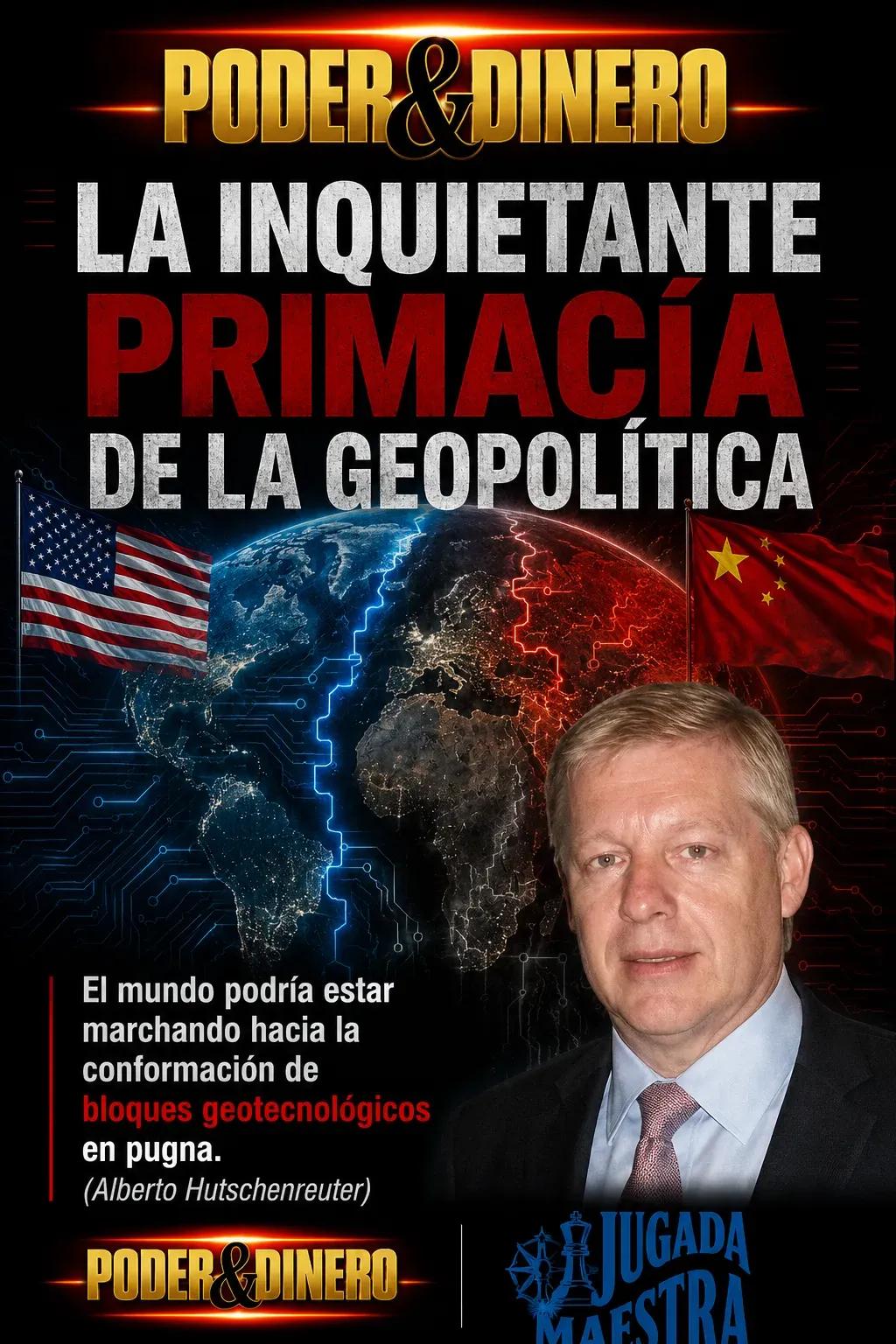
Geopolitics, that is to say, the projection of political interests over certain territories with aims associated with the increase of state power, has been and is one of the great regularities of history. Although the term emerged toward the end of the 19th century, its practice is proto-historical.
Having been born in a time of dominant "isms" in the world of that time (nationalism, militarism, imperialism), and later suffering the hijacking of national socialism that turned it into an instrument of territorial-racial expansion, geopolitics became associated with interstate rivalries and the very origin of wars.
Although after 1945 attempts were made to "de-Germanize" it, in the West it was considered a "cursed discipline" and little was said about it, yet the logic of the Cold War implied a colossal geopolitical struggle from its beginning to its end. Moreover, the fact that one of the contenders was an ideological state made geopolitics ideological, that is to say, the territorial status quo was impossible (although in the seventies the USSR committed to respecting borders in Europe).
Toward the end of the eighties and especially with the onslaught of globalization in the nineties, geopolitics underwent a second displacement, even speaking of the "end of geopolitics," understanding thereby its deterritorialization and the adoption of a "customized" conceptual approach: everything was geopolitics, from climatic phenomena to financial crises.
However, despite this "liquefaction" of the discipline, a more fact-focused register and less on the hopeful climate of that time would have warned about the continuation of geopolitics, both in classical terms, such as the Gulf War, and in a renewed sense, for wasn’t globalization the "continuity of geopolitics by other means"?
In the 21st century, growing connectivity, new technologies, the expansion of trade, and the rise of new actors, among other new realities, were impacts that would undoubtedly end the embers of geopolitics.
Then occurred the "third death" of geopolitics, despite the fact that (once again) a more analytical reading of the facts would have concluded that geopolitics was everywhere: in the global territorial conception of transnational terrorism and its impact on the most protected territory of the globe, even in the assertive approach of national spatial doctrines, passing through wars in red zones of powers, and the successive NATO movements eastward, among others.
Since the annexation of Crimea by Russia in 2014, authorized experts referred to the return of geopolitics. From then on, the discipline was never again out of discussion, and even interdependentists, globalizers, and enlightened individuals began to refer to it, convinced that the evolution of humanity, in the sense that Immanuel Kant considered, was unalterable.
But, rigorously speaking, geopolitics had never left, not even when the Cold War ended (a regime with which it was supposed that geopolitics would disappear), reaching its highest expression on February 24, 2022, with the Russian invasion of Ukraine, a fact that can only be understood from geopolitics.
But perhaps the unsettling aspect of the primacy of geopolitics in the 21st century is that it "geopolitizes" globalization; that is, the profuse commercial network and interdependencies in the world are conditioned and cornered by the evolution of political-territorial issues, with the current situation in the Strait of Hormuz being a conclusive case regarding the primacy of the equation that combines political interests, territories, and power.
This is not the first time that globalization has been conditioned by geopolitics, but it is the first time that so much globalization is succumbing to geopolitics. Because, alongside technological advancements and the degree of connectivity, globalization was a force that, as Professor Esward Prasad argues, would not only overcome divisions between countries but would even promote geopolitical stability.
In conclusion, too much geopolitics to be true, especially since we find ourselves in the third decade of a century with unimaginable advancements. But today it is so and the facts are compelling. Geopolitics not only never left, but its dynamics are such that it could fracture globalization, the last refuge of international order substitute we have.
Perhaps greater technologies or megatechnologies will come to restrict the primacy of geopolitics, as their reach could well shift state sovereignty toward "technological sovereignty," creating a new paradigm: "technopolar" relations instead of international relations. Moreover, there are those who speak of "inter-AI" relations.
But beyond the growing impact of technologies, the "territory" of issues is broad: on one hand, since the seventies, the state has stood against erosion phenomena of its capacities and abilities (it did so against the so-called "technotronic era," interdependence, globalization, and even the digital age); on the other, security issues, lack of global governance, sophisticated crime, among others, require states with capabilities.
It is true that the state has lost authority, but it is not considered on the verge of irrelevance. Moreover, as numerous cases demonstrate, such as Palantir Technologies, to cite one, there are strong ties between corporations and the state (in 2025, almost 55% of that firm's revenue came from government clients).
Furthermore, states are working on building regulatory frameworks to prevent their authority from being excessively relocated, especially in democratic regimes, because in authoritarian regimes, technologies are favorable for social control, which is why we can talk about "digitalitarian" regimes.
Lastly, from a strictly geopolitical standpoint, in parallel to the technological era there will always necessarily be an era of imperialism over supplies; likewise, the world could move toward the formation of contesting geotechnological blocks.
Perhaps it will be artificial superintelligence (ASI) that will corner geopolitics in the future. But here it is advisable to refer to Machiavelli's caution and refrain from making judgments about "unknown realms."

Alberto Hutschenreuter holds a PhD in International Relations (summa cum Laude) from USAL. He has been a professor at UBA, ISEN, Air War College, and other educational centers. He has written numerous articles and books on international issues and geopolitics.

Comments