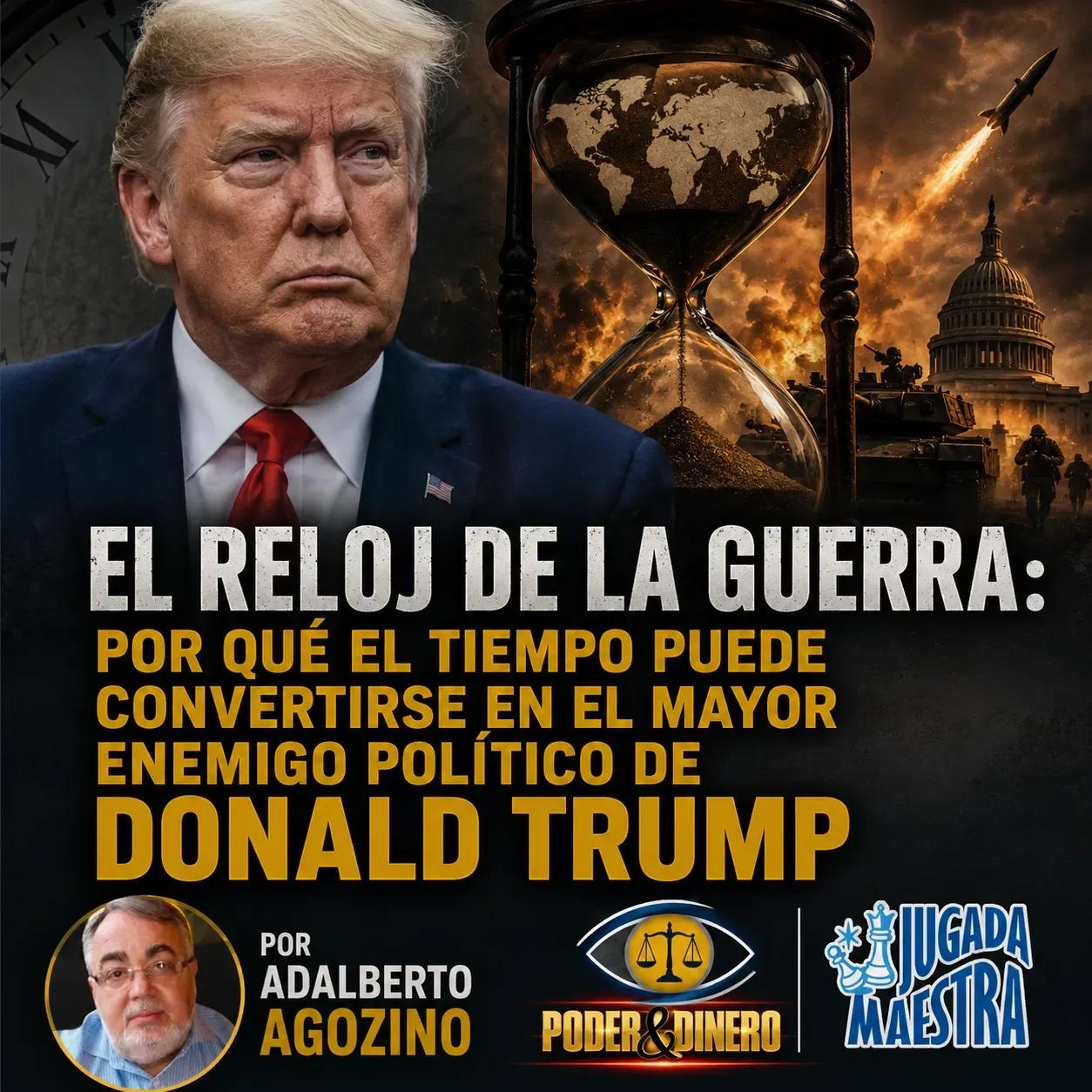
The history shows that great powers often enter conflicts convinced that they will be able to control both their duration and costs. However, they frequently discover that the decisive factor does not reside exclusively in military superiority, but in the political and economic capacity to sustain prolonged campaigns. In this sense, various specialists believe that the Trump Administration could find itself in a scenario where time has become a strategic resource as important as aircraft carriers, bombers, or missile defense systems.
The evolution of the conflict in the Middle East has substantially modified Washington's strategic priorities. What initially seemed like an operation intended to degrade Iranian military capabilities has, according to numerous observers, evolved into a much more complex regional confrontation, one where the interests of state and non-state actors converge, threats to major international maritime routes, and a growing uncertainty about global energy stability.
From this perspective, the main problem for the White House would not be solely military, but political. Each additional week of operations increases the likelihood that energy inflation will re-establish itself in the U.S. economy. For any U.S. administration, but especially for one facing decisive elections, the price of gasoline constitutes one of the most sensitive indicators of voter sentiment.
Although the international price of oil fluctuates daily based on market expectations, numerous analysts agree that the real bottleneck continues to be the Strait of Hormuz. A substantial portion of the world's hydrocarbon trade passes through that maritime route, and a prolonged interruption — or even the mere perception of insecurity — can immediately impact maritime insurance, logistical costs, and energy final prices. The increase in insurance premiums, on the other hand, has acquired its own dynamics that influences as much as the crude oil price itself.
Various economists warn that this situation could generate a particularly sensitive phenomenon for Western economies: a combination of weak growth with persistent inflation, that is, a process of stagflation similar to what was observed after the oil crises of the 1970s. If that scenario consolidates, the political pressure on Washington would considerably increase, given that a good part of its European and Asian allies also depend on the stability of international energy trade.
Politics
The difficulties do not end in the economic realm. Another concern raised in various strategic studies centers pertains to the accelerated consumption of high-tech munitions by the United States. Various reports state that defense against Iranian attacks would be demanding an intensive use of THAAD, Patriot, and Standard interceptors, whose industrial production requires years to replenish the utilized stocks. According to this interpretation, the real problem would not be the availability of aircraft or warships, but the limited capacity of the U.S. industry to quickly rebuild inventories of certain critical systems.
Although the specific figures concerning stocks and costs differ among various sources and there is no official confirmation of several of these aspects, numerous specialists agree on one point: modern wars consume industrial resources at a much faster rate than the production capacity in peacetime. This circumstance obliges the Pentagon to simultaneously manage the needs arising from the Middle East, military support to Ukraine, and deterrence in the Indo-Pacific.
The situation becomes even more complex when analyzing the global geopolitical context. Some Western analysts have hypothesized that Russia and China could be providing different types of indirect support to Iran. Among the possibilities mentioned are the exchange of intelligence information to the supply of dual-use industrial components that could be incorporated into Iranian military programs. However, it is worth emphasizing that these hypotheses continue to be debatable, and there is no conclusive public evidence indicating that Moscow or Beijing are participating directly in the conduct of specific attacks against U.S. forces.
In any case, from a strategic point of view, some experts consider that both Russia and China could indirectly benefit from the prolongation of the conflict. Moscow would achieve a reduction of Western pressure on the war in Ukraine and force the U.S. to distribute its military resources among various theaters of operations. Beijing, for its part, would closely observe the behavior of U.S. logistics, the capacity of its defense industry, and Washington's political response to simultaneous conflicts.
Another potential consequence would be the gradual wear of the Western alliance system. The European economies, Japan, South Korea, and other allies depend on global logistics chains that are extremely sensitive to rising energy costs. If the war continues to affect maritime trade and keeps oil and gas prices elevated, divergences may arise among allies regarding the political and economic costs of maintaining a prolonged confrontation strategy.
Politics
Domestically, several analysts argue that the main threat to the Trump Administration does not necessarily come from the battlefield, but from the electoral calendar. Various polls reflect a deterioration in presidential approval ratings and a Democratic lead in voting intentions for the midterm elections, although this data corresponds to a specific scenario and should be interpreted with caution.
The importance of the midterm elections lies in the fact that a potential loss of control of Congress could significantly limit the president's maneuverability on foreign policy. The U.S. Constitution grants Congress broad budgetary and oversight powers, which would allow it to condition the pace of funding for certain military operations or demand greater oversight on future interventions.
From this perspective, some observers argue that a hostile legislative majority could favor a more prudent foreign policy less inclined to direct military force employment. Others, however, believe that even with an adverse Congress, the president would retain significant powers as commander-in-chief. The real extent of those limitations would depend, should the occasion arise, on the political balance that emerges from the ballots and the willingness of both parties to reach agreements.
The uncertainty also casts its effects on the future of the Republican Party. A prolongation of the conflict coinciding with internal economic deterioration could affect not only the outcome of the midterm elections but also the positioning of the party in the lead-up to the next presidential election. In U.S. politics, long wars are rarely evaluated solely by their military outcomes; they are often measured also by their economic cost, duration, and impact on the daily lives of citizens.
Ultimately, the evolution of the conflict in the Middle East has turned time into a strategic factor of paramount importance. If the situation stabilizes before November, the Trump Administration could present a narrative based on the restoration of regional security and economic recovery. If, on the contrary, energy volatility, commercial uncertainty, and the high cost of military operations persist, the war runs the risk of becoming a significant internal political problem.
As has occurred in other stages of contemporary history, military campaigns can be decided both on battlefields and in markets, parliaments, and ballots. In the U.S. case, the outcome will depend on whether the White House can demonstrate that the cost of war yields strategic benefits that surpass its rising economic and political costs. That is, probably, the real battle that Donald Trump's presidency is fighting today.
Adalberto Agozino holds a PhD in Political Science, is an International Analyst, and is a Lecturer at the University of Buenos Aires

Comments