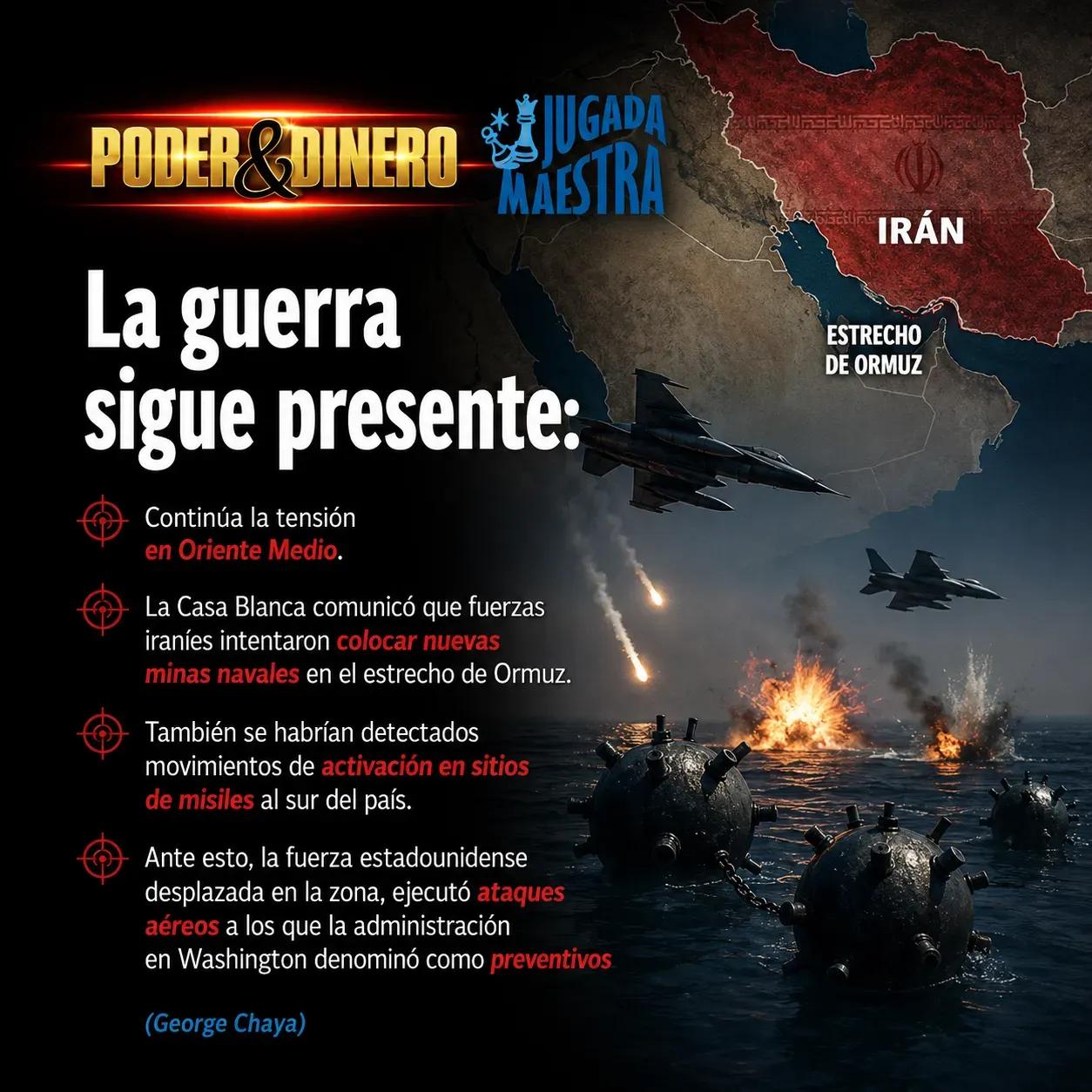
The White House communicated that Iranian forces attempted to place new naval mines in the Strait of Hormuz. Movements of activation at missile sites in the south of the country were also detected. In response, the U.S. force deployed in the area executed airstrikes that the administration in Washington termed as preventive.
President Donald Trump explained and justified the bombings in the Arabian Sea and the Gulf of Oman, defining them as actions of strict protection not only of their bases and military forces deployed in the region but also of international civilian maritime traffic and their regional Sunni partners. However, the military response immediately raised international alarms after the U.S. president accused Iran of violating the fragile ceasefire in effect in the Middle East. The accusation comes amid a backdrop of extreme tension following a series of nighttime armed incidents. The events threaten to reactivate a large-scale conflict and expand the theater of operations. The non-aggression pact hangs by a very thin thread today, said a source from the Pentagon under condition of anonymity.
For its part, the Iranian Ministry of Foreign Affairs rejected Washington's version and described the U.S. offensive as a serious violation of the agreed ceasefire. Tehran denounced that the attacks by the coalition made up of the U.S. and Israel have broken the rules of hostilities cessation. Meanwhile, Israeli authorities assured that their movements continue to be routine within the doctrine of defending their northern border against renewed guided missile fire from Hezbollah.
The crisis escalated early Tuesday morning, and the clash occurs at a crucial political moment. At this hour, delegates from both countries are seeking to strengthen talks at political dialogue tables in Qatar. The meetings in Doha aim to extend the ceasefire for another sixty days. The overall plan seeks to reopen the Strait of Hormuz to global trade in a completely unrestricted and safe manner. This step is vital for normalizing crude oil prices, and for that, the flow of ships through this commercial maritime route is key.
Secretary of State Marco Rubio tried to calm the waters, stating that a final arrangement is still very feasible. Rubio clarified that President Trump wishes to sign a robust and secure agreement. The U.S. president prefers not to close a deal rather than accept a weak plan. Negotiations are progressing slowly due to disagreements over frozen funds, and Iran demands the recovery of billions of dollars held in international banks, which, in Washington halls, is asserted will not happen. On Wednesday morning, a high-ranking political figure from DC assured me that it is not Obama who is in government so that Iranians receive planes loaded with millions of dollars in cash as happened in 2011.
The international community is watching the situation with great concern. The Chinese government formally requested restraint from the parties. Beijing called for respecting the commitment made to protect the civilian population. Meanwhile, rescuers are working in Lebanon after peripheral bombings, as Hezbollah continues its fighting to return to the towns and villages in the south of the country where Israeli forces are deployed within Lebanon. In this scenario, regional instability complicates humanitarian aid efforts in the affected areas.
In conclusion, it is very possible that the fate of the Middle East will be defined in the coming hours. President Trump convened his entire cabinet at Camp David on Tuesday, which is unusual and heralds significant events regarding defense and national security. Diplomacy does not offer guarantees of success, and if it fails -as it is believed it may happen- cross-attacks could turn the region into a theater of open and devastating military operations. International mediators are rushing last-minute political contacts. The current major challenge is to prevent the talks from collapsing completely. It is very clear that regional peace is facing its most difficult test in the first twenty-five years of the 21st century.
However, for us -and a small handful of close colleagues to decision-makers- the scenario is nothing new and brings nothing that has not been alerted by the last twenty years from various academic papers, hundreds of published articles in different languages in dozens of international press outlets, and no small number of hours of classes held in universities in the United States, Europe, and Latin America. However, unfortunately, the West never understood it, and I am convinced that it never will.
*Prof. George Chaya, is a Senior Advisor on Middle Eastern Affairs and a USA National Security expert OSINT based in Washington DC.

Comments