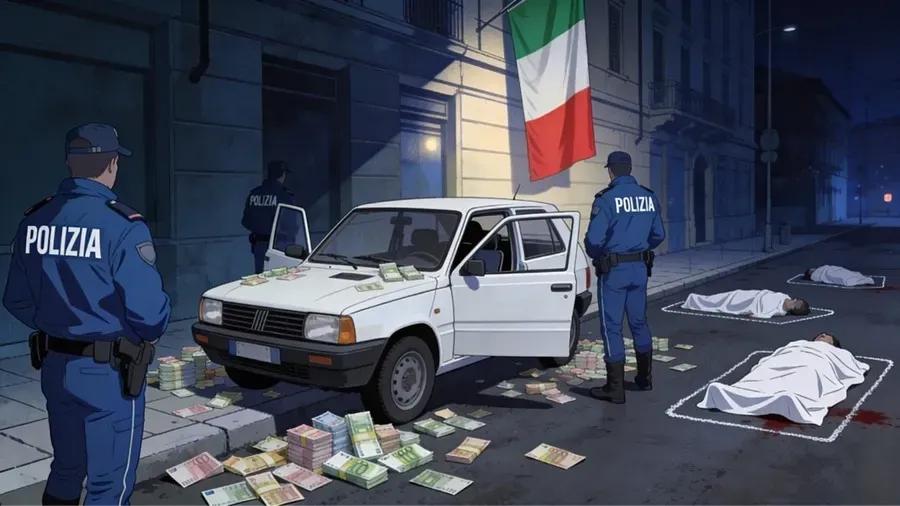
Between 1987 and 1994, northern Italy lived a story that seemed impossible to accept: a long series of robberies, ambushes, and murders were being committed, largely by men who every morning put on a police uniform (Cesenatico Noir). The members of the so-called "Banda de la Uno Blanca" knew radios, response times, blind spots, and weaknesses of security devices because they themselves were part of the Italian state police, the Polizia di Stato (Trabucco). The magistrate Daniele Paci, who took on the case in January 1994, would remember decades later that "the smartest move was to create a working group" dedicated exclusively to this investigation, working "without any prejudice" (Trabucco). The investigation that ended with the capture of the gang not only solved more than a hundred criminal acts and at least 24 murders; it also forced prosecutors and agents to grapple with an uncomfortable suspicion: that the killers could be sitting in the office next door (Cesenatico Noir; Ciotti and Fallara).
A case that overwhelmed investigators
For almost seven years, the Italian state's response to the violence of the Uno Blanca was fragmented and often misguided (Trabucco). Apparently disconnected crimes—toll robberies, armored truck heists, racist attacks, and witness homicides—were investigated as isolated episodes, scattered among different prosecutors' offices and units that rarely shared all the information (Cesenatico Noir; Comune di Rimini).
This lack of coordination was compounded by serious errors. In the first wave of toll robberies in Pesaro in 1987, four young people were arrested, who were later recognized as completely unrelated to the events (Cesenatico Noir). At the same time, some actions were attributed to or "claimed" by a mysterious organization called Falange Armada, used then to confuse the authorship of various crimes and divert attention to supposed terrorist plots (Cronache Ribelli).
Meanwhile, the gang continued to operate with a level of effectiveness that bewildered investigators: they left no traces, knew how security cameras worked, and seemed to anticipate the arrival of patrols and checkpoints (Cesenatico Noir; "La storia della banda della Uno bianca"). This mixture of impunity and silence in criminal environments led some, like Paci and his closest circle, to suspect that the perpetrators did not come from common crime but from an "external" world (Trabucco).
The turning point of 1994: a workgroup without excuses
The decisive change came in January 1994 when the prosecutor's office in the city of Rimini entrusted the case to the young magistrate Daniele Paci, newly arrived and unbound by old lines of investigation (Trabucco). Paci requested the bulky file on January 1, 1994, took it home, and began reading it from scratch, convinced that the key was in studying the whole, not the fragments (Trabucco).
In an interview published in 2021, Paci explained that "the smartest move" was the creation of a small joint working group of police and carabinieri dedicated exclusively to the Uno Blanca, with nine officials working literally door to door with his office (Trabucco). From there, he decided to review each and every incident attributed to the gang after a double homicide that occurred on May 2, 1991, in a Bologna gun shop, the point from which ballistic evidence showed it was a single criminal organization (Trabucco).
This team adopted a simple yet radical premise: to take nothing for granted and work, in Paci's words, "without any prejudice," even if that meant scrutinizing uncomfortable hypotheses (Trabucco). In another interview, he summarized the nature of the group with a phrase that dismantled conspiracy theories: "The objective of the Banda de la Uno Blanca was to make a lot of money," rather than obeying a political or terrorist logic ("Daniele Paci, pm che risolse caso Uno Bianca").
Baglioni and Costanza: looking where no one wanted to look
On the ground, the work of the group relied on police officers who were well acquainted with local realities. Among them stood out Inspector Luciano Baglioni and Subofficer Pietro Costanza, both from the Rimini police headquarters (Cesenatico Noir; Trabucco). When the formal group disbanded, these two agents decided to continue, almost on their own, with the surveillance and analysis they had begun (Trabucco).
One of the methods they adopted was as simple as it was patient: identifying bank branches with characteristics similar to those that the gang usually attacked—close to highways, without fixed guards at the door, with access points that facilitated entering with hostages—and setting up discreet outposts to surprise the potential perpetrators during preliminary reconnaissances (Trabucco; Comune di Rimini). At the same time, they reviewed recordings from cameras, notes from roadside checks, and files scattered across various offices, searching for patterns that no one had connected (Trabucco; Comune di Rimini).
In that data crossover, a disturbing intuition began to take shape: those perpetrating the attacks seemed to know the reaction times of patrols, the functioning of tolls, and the routines of guard services too well ("La storia della banda della Uno bianca"; Comune di Rimini). The summary that Il Sussidiario made in 2021 is very clear: "Along with agents Luciano Baglioni and Pietro Costanza, prosecutor Daniele Paci put an end to the terror that imposed itself on the citizens of northern Italy during those years" ("Daniele Paci, pm che risolse caso Uno Bianca"). That efficiency, combined with the absolute silence of the criminal world, reinforced the idea that the suspects could be people without criminal records, appearing as respectable citizens, and perhaps with police training (Trabucco).
A blurry photo, a fishing license, and a name
In the memory of the protagonists, the moment of the turning point is as clear as a scene from a movie. During one of the bank robberies in the Cesena area, a security camera fleetingly captured the face of one of the robbers without a mask (Trabucco; Ciotti and Fallara). The gang, which usually tore or stole tapes after each hit, made one of its few mistakes there: this time the video was preserved and from the recording, a photograph was extracted to create a composite sketch (Trabucco).
For months the image found no "owner." The connection came later, during a field operation. Following the lead of a vehicle linked to other robberies, Baglioni and Costanza arrived at a residence where they found a fishing license; in the document was a photo, and when comparing it with the sketch, the similarity was evident: the name on the license was Fabio Savi (Ciotti and Fallara).
When they returned to the headquarters and mentioned the name, some colleagues reacted immediately: Fabio was the brother of a well-known police officer, Roberto Savi, a subofficer of the state police in Bologna (Muccioli). Thirty years later, Baglioni described that moment in Il Resto del Carlino: "He was arrested in the operational room of the headquarters. Then his garage was searched, and everything appeared: pistols, rifles, ammunition, explosives. It was the turning point we had been waiting for. But it was also a tremendous shock" (Muccioli). In the same interview, he summarized the method followed by his team: "We had studied the case in depth; we knew every detail," and that allowed them to focus on Fabio Savi and track him down (Muccioli).
Witnesses from within: Gugliotta and Eva Mikula
From that coincidence, the investigation entered an extremely delicate phase. Solid evidence had to be gathered against armed men, with access to sensitive information and the ability to destroy clues (Trabucco; Comune di Rimini). The circle closed thanks to two types of witnesses: a colleague and a romantic partner.
The first was police officer Pietro Gugliotta, a radio operator in the same Bologna headquarters where Roberto Savi worked (Trabucco; Cesenatico Noir). Arrested on the night of November 21, 1994, Gugliotta admitted to having substituted for Alberto Savi in some incidents, confirming that the third brother was involved in the gang and detailing parts of the internal workings of the group (Trabucco).
This confession helped outline the structure of the Uno Blanca as a core of three brothers backed by other agents (Trabucco).
The second piece was Eva Mikula, a 19-year-old Romanian woman who lived with Fabio Savi (Cesenatico Noir; Trabucco). Arrested with him near the Austrian border, she was released shortly after because Fabio took exclusive responsibility for the weapon they carried (Cesenatico Noir). That same night she was taken to Rimini and heard by Paci, who, as he recalled in 2021, "immediately opened the way for us": she confirmed that the Savi were not only the Uno Blanca but also authors of other series of robberies, and clearly identified Alberto as the third member (Trabucco). Her testimony provided details about weapons, meetings, and movements that matched the evidence already collected and helped to break the wall of silence around the brothers (Trabucco).
The night of the arrests
With the accumulated elements—the Cesena photograph, the identification of Fabio Savi, the connection with Roberto, the confirmations from Gugliotta and Mikula, and the meticulous cross-reference of police shifts with crime times—the team considered that the time to act had come (Trabucco; Comune di Rimini). The decision was not easy: it was necessary to arrest colleagues in uniform, prevent leaks, and minimize the risk that someone would continue shooting while the case was still open (Cesenatico Noir; Comune di Rimini).
On November 21, 1994, Roberto Savi was arrested at the Bologna headquarters, while on duty, in a gesture that symbolized for many police officers a deep but necessary wound ("Banda della Uno bianca"; "Rimini: Trent'anni fa gli arresti Uno Bianca"). Shortly after, near the Austrian border, Fabio Savi was captured while trying to flee with Eva Mikula (Cesenatico Noir; Ciotti and Fallara). In the following hours, the raid was completed: Alberto Savi was arrested that same night, and in the following days, police officers Marino Occhipinti, Pietro Gugliotta, and Luca Vallicelli also fell (Cesenatico Noir; Trabucco).
In 1996, the trials concluded with life sentences for Roberto, Fabio, and Alberto Savi, as well as for Occhipinti, while Gugliotta received a reduced sentence, and Vallicelli was convicted as a lesser participant (Cesenatico Noir; "Banda della Uno bianca"). By then, as summarized by the very article in Cesenatico Noir, it was not only "a story of criminals willing to do anything but a story that holds a surprise, because the criminals of the Banda de la Uno Blanca are police agents" (Cesenatico Noir).
Involved police: ranks and bodies
The six judicially recognized members of the gang included five active police officers and one police candidate who was never admitted due to vision problems ("'Linea di confine', la banda della Uno Bianca"; "La storia della Uno Bianca").
Roberto Savi
• Rank: Subofficer (assistant chief) of the Italian state police.
• Posting: Bologna headquarters, radio operator in the operational room.
• Role in the gang: Operational chief and central figure within the group of police officers (Cesenatico Noir; "La storia della Uno Bianca").
Fabio Savi
• Rank: Civil; candidate rejected in police entry exams due to a vision defect.
• Role: Armed arm and driver, co-founder of the gang along with Roberto ("La storia della Uno Bianca"; "Banda della Uno bianca").
Alberto Savi
• Rank: Agent of the state police.
• Posting: Rimini police station, with previous services in Ferrara and at the Miramare tourist airport.
• Role: Third brother of the core; present in numerous robberies and shootouts (Cesenatico Noir; "Banda della Uno bianca").
Marino Occhipinti
• Rank: Subinspector at the time of arrest.
• Posting: Mobile brigade of the Bologna headquarters, narcotics section.
• Role: Police "support" member, but directly participated in the assault on the armored car of the Coop chain in Casalecchio di Reno (1988), in which guard Carlo Beccari was killed; for this, he received a life sentence ("Uno bianca, scarcerato Occhipinti"; "La banda della Uno Bianca").
Pietro Gugliotta
• Rank: Agent of the state police.
• Posting: First in Bologna patrols and later in the mobile brigade of the same headquarters.
• Role: Colleague and friend of Roberto Savi, involved in several robberies without fatalities; was sentenced to 18 years in prison ("Banda della Uno bianca"; "La storia della banda della Uno bianca").
Luca Vallicelli
• Rank: Agent of the state police.
• Posting: Traffic police unit (Road Police) of Cesena, in a training center.
• Role: Minor member, primarily acted as a driver in one of the early toll robberies without victims; was sentenced to 3 years and 8 months ("Banda della Uno bianca"; "La banda della Uno Bianca").
According to a summary from Italian public television, "five of the six members of the gang were police officers," meaning all except Fabio Savi were active agents of the state police when they participated in the crimes ("'Linea di confine', la banda della Uno Bianca").
Conclusion: an investigation against fear and denial
Thirty years later, Daniele Paci insists that the Uno Bianca case is not a "mystery of Italy," but rather the story of an investigation that, despite initial errors, reached its conclusion thanks to an uncomfortable decision: not to exclude anyone as a principle, not even one's own colleagues (Trabucco). In his words, the key was to work "without any prejudice" and to remain true to a single flag: that of truth, even when it pointed inward (Trabucco).
The capture of the gang was, at once, both a defeat and a victory for law enforcement. A defeat because it showed that for years some of its members used their badge and weapon to kill for money and out of hatred (Cesenatico Noir; "Banda della Uno bianca"). A victory because it was other police officers — like Baglioni and Costanza — and a young magistrate who dared to follow the leads to the end, not looking the other way when the suspect turned out to be a colleague ("Daniele Paci, pm who solved the Uno Bianca case"; Muccioli).
For today's investigators, the lesson is clear: no body is vaccinated against corruption, and the only way to protect its credibility is to accept that, sometimes, justice must start at home (Trabucco; "Rimini: Thirty years ago the Uno Bianca arrests"). The story of the Uno Bianca reminds us that the real scandal is not discovering that there are criminal police officers, but rather giving up on discovering them.
References
"Banda della Uno bianca." Wikipedia, it.wikipedia.org/wiki/Banda_della_Uno_bianca. Accessed 31 Mar. 2026.
Cesenatico Noir. "L'Italia della Uno bianca: la storia, i killer e gli arresti." Cesenatico Noir, 4 July 2021, www.cesenaticonoir.it/litalia-della-uno-bianca-la-storia-i-killer-e-gli-arresti/.
Ciotti, Nicole, and Marco Fallara. "Dalla 'Banda della Uno bianca' ad oggi, il racconto del pm Daniele Paci tra Pesaro ed Emilia Romagna." Il Ducato, 8 Mar. 2026, www.ilducato.it/2026/03/09/dalla-banda-della-uno-bianca-ad-oggi-il-racconto-del-pm-daniele-paci-tra-pesaro-ed-emilia-romagna/.
Comune di Rimini. "Falsi misteri d'Italia e il caso Uno bianca. 25 anni dopo gli arresti." Comune di Rimini, 22 Oct. 2019, www.comune.rimini.it/novita/notizie/convegno-falsi-misteri-ditalia-e-il-caso-uno-bianca-25-anni-dopo-gli-arresti..
"Daniele Paci, pm che risolse caso Uno Bianca / 'Banda? La mossa intelligente è stata...'" Il Sussidiario, 28 Nov. 2021, www.ilsussidiario.net/news/daniele-paci-pm-che-risolse-caso-uno-bianca-banda-la-mossa-intelligente-e-stata/2257506/.
La banda della Uno Bianca." Corriere della Sera, 1 Aug. 2005, www.corriere.it/Primo_Piano/Cronache/2005/08_Agosto/01/pop_banda.shtml.
"La storia della banda della Uno bianca. Parte I." Polizia Penitenziaria, www.poliziapenitenziaria.it/la-storia-della-banda-della-uno-bianca-parte-i/.
Accessed 31 Mar. 2026.
"La storia della Uno Bianca, la Banda dei poliziotti criminali che terrorizzò l'Italia." Il Riformista, 28 Nov. 2021, www.ilriformista.it/la-storia-della-uno-bianca-la-banda-dei-poliziotti-criminali-che-terrorizzo-litalia-263907/.
Muccioli, Lorenzo. "Uno Bianca, 30 anni dopo. Baglioni: 'Arrestare Roberto Savi fu la svolta.'" Il Resto del Carlino – Rimini, 20 Nov. 2024, www.ilrestodelcarlino.it/rimini/cronaca/uno-bianca-30-anni-dopo-1891258f.
"Rimini: Trent'anni fa gli arresti Uno Bianca, 'fu un colpo al cuore per la polizia.'" Teleromagna, 21 Nov. 2024, teleromagna.it/it/attualita/2024/11/21/rimini-trent-anni-fa-gli-arresti-uno-bianca-fu-un-colpo-al-cuore-per-polizia
Trabucco, Alessandro. "La 'banda della Uno bianca'. Intervista al magistrato Daniele Paci." Pandora Rivista, 27 Sept. 2021, www.pandorarivista.it/articoli/la-banda-della-uno-bianca-intervista-al-magistrato-daniele-paci/.
About the Author
William L. Acosta graduated from PWU and Alliance University. He is a retired police officer from the New York Police Department, a former U.S. Army service member, and is the founder and CEO of Equalizer Private Investigations & Security Services Inc., a licensed agency in New York and Florida, with international reach. Since 1999, he has led investigations in narcotics cases, homicides, and missing persons, as well as participated in criminal defense at both state and federal levels. A specialist in international and multijurisdictional cases, he has coordinated operations in North America, Europe, and Latin America.

Comments